The current crisis is hitting even the classified growths, when all the professionals thought them out of reach. This vision of a universe of great châteaux where everything is always fine and where prices constantly follow an upward slope is very far from reality. There were very difficult periods, to the point that some classified-growth vineyards were entirely pulled up.
The grands crus have just lived through a period of great prosperity, as there was under the Second Empire, for example. During the imperial era most of the magnificent residences that embellish the Médoc were built, just as in the present day cellars have been built, veritable works of art created by the greatest contemporary architects. Between these two eras of splendour stretched a period of roughly a century during which the grands crus, and even more so the more modest winegrowers, faced continual difficulties.

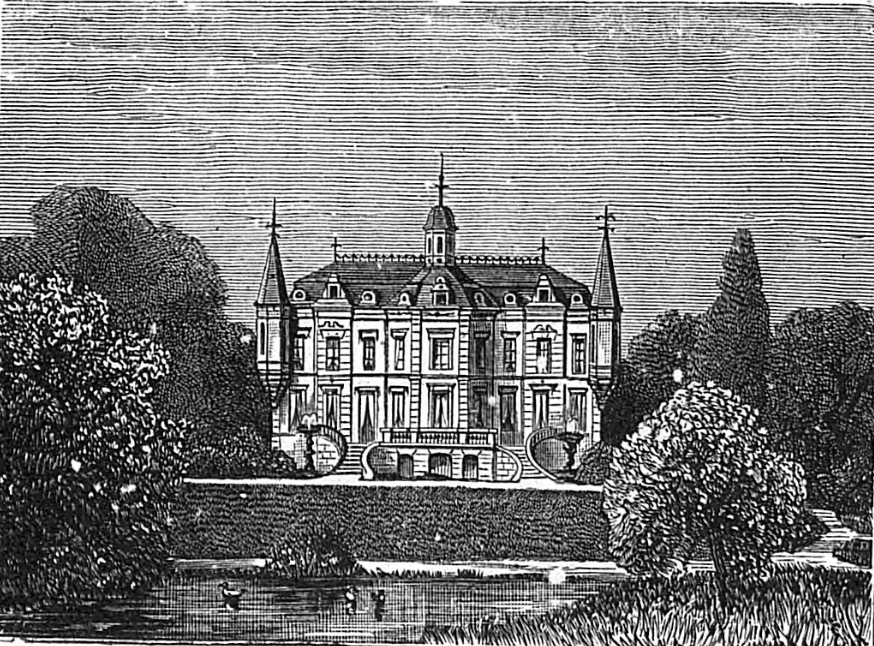
Engraving of Château Cap de Mourlin presented in the 9th edition of Bordeaux et ses Vins, 1922
We will not deal with the period following the war of 1870, because the crisis raging at that time was due essentially to health problems: the invasion of the vineyard, around 1875, by an aphid — phylloxera — that devoured the roots of our French vines; then, around 1882, the arrival of a microscopic fungus that destroyed the harvests, downy mildew, from the United States. We will begin our story after the armistice of the First World War, once all these health problems had been resolved. In today’s episode, we will cover the period from the armistice up to the superb 1937 harvest.
Flags flap in the wind on this 11 November 1918: the end of the war is finally signed, we have won the victory! There is euphoria and wine prices soar, but it will not last very long. It quickly became very clear that many of the former commercial destinations for Bordeaux wines no longer worked. In Russia, the tsarist regime had collapsed and the country was in communist hands; the Austro-Hungarian empire, a big customer, had been dismembered and defeated Germany no longer bought wine. The American market had closed, subject to Prohibition! Between 1921 and 1925, wine prices remained very low. Properties were therefore barely profitable, when they were not simply loss-making. They did not attract buyers, which allowed the Miailhe brothers to negotiate, in 1925, the purchase of a Second Growth of Pauillac, Château Pichon-Lalande, with exorbitant payment terms: payment was spread over five years!
Business picked up thanks to the very fine and abundant 1924 harvest, then continued until the end of the 1920s. The sumptuous 1928 and 1929 vintages closed the decade in the best possible way. This allowed all Bordeaux wines, as well as the Crus Classés, to rebuild their cash position; but already, from the last weeks of 1929, bad economic news from the United States cast a chill over business.
At the same time, the châteaux had great difficulty getting paid by a négoce whose financial situation was not good. All of this augured very badly for what was to come.
The exceptional wines of 1928 and 1929 were followed by three vintages of dreadful quality: 1930, 1931 and 1932. The year 1930 was so rainy that downy mildew had a field day, attacking the bunches when it did not destroy them completely. The vintage’s reputation was compromised. The weather was just as rainy in 1931, with the same consequences for the wine. The broker Lawton noted in dismay: “It is a disastrous blow to the reputation of our wines to see such goods sold under illustrious names”. The 1932 vintage “did not, because of its great mediocrity, allow the situation to be redressed”, notes Pijassou.
These three harvests collated every fault: weak colour, lack of concentration, greenness, low alcohol and, to cap it all, many taint deviations due to mildew and rot. Everything was in place to cause a collapse in prices: to the pathetic quality of the wines was added an equally wretched economic situation; we were in the midst of the “1929 crisis”. Most of the 1930s were sold off, whatever the classification of the château, at 2,000 francs per tonneau, that is, at the price of ordinary wines. The following two vintages sold no better. The 1933 harvest, though of decent quality, had no knock-on effect on wine selling prices.
The 1934 vintage interrupted this mediocre series: the harvest was abundant and produced very pretty wines of excellent quality, but it was hopeless: the economic situation was too degraded for the quality of the harvest to be enough to bring about an improvement in prices. That might perhaps have been the case if countries traditionally among the best customers for Bordeaux wines, such as Great Britain or the Nordic countries, had not erected customs barriers in an attempt to ward off the crisis.
There was no en primeur campaign. The broker Lawton did a few very rare deals, but at prices so derisory that he states in his notebooks that he chose never to speak of them. This gloom also spread to the quotations of wines previously sold on good terms, such as the fabulous 1929 vintage, whose prices as “finished wine” fell well below the en primeur release prices. The reality of the market was as follows: whether the wine was classified or not, prices were very low and close to those of everyday wines. The traditional hierarchy no longer had much meaning. Only the first growths managed to sell their 1934 wines at decent prices.
The 1935 and 1936 vintages were very small vintages but pleasant, unlike the ill-fated trilogy of the early 1930s. They were snapped up at very low prices.
Finally came a superb vintage: 1937, unquestionably the best of the 1930s. We will discuss it in the next letter.