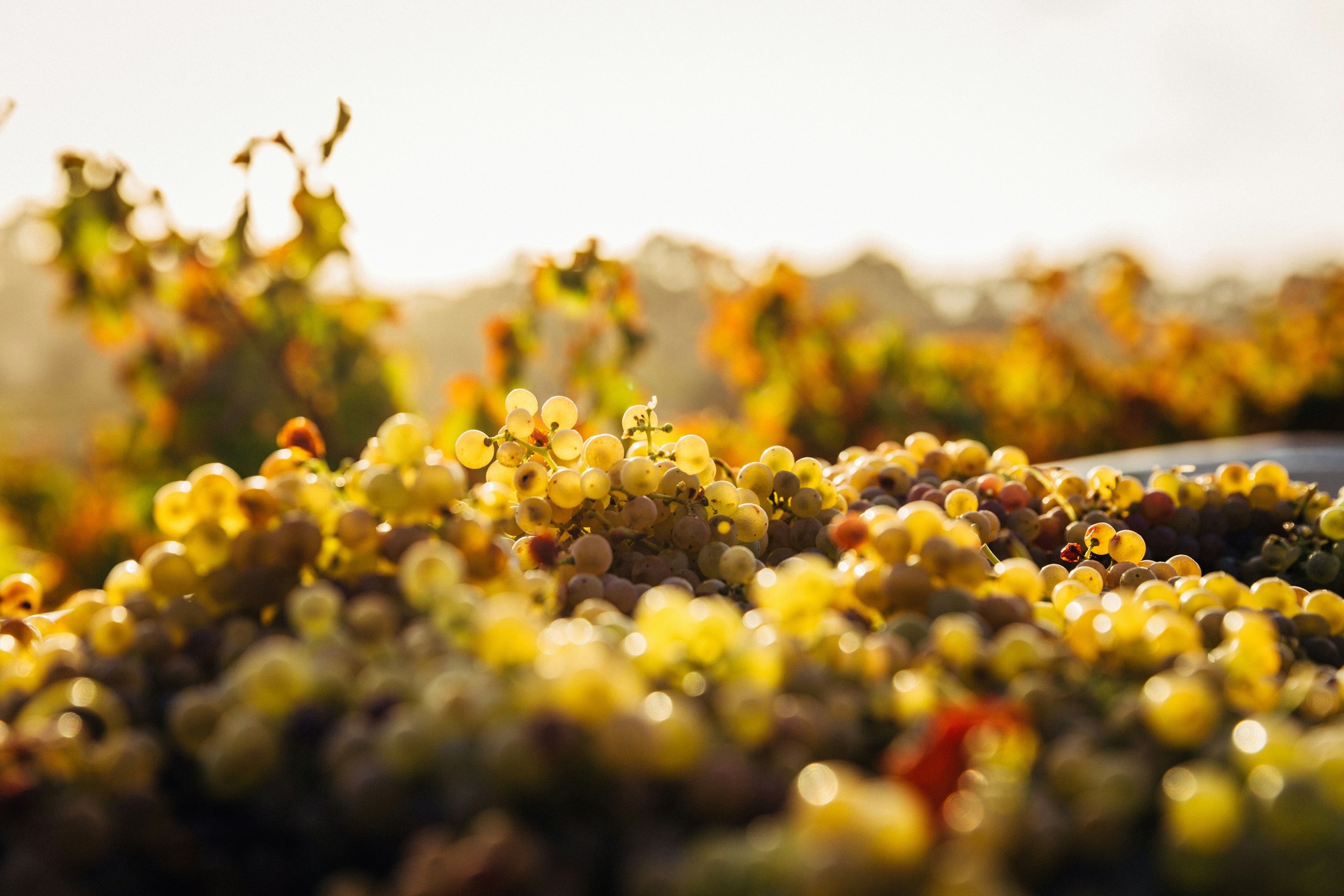
If we go by the belief that vintages ending in the digit 5 carry the seal of a great year, 2025 seems to subscribe to it on the strength of the grapes harvested, fine but not abundant. Setting aside its economic context, Bordeaux therefore has reason to be satisfied with a wine year that nevertheless unfolded in an atmosphere of unique heat and drought. This context somewhat upset the vine’s successive cycles, from its growth to its ripening, sharing an earliness never seen before. Now that vinification is entirely complete, including for the sweet wines, and the nature of the wines has revealed itself, all the signs lead us to forecast a great vintage. A look back at a year with a surprising course, a witness to climate change.
An unprecedented drought
Its exceptional character in terms of rainfall can be stressed straight away, because although the vine’s dormant period (autumn – winter 2024/2025) was not significantly dry, the cumulative rainfall proved appreciably below the average of the last 25 years (typically 112 mm less, as in the Pessac area). In sharp contrast with this trend, April was particularly wet, what is more with rain concentrated over the Easter weekend, when up to 100 mm fell in places. Arriving at the right moment to replenish the soils, rainfall then became very scarce, as the whole Bordeaux region recorded only 75 mm on average between mid-May and mid-July, characterising a remarkably dry vintage. That is why the rains around 20 July took on a providential character by allowing a véraison that had until then been hesitating to take place. The same applied to those of late August – early September, whose action was, to say the least, beneficial, interrupting a cycle of heat and the drought inherent in it. While these late and light rains had no effect on a water balance that was in the end very deficient, they nevertheless helped to regulate the ripening process.
Heat peaks of 42 °C!
Relatively mild as a whole, the winter was especially so in February, to the point of favouring a very early budburst, beginning in late March in some areas and already stamping this character on the vintage. Its cycle nonetheless unfolded in good water and temperature conditions, proving homogeneous and high in quality. The same context favoured flowering, which appeared in mid-May with rapid development thanks to relatively high temperatures. This warm trend intensified at the beginning of summer, between mid-June and mid-July, exceeding the seasonal norms recorded since 2003 by 4 °C. Thus reinforced, the vintage’s earliness saw the first signs of véraison appear at the beginning of July, only to slow down thereafter for lack of rain. The rains would fortunately come to the rescue to allow the cycle to be completed, as indicated above. This short rainless pause in no way interrupted the reign of heat, since the first half of August experienced a 10-day heatwave, the longest recorded since 2003, with temperature peaks recorded at 42 °C. That said, the large day/night temperature swings during this period, averaging more than 15 °C, had the happy consequence of sparing the vintage the much-feared “sunny” character.
Very early and healthy harvests
With an earliness of historic value, starting on 12 August, the harvest dates recall, by preceding them by a few days, those of 2022, a vintage that comes close in other respects. While this symbolic date in fact applies to whites destined for crémants, those used for still wines were harvested a little later, largely in the course of August. As for the Merlots, the very first to reach ripeness were picked on 3 September, an exemplary date to draw attention to an unprecedented situation in Bordeaux. The Cabernets were not to be outdone in earliness, since they were harvested almost immediately afterwards. Considering the extreme characters of the vintage, it can be said that the health of the grapes did not suffer unduly, with an observed absence of scalded or prematurely withered berries. Only the size of the berries was reduced, thus resulting in lower yields, which must also be attributed to a lower fertility of the vine, bearing the scars of a 2024 upset by bad weather.
What grapes… What wines?
For the reds, a major finding is that the profile of the grapes was not affected by such a vintage as much as one might have feared a priori. Indeed, a contrario to what one could apprehend, the berries showed no signs of overripeness nor harboured excessive alcoholic potential. The fruit of a completed ripening, despite its rapid course, they met all the expected criteria in terms of colour, aromas and tannins to hope for complete expressions. The first vinifications moreover confirm this with a more than satisfactory translation of these factors, a finding made on a wide scale and suggesting a homogeneity of the vintage.
As for the white grapes, most of them were harvested in August, before the rains that fell at the end of the month and in early September; nevertheless, there does not seem to have been a glaring distinction between those picked before or after this episode. Sauvignon and Sémillon were treated practically alike, with a common denominator of very low yields. This last remark applies a fortiori to those destined for sweet wines, which greatly benefited from the prevailing September climate, crossed by some showers that favoured the appearance of noble rot as early as it was exceptional in quality.
Mohamed Boudellal