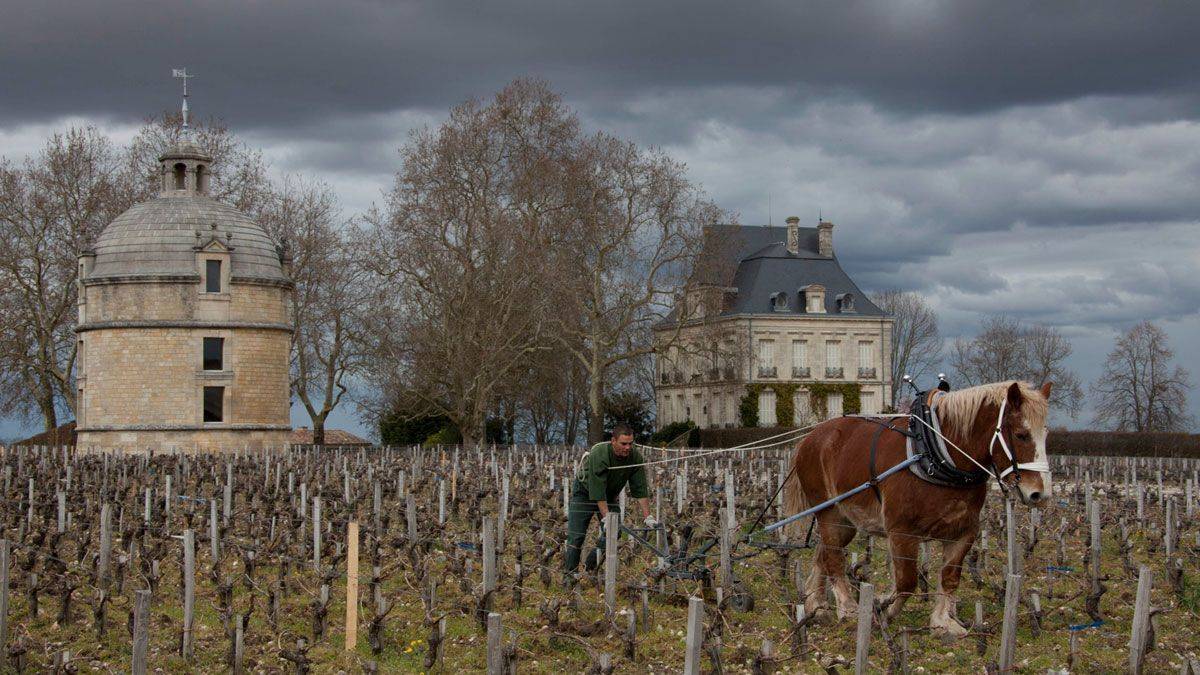
Located between the cellar and the château, which itself was only built in the mid-19th century, the dovecote dates from the 17th century. But it is from the Tour de Saint-Maubert, which overlooked the Gironde in the 16th century and of which no trace remains, that Château Latour takes its name.
The Château Latour vineyard, created around 1680, is one of the oldest vineyards of the Médoc.
Thanks to the action of the Marquis de Ségur, its owner at the beginning of the 18th century, it very quickly acquired a prestigious renown driven by the quality of its wines; this quality derived first of all from exceptional geographical and geological positions on the gravel rises overlooking the Gironde, the closest to the river of the entire Médoc vineyard.
The estate’s grape varieties, typical of the Médoc, are mainly Cabernet Sauvignon and Merlot. There are also Cabernet Franc and Petit Verdot.
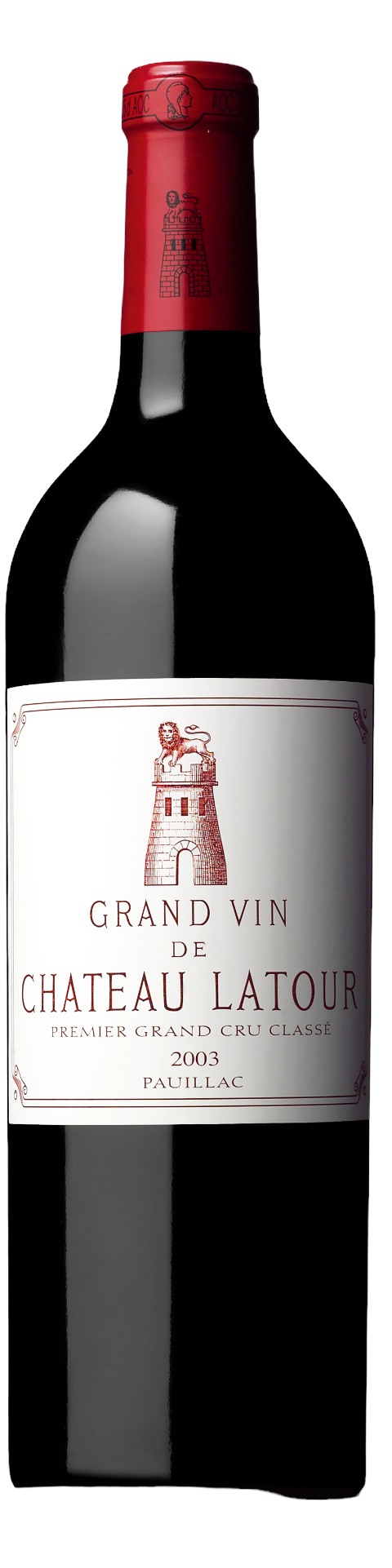
The Grand Vin of Château Latour comes from the Enclos, the heart of the vineyard, made up of 48 hectares of old vines. This unique terroir, which dominates there, is the only one able to bring every year the depth, elegance and concentration worthy of what one is entitled to expect from a great wine.
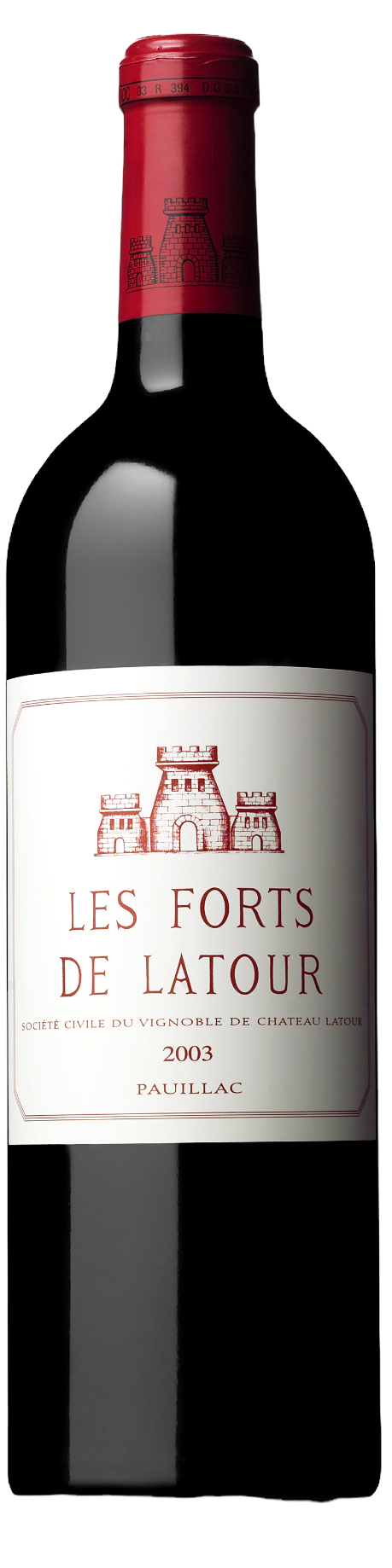
“Les Forts de Latour”, the estate’s second wine, takes its name from a historic plot of the Enclos. This high-quality second wine comes from the 43 hectares of outlying plots, and from the vats intended for the Grand Vin which, after tasting, do not match the quality of the Grand Vin. The continuous quality efforts since 1966, the date at which the wine was labelled under this name, place it at the level of the very good classified growths of the Médoc.
Since 1990, Le Pauillac de Château Latour, the third wine of Château Latour, has been produced every year, based on a qualitative selection from Les Forts de Latour and also from the estate’s young vines.
In 1963, the acquisition by the British group Pearson gave Château Latour a powerful impetus and enabled a thorough technical update: thus Latour, in 1964, was one of the first growths to equip itself for vinification with stainless steel vats with automatic, controlled cooling.
After 30 years of “English occupation”, Château Latour became French again when it was bought by François Pinault in June 1993.
Between November 1999 and September 2003, a complete renovation of the buildings (cellars, vat room, etc.) was undertaken. The vat room was entirely renovated in order to modernise the facilities for receiving the harvest and for vinification. Beyond visual observation, which remains fundamental, and berry tasting, which determines in particular the final decisions on the eve of the harvest, new analytical capabilities and advanced technologies have opened access to a level of information never before attained.
The wines are aged in strict respect of tradition in new oak barrels, for 17 to 20 months.
This happy marriage of progress and age-old traditions makes it possible to achieve supreme quality.
Since the 1990s, the cultivation practices at Château Latour have undergone continuous evolution.
The gradual adoption of organic growing methods has committed the estate to an approach that views the wine estate as a living organism, rich in information and natural resources, allowing a form of self-management using tools themselves produced by nature. The implementation of biodynamic practices follows the same logic. Begun on 3 hectares in 2009 and covering around a third of the Enclos in 2014, it takes into account the vine’s natural balances and seeks to help it develop its own defences with preparations based on plants chosen according to observed needs and the climate.
The reintroduction of the horse in the vineyard, since 2008, also illustrates one dimension of an approach combining the continuous search for the best cultivation practices, attention to preserving the beauty of a site and respect for its environment.
Adopted to reduce soil compaction and improve the carbon footprint of work in the vineyard, this initiative establishes a harmonious relationship between man, animal and vineyard. It also contributes to a better knowledge of the soils and more precise adaptation.
The priority remains to do everything possible to pursue the goal of excellence that motivates the whole Château Latour team.
Château Latour
1er Grand Cru Classé en 1855
Pauillac • 90 HA