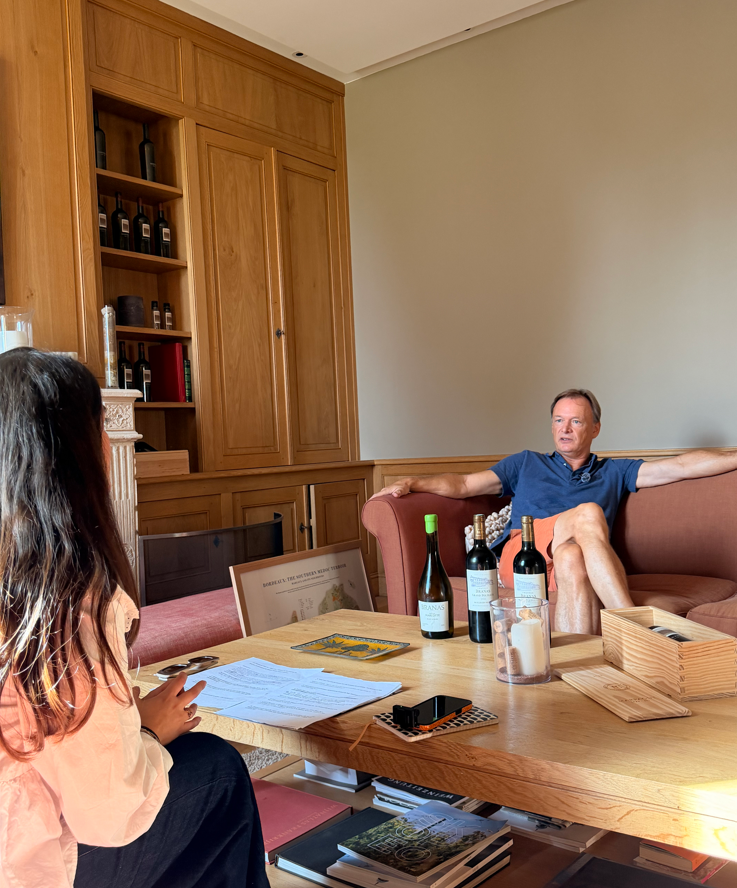
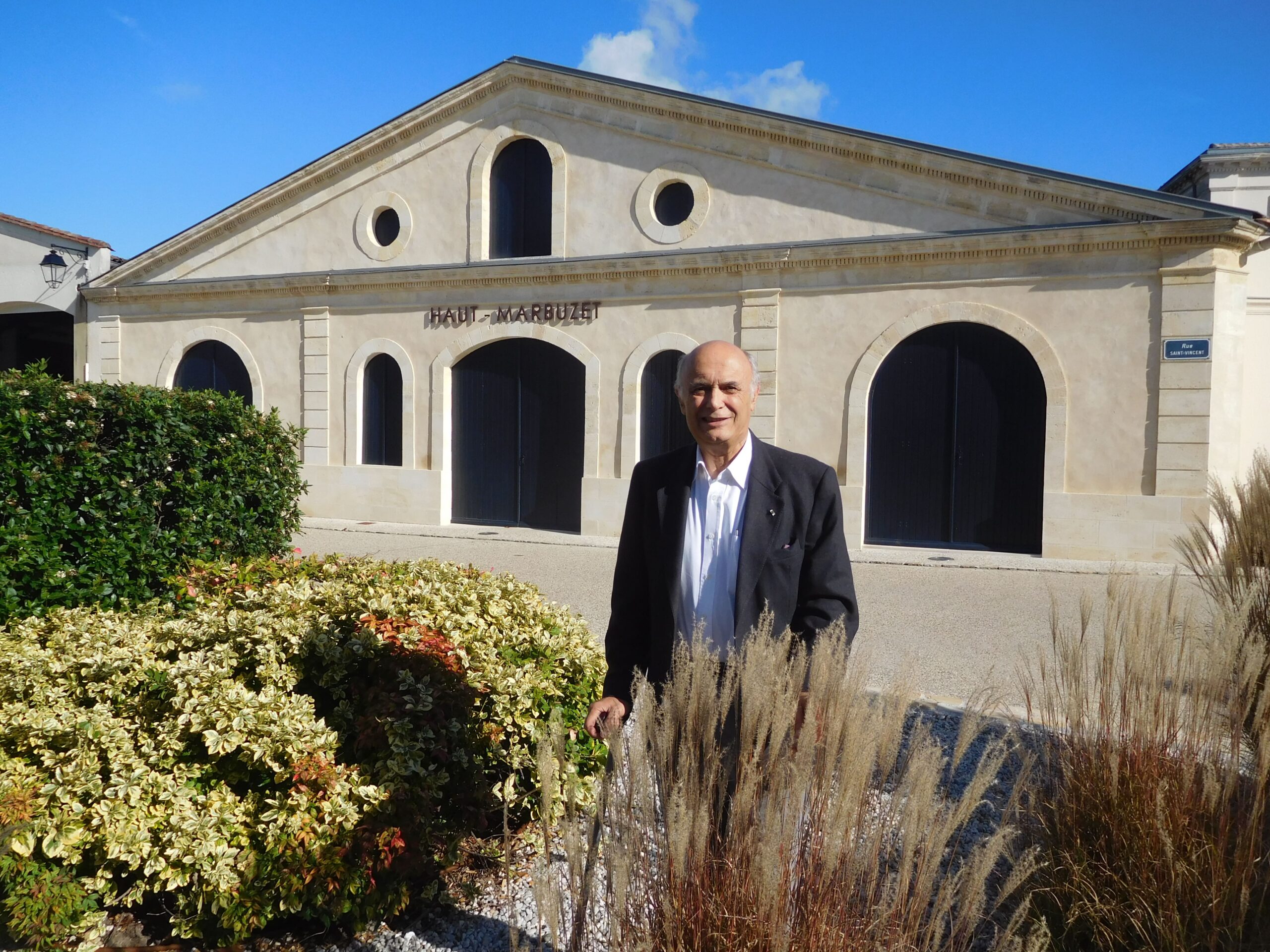
Originally from the Netherlands, he has had several professional lives: an international career that took him to the post of sales director at KLM, then entrepreneurship in renewable energy with projects developed in Europe and South Africa. But his path also led him to the world of wine. After a first immersion in two Fronsac properties, Châteaux Richelieu and Arnauton, he joined Château Branas Grand Poujeaux in Moulis-en-Médoc, of which he is today director and shareholder. An atypical journey between travel, innovation, entrepreneurship and passion for terroir.
[…]
You first built a large part of your career in the airline industry, up to becoming sales director at KLM. What memories do you keep from that period?
I did almost 12 years in that sector all the same. I worked for three companies. Lufthansa was my first employer. After that, I left for Switzerland. My first daughter was born in Switzerland, the second in Germany and the third in the Netherlands. Yes, it was a dynamic, international world! I enjoyed it a lot. Of course, I had a lot of responsibilities, stress and meetings that were sometimes inefficient, as we know them in big companies. But I keep very fond memories of that part of my career. The advantage of working for an airline is that you can travel easily. And as I was worldwide sales and marketing director, I was obliged to travel often.
At what point did you feel the need to leave that career and build your own projects?
It was in 2004, a turning point in my career. It was the year Air France bought KLM. I was one of the only Dutch people who mastered the language of Molière quite well. But I had to leave the company because there was one sales director too many and it was me. So at that point you start to wonder what to do with the next part of your professional life. And as I have this genetic agricultural side – my grandparents had farms, my father was an agronomist –, I had developed a great passion for wine because in Switzerland I was also responsible for on-board products. My favourite meetings were the meetings with a team of sommeliers to choose the wine for business class and first class. So there you go, I had developed a real passion for wine, and Bordeaux in particular, because my father was a collector of Bordeaux wines.
You also turned to renewable energy. Why this sector?
Yes, after seven or eight years in Fronsac, I was obliged to sell a property to a Chinese billionaire. And as I had quite a bit of time, I developed an agricultural project in South Africa. That was in 2010, in the middle of the harvest. It was a farm that had table grapes and wine grapes. We made wine and exported a lot of table grapes. However, there was not enough electricity in the country. At that point, with my partner on the ground, we decided to launch into renewable energy because there is so much sun in South Africa. Since then, I am still involved in a few projects in Africa, but also here in the region.
I had a former colleague, a German, who worked with me at Lufthansa in Germany. And we stayed in touch. He settled out there. And when I sold Fronsac, I analysed an economic project, an agricultural project in South Africa. And I fell in love with this country, which is so beautiful despite its problems. But it is a country close to my heart, South Africa.
And do you still have a link with this South African property?
Today, I am no longer a shareholder in that farm. On the other hand, I still have land there where we are still developing a solar farm. It is in the north-west of South Africa, near Namibia.
There is no more wine. On the other hand, a little anecdote: in a week, we have the Marathon du Médoc. And this year there is a Branas Grand Poujeaux team. There are only South African athletes in the team. They are wine lovers I know who asked me whether they could form a team. For châteaux, it is easier to get places than for individuals.
When you compare Bordeaux and South Africa, you are comparing two very different wine histories. What fascinates you about each of them?
What fascinates me in South Africa is their freedom, their creativity. They have tried pretty much all the grape varieties. You are freer to buy grapes and make a cuvée in another region. It has led to more creativity and I think I learned a bit on that front.
Do you remember the moment when you said to yourself that wine could become an important part of your life?
Yes, it was in 2004, when I began looking for a small terroir in Bordeaux.
Did you land directly on Fronsac?
Not directly, I looked around a bit, but at the time I made the acquaintance of a very good oenologist who was not yet as well known as he is today. His name is Stéphane Derenoncourt. It was he who guided me towards Fronsac.
Let’s say that it is a magnificent terroir, a little undervalued. And there is potential.
And you did both a bit at the same time, Richelieu and Arnauton, I believe?
Yes, first Richelieu and then a Dutch group asked me to look for an estate for them. And we negotiated the purchase of Château Arnauton.
What differentiated these two properties in the way you worked them, in your vision of wine?
In fact, what attracted me to Arnauton was also being able to create a synergy between the two estates. Technically, we tried to create as many synergies as possible between these two estates. Arnauton was very interesting for its hillock. At the top of this hillock, it is an absolutely unique terroir. And we made a cuvée called Le Grand Sol. For me it was perhaps the best Fronsac at the time.
[…]
How did you come to meet Château Branas Grand Poujeaux? What was your first impression when you discovered it?
Yes, in fact, there was a partner. There is still a Belgian partner called Justin Onclin. He is a big name in the Bordeaux wine world. He created a large négoce house called Sovex Grands Châteaux. He was also, at one point, managing director of Château Prieuré-Lichine in Margaux. And he had already heard about this terroir around Grand Poujeaux, which is among the best terroirs of the Médoc. So he invested here for his family in 2002. At the time, it was only 6 hectares. Today we have 25. And when I met him, he said to me: “Arjen, my children don’t have the ambition to take over. Would you like to become my partner?” Then I suggested it to another friend who became majority shareholder with me here.
[…]
There is this very small plot of Merlot that many people are talking about today. What is its story?
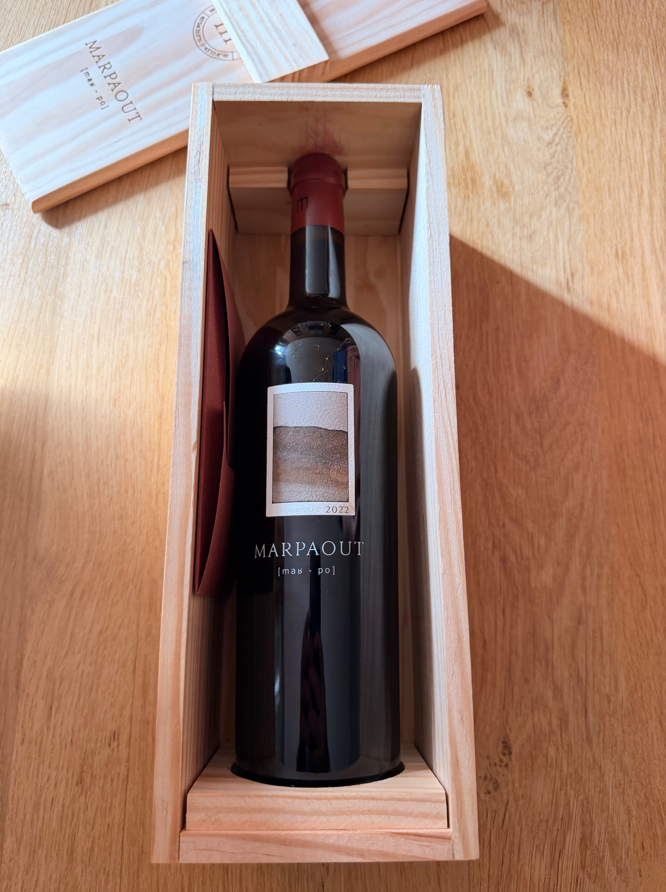
Yes, it’s a nice story. It began in 2018. I was walking all the plots with a gentleman I had just met, called Hubert de Boüard, a man with a lot of experience with, in particular, Merlot. And while we were walking, to discuss the harvest date, in a certain plot called Marpaout, Hubert said to me: “Arjen, this Merlot, it’s a Merlot from another planet. Angélus is jealous of this quality of Merlot”. But at that time, I was still mentally a prisoner of the blending tradition. Because in Bordeaux, practically everybody makes blends. It took me four years to tell myself that, in the end, I was going to make a single-plot wine from this plot. During those four years, I also studied it. I wanted to understand why this plot produced this quality of Merlot. […]
Would you like to discover the full interview? You can listen to it on Les Chroniques Féret.