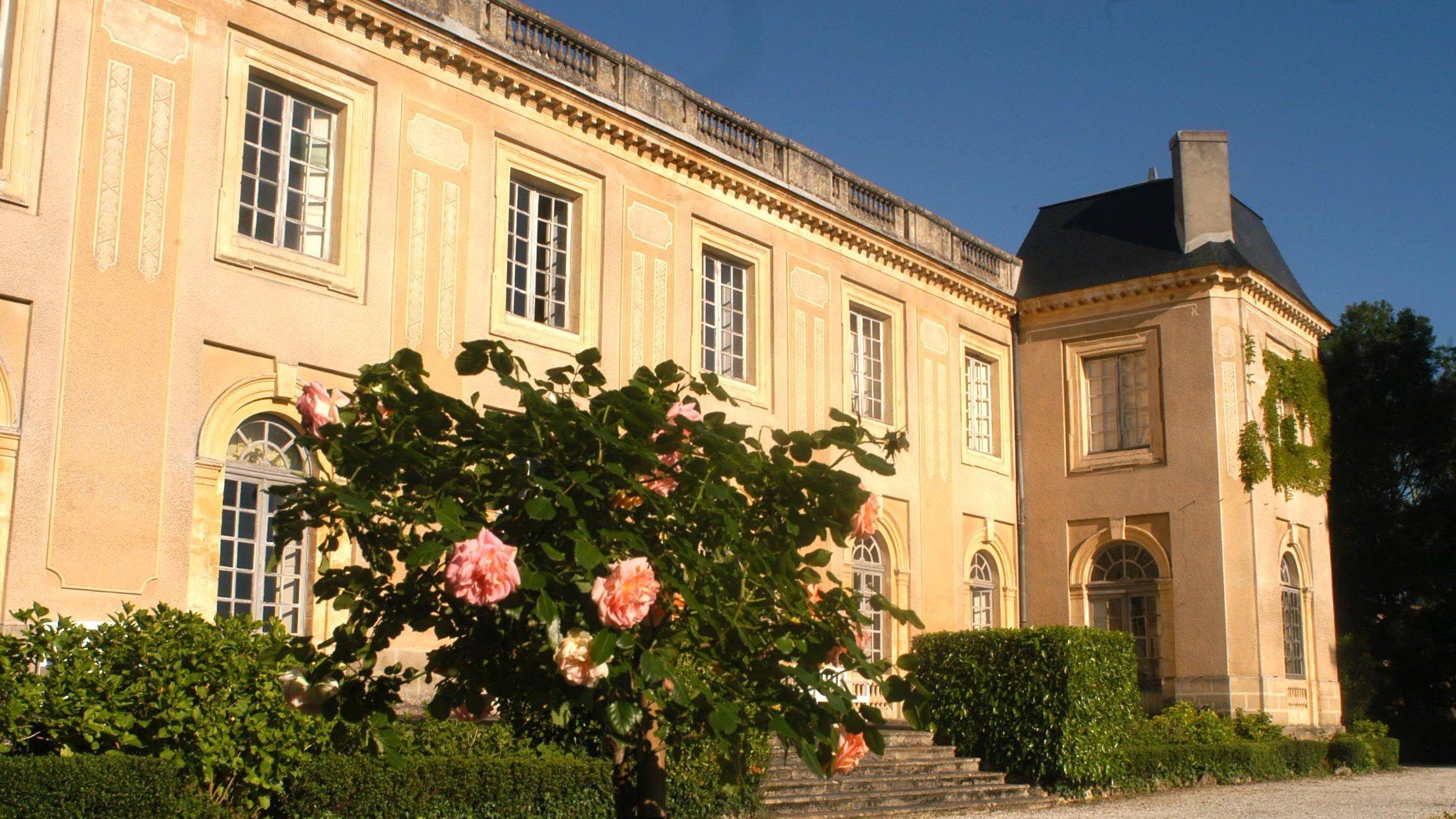
Château Nairac bears the name of a famous Protestant family originally from Castres. In the 18th century, their trading house was considered the foremost in Bordeaux, whose commerce was then at its height. It was run by Paul Nairac, elder brother of Élysée, who ordered the construction of the present château, completed in 1786, and whose drawings are kept in the archives of the city of Bordeaux.
Previously Nairac bore the name “Bourdieu de Durancau”, the noun Bourdieu denoting a country property, often a wine-growing one, and Durancau being the name of its creator.
The remains of the Durancau house, still incorporated into Château Nairac and clearly visible (the eastern building of the present service courtyard, the right-angled wings to the west of the main residence, the groin-vaulted chapel, and the remains of two stair towers lit by narrow bays topped with chamfered segmental arches), clearly prove that a large mansion of the second half of the 17th century once stood here, commanding a wine estate.
André Durancau was succeeded by Jérôme Mercadé, a member of a family of very old Bordeaux bourgeoisie that had distinguished itself in trade from the 16th century. In 1692, he acquired the office of chief clerk of requests of the palace. In 1696, he had his coat of arms registered, which can still be made out in the château’s chapel. Indeed, his alliances with the Roborels and the Montalliers, two houses of the aristocracy of the royal provostship of Barsac, had enabled him to acquire Durancau at the beginning of the 18th century, which he kept until his death in 1744.
His eldest son Pierre, established in trade, owned warehouses in Port-au-Prince, where he had married Elizabeth Prost, daughter of a wealthy Creole planter. Left a widow, she would marry Félix Grandjean. It seems that Elizabeth Prost stayed very frequently at her Barsac property between 1759 and 1771. She enlarged it by buying various plots of vines in the northern part of the parish, including a manor house. At Durancau she had a garden laid out and a warren planted. She decided to sell her estate in 1777 to Élysée Nairac.
A man as considerable as Élysée Nairac was bound to have the residence rebuilt.
The Parisian architect Victor Louis was completing the Hôtel Nairac in Bordeaux (cours de Verdun): it is plausible that he was consulted; the plans, elevations and section of the building were found in the famous artist’s portfolio. However, the drawings are signed for execution between Élysée Nairac and Jean Mollié, son of André and brother of Pierre Mollié, both architects to the Duc d’Aiguillon. Jean Mollié also took part in the work on the Château Ducal. The main staircase at Barsac, making allowance for scale, is not without similarity to the grand staircase of the Château d’Aiguillon.
Élysée Nairac, a great négociant of the Ancien Régime and a man of honour, died in 1791, before the radicalisation of the Revolution that brought many difficulties. One Nairac emigrated to Holland, to Barneveld, of which he was burgomaster for more than forty years.
The painter Wertmuller, a fashionable artist of high Protestant society, painted the portrait of Élysée Nairac and of the two daughters, Julie Émilie and Henriette, who inherited Nairac. After Henriette’s death in 1837, the name of Bernard Capdeville, a Barsac farmer and wine négociant on the quais des Chartrons, often appears. His successes were not unrelated to the fact that his wife belonged to the Merman family: Mme Capdeville’s brother was the greatest broker of his time in Bordeaux.
Capdeville had acquired the Ségur estate after the Revolution. He bought Nairac after Henriette’s death and attached it to Ségur.
In 1855 its vineyard was classified a Second Growth and appears on the list drawn up by the Bordeaux brokers, together with Broustet, another Capdeville property. On his death, his daughter Georgina, wife of Pierre Brunet, received Nairac. Brunet presided over the Académie des sciences, lettres et arts de Bordeaux and was a prolific writer. He took an interest in viticulture, on which he wrote, and served as director of the Bordeaux chamber of commerce between 1854 and 1876.
Our 1868 edition emphasised the quality of the wines of Nairac, which it ranked above its peers. Having fallen out with her nephews, Georgina Brunet named as her heir a distant relative, Mme Arnichard, who sold the estate in 1908 to a Lorraine négociant and owner: Jacques Charles Perpezat.
During the almost half century when Nairac was managed by M. Perpezat, the vineyard enjoyed a new surge. Plots were added to it and the whole estate was devoted to the vine; its production reached some thirty tonneaux.
In 1954, M. and Mme Perpezat gave Nairac to their daughter Mme Mas. She sold it to Dr Seynat, a Bordeaux municipal councillor, who did not manage it as a great cru demands; he sold it in 1972 to Thomas Heeter, an American with a passion for wine, and Nicole Heeter, née Tari (of Giscours and Branaire Ducru).
During this period of eclipse for the great Sauternes wines, which had nonetheless been the most expensive in Bordeaux in the 1920s, they relaunched Nairac with great confidence in the renewed rise of these exceptional wines. They added three hectares in Haut Barsac and brought the residence back to life, living there as a family from 1974 to 1984.
Since 1987, Nicole Tari-Heeter has remained alone at the helm with her three American-French children, who are deeply attached to Nairac: Nicolas, Jessica and Éloïse.
She is working to reassemble the main walled enclosure, has undertaken the restoration of the 17th-century farm buildings, and takes care to maintain rigorous choices in order to obtain the highest quality.
In the vineyard: severe pruning, traditional practices, and very selective harvesting to pick only the berries affected by botrytis, a noble rot here and a disaster everywhere else, but whose very specific taste alone gives the wines of Barsac and Sauternes their full character.
For vinification, fermentation in oak barrels is the rule even in difficult years, even if it is known that the wine will not be able to be bottled under the Nairac label and will be sold as “generic”.
Quality of presentation for this exceptional wine. Finally, quality of a welcome that is always personal and refined for this product “inseparable from a culture”.
Château Nairac
Barsac • 18 HA