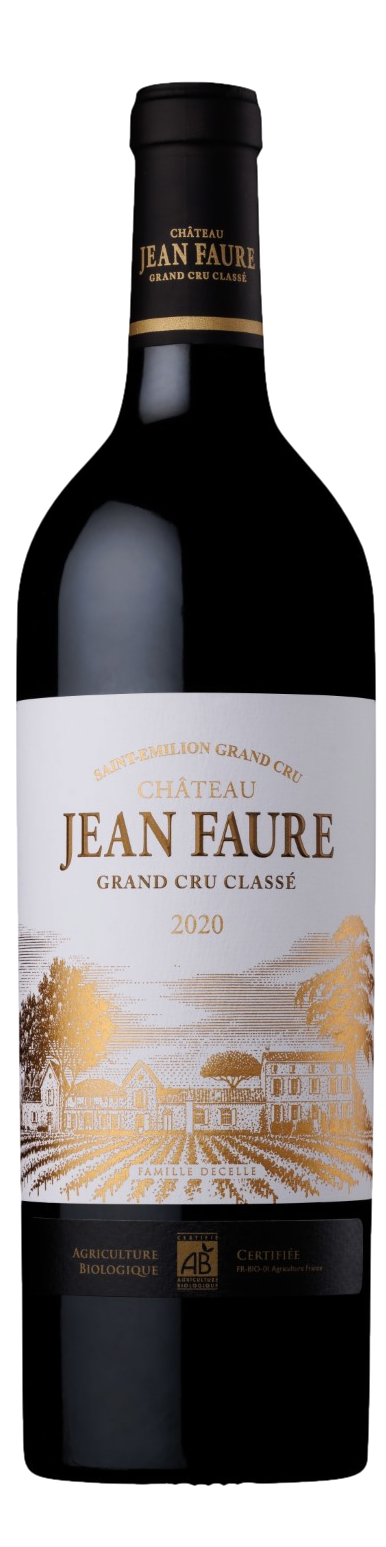
Château Jean Faure, an 18-hectare vineyard, is rooted in the same terroir as the greatest Grands Crus Classés of Saint-Émilion. If château Cheval Blanc, Premier Grand Cru Classé A, is less than 100 metres away, the vines of La Dominique extend the property to the west, while less than 500 metres as the crow flies the outline of château Figeac can be seen.
Classified as early as 1898 as a Premier Cru des Graves, château Jean Faure suffered a reversal of fortune. Named Grand Cru Classé in 1955, it was excluded from the classification in 1986 following negligent management. Today, thanks to the determination and rehabilitation efforts of Olivier Decelle, its owner since 2004, château Jean Faure is regaining its rank among the Grands Crus Classés of Saint-Émilion.
Although the history of Jean Faure probably goes back to Roman Antiquity, the existence of the Jean Faure estate officially appears on the Belleyme map dating from 1763-1770. Since then, château Jean Faure has changed hands only twice, the last being the acquisition in 1921 by M. Marcel Loubat, brother-in-law of the grande dame of Pétrus.
Its terroir speaks for itself: “80% of the surface of the château Jean Faure vineyard has a subsoil with very clayey horizons appearing at 30 to 10 cm depth,” says Xavier Choné in his study of the vineyard plots. In 1989, Cornelis Van Leeuwe was already telling us: “for the most part, totally identical to the terroirs of La Dominique: sandy or sand-clay brown soil and iron residues between 40 and 60 cm”.
The vines, with an average age of 40 years and a yield of 38 hectolitres per hectare, are made up of 56% Cabernet Franc, 40% Merlot and 6% Malbec: a distribution that is atypical in Saint-Émilion but close to the emblematic growths of Cheval Blanc or Figeac.
After draining the entire vineyard (from 2004) and resuming ploughing to encourage deep rooting, château Jean Faure took a step towards organic and decided in 2007 to stop all chemical weedkillers. Priority is given to safeguarding soil life and respecting the plant’s physiology.
As for vinification, a new ultra-modern vat room has come into being. Fully temperature-controlled, equipped with small concrete vats of 70 hectolitres each, it allows made-to-measure parcel-based vinifications. After harvesting by hand in small crates, the grapes are sorted manually on two vibrating tables and then conveyed by gravity into the vats.
In this way, the integrity of the grapes is respected for whole-berry vinification. The cap is punched down by hand during the alcoholic fermentation in order to favour gentle extraction. A brief pumping over (without racking) accompanies the maceration phase. The wine is aged for 18 months in oak barrels (40% new and 60% one-wine).
Château Jean Faure
Grand Cru Classé
Saint-Émilion Grand Cru • 18 HA