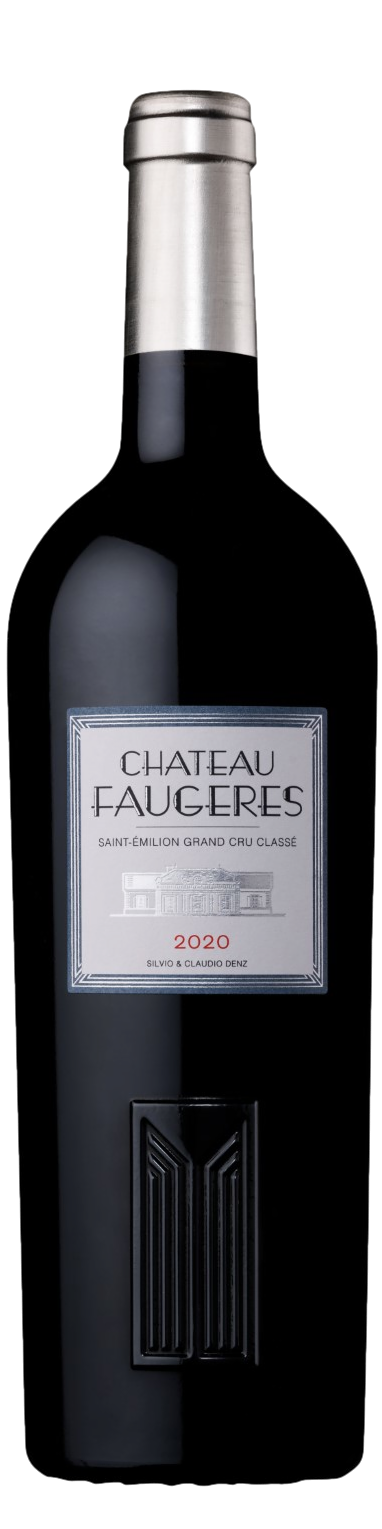
Château Faugères has existed since the 16th century, as attested by the Renaissance windows of a stone house next to the present château. The first known owner dates back to 1823 with Jean Esquissaud, who bought the terroirs of Château Faugères, Château Péby Faugères and Château Cap de Faugères. Philippe Esquissaud, his direct descendant, died in 1987, leaving the property to Pierre-Bernard Guisez. Committing themselves with his wife Corinne to the pursuit of quality, they made of these very fine terroirs, with the help of Michel Rolland, two of the flagships of the Saint-Émilion Grand Cru appellation. As early as 2001, Robert Parker said of Château Faugères 2000 that it was “one of the great revelations of the vintage”. In 2005, Silvio Denz acquired it. A creator of perfumes, a wine lover and owner of Lalique, he also owns two wine trading companies in Switzerland (Zürich).
Château Faugères consists of 37 ha in one piece of the finest terroirs of Saint-Émilion: its vines are located on the limestone plateau made up of calcosols on Asteries limestone dating from the Lower Oligocene, and on clay-limestone hillsides facing south to south-east in an amphitheatre, made up of calcosols on clay-limestone molasse of the Upper Eocene and Oligocene.
This terroir, cultivated using sustainable natural viticulture, has always been treated with great respect by Silvio Denz and his team. For Silvio Denz, the constant pursuit of wine quality at every stage of production through the use of the most cutting-edge technologies required a winemaking tool of the highest performance. The monumental winery was designed by Mario Botta, an international architect, and sited at the top of the hillside, facing the 18th-century chartreuse of Château Faugères, blending harmoniously into this landscape listed as a UNESCO World Heritage Site. Mario Botta, the “master of light and gravity”, managed to make the winery of Château Faugères a masterly work of art, a veritable cathedral of wine.
Favouring the expression of the great terroirs of Faugères, Silvio Denz’s efforts have borne fruit: Château Faugères became a Grand Cru Classé in 2012. An exceptional site to discover, it received a wine tourism award in 2013: Best Of Gold, in the category “Architecture and Landscapes”.
Château Faugères
Grand Cru classé
Saint-Émilion Grand Cru • 37 HA