The crisis that Bordeaux has endured in the last few years has mainly affected its most modest representatives, in particular those working under the banner of the Bordeaux AOC. Only twenty years ago, the mere mention of the name Bordeaux was synonymous with a benchmark for a very wide public. But a combination of factors began to chip away at this almost universal reputation, to the point of provoking a phenomenon of mistrust that some have called “Bordeaux bashing”. Added to a glaring de-consumption of wine observed internationally, the fall in demand has led in Bordeaux to a notable overproduction, with consequences such that measures as drastic as vine pulling have been resorted to.
Faced with a crisis of such magnitude, materialised in overflowing stocks, this shock treatment was the only way out when other solutions were proving powerless, whether the stopgap of distillation or the inevitable fire sale. Moreover, these palliatives do not protect against the sword of Damocles that is compulsory liquidation, itself a corollary of the coercive system we know, in which the human factor does not come into account (1). In the face of a situation as grave as it is inextricable, the solutions for averting such a dark destiny are mere wishful thinking, except the one that would consist in tackling head-on the question of the immense territory left by the vine pulling, from which the economy has withdrawn altogether. So that its management is not in pure loss, a concerted plan of conversions to rural activities alternative to the vine has been proposed. Even if this project is a challenge, its merit would be to bring back to life the areas abandoned by the vine pulling, thus offering an indirect and fruitful way of restructuring the vineyard.
Vine pulling, the fatality of the figures
When one reads the Ministry of Agriculture’s press release dated November 2023 announcing the pulling of vines in the Gironde, one might well be surprised by the skewed wording used to describe it. It speaks of “sanitary” pulling, whereas it stems from a far more compelling reason than the preventive character suggested by its official designation. Taking up this qualifier at leisure, the text betrays a sort of embarrassment on the legislator’s part in the face of a proven and deep structural crisis of the vineyard. That said, one cannot deny the risks of epidemic diseases spreading, above all flavescence dorée, from plots left fallow without any precaution, but this is a consequence and not a precondition of the pulling process required by the gravity of the situation.
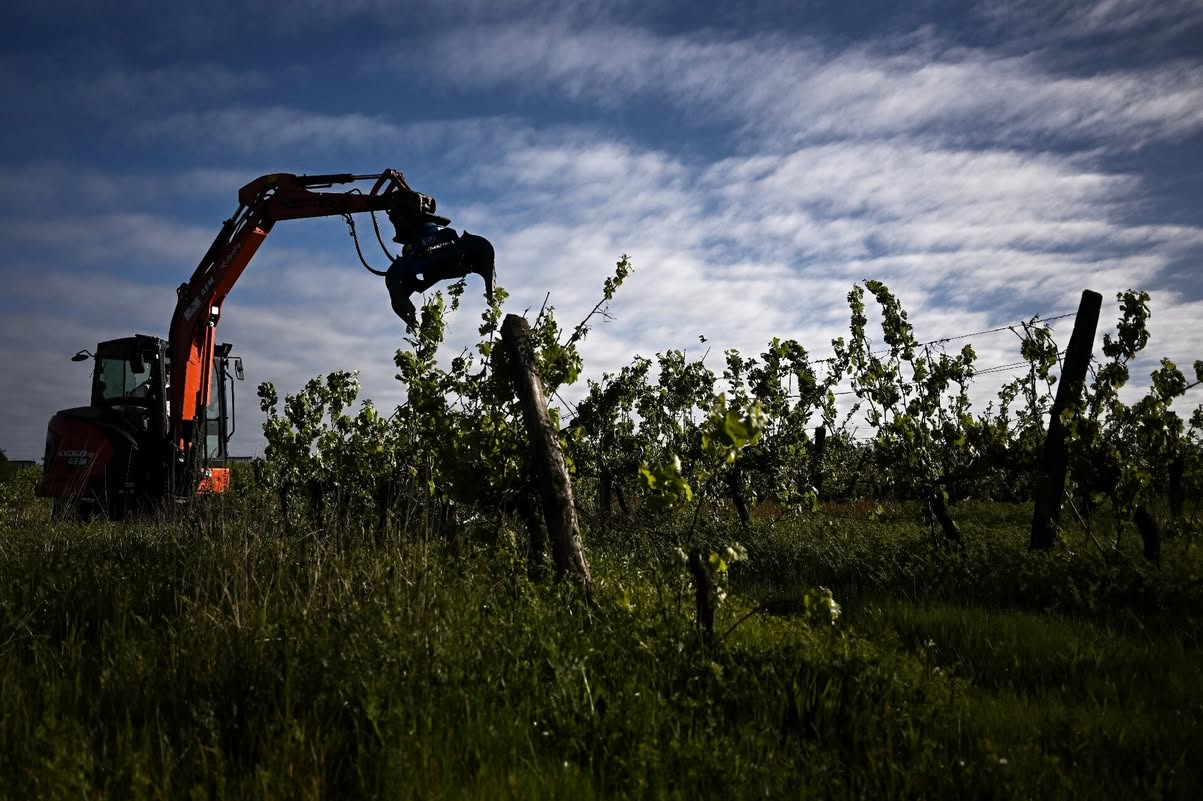
Beyond the terms used to soften the heart-rending nature of a reality, the figures are, alas, more than eloquent. Indeed, to the 12,000 ha of the subsidised pulling campaigns must be added some 5,000 ha carried out without funding(2), which represents a total of 17,000 ha removed from the Bordeaux vineyard in 2024-2025, or nearly 18% of its declared area in production at the start of 2025 (95,000 ha). Other figures convey this upheaval, not to say the dismay that has struck its humblest players, namely those in the Bordeaux AOC in all its variants. This appellation accounts for 54% of the total area pulled, its delimited area having been reduced by more than 9,000 ha. This statistic of despair is also reflected in all the growers who have permanently ceased their activity, whose number, not officially disclosed, would be on the order of 300.
Fewer vines: what to do with the wasteland?
Inevitable consequences of the vine pulling, fallow land is becoming a major issue as soon as it embodies a substantial shortfall across an entire region, now deprived of part of the income provided by the vine economy. Indeed, still set to grow, uncultivated land already comes to nearly 20,000 hectares, resulting in an operating deficit commensurate with this area. While this situation had indeed been anticipated in the conditions imposed on the pulling, these were driven more by urgency than by reasoned planning. Whether it be afforestation or what is called “renaturation”, these measures were not part of a productive framework. And although the legislator did nevertheless offer the option of putting fallow plots back into cultivation for other agricultural activities, this solution was in the end little taken up, for obvious reasons: it meant practising another trade, with everything that implies.
That is why, in order to avoid a break in the farming of large areas and to put them back into production in other forms in an efficient and concerted manner, a wine-growers’ union, the Confédération paysanne de Gironde, has initiated a collective project aimed at bringing back to life a rural space doomed in places to a form of abandonment. Thus, under the aegis of the public authorities, a public land agency (Établissement Public Foncier, EPF) would be set up for this purpose, mobilising all the players in charge of the territory, and notably the SAFER of Nouvelle-Aquitaine (3), the professional bodies and the banks. Requiring the cooperation of all stakeholders, such an undertaking — a sort of estates-general of Gironde viticulture — would equip the region with an infrastructure charged with preventing its being riddled with barren spaces in every sense of the term. This scheme has caught the attention of all those involved, up to the highest level, and is well on the way to being launched.
Closing ranks, for want of anything better
There is no doubt that the measures taken by the Bordeaux AOC union at the end of its meeting on 20 November last are the reflection of a firm will on the part of its bodies not to throw in the towel in the face of this crisis, which its president, Michel-Éric Jacquin, expresses eloquently in his closing words in these terms: “believe in my fierce determination”, with regard to their implementation. Given the immensity of the task, one would be entitled to greet these measures with circumspection as to their scope. Be that as it may, they at least have the merit of pointing out where the shoe pinches. Thus, on the question of prices in the event of compulsory liquidations, a principle of vigilance will be introduced to prevent wines from ending up sold off cheaply in supermarkets. Besides weighing down already distressed farms, prices of that order have the effect of a shock wave, as the press is on the alert to relay such announcements. There is no need to stress how damaging this is to the already withered image of Bordeaux wines.

In other resolutions adopted, the consumer is (at last) taken into account, with the union committing to increasing quality guarantees through more efficient checking of products by its own means. In addition, in order to better understand current and future demand, the body is going to start a consultation with its members and winegrowers in order to recommend an offer as close as possible to presumed consumer expectations. Without wishing to prejudge what will emerge from this campaign, it is permissible to think of a type of Bordeaux that is on everyone’s mind: a supple red, to be drunk fresh, light in alcohol and ostentatiously seductive. To that end, there is already thought of relaunching the production of a wine that already exists under the designation “Bordeaux Claret”, not to be confused with its rosé counterpart, Bordeaux Clairet. With a view to the 2025 vintage and those that follow, efforts are in fact under way to define its characteristics in order to bring it up to date.
Glimpsing tomorrow
Even though its most vulnerable sector, that of its regional appellation, is the hardest hit by the crisis, the economy of the Bordeaux vineyard as a whole now finds itself under the sway of uncertainty. Already stigmatised by the climate of mistrust of “Bordeaux bashing”, the region could well have done without the wide media coverage of the vine pulling, misfortune selling better than its opposite. How, then, can Bordeaux win back even a little of the esteem its wines have always enjoyed? The undertaking is all the less easy in the context of a proven de-consumption and of communication restrained by the Evin law. Under these conditions, what narrative can be substituted for the one that has always made its prestige and benefited all its players, from the humblest châteaux to the classified grands crus? Is this “happy” amalgam still tenable at a time when this crisis is exposing glaring divides between its players?
If Bordeaux must therefore step down from its pedestal and put an end to the illusion of its unity, what would the alternative be to its image of old? If indeed it is still relevant, the question will remain open as long as its vineyard has not “cleaned up” its situation, to which new vine pulling should contribute, indeed planned this very year by a third funded campaign. We would then be at nearly 30,000 ha pulled, a figure that visionary minds had already estimated in 2018. Instead of being perceived as a grave amputation of its potential, this forced restructuring could however vindicate the proverb “it’s an ill wind that blows nobody any good”. Indeed, besides the chance to adjust supply to demand better, it offers the opportunity of converting wasteland into farmland, so as to relieve the economy of the whole region, thus breaking with a monoculture whose torments are now being measured on the least privileged terroirs. To that end, only a large-scale initiative, backed by broad consultation, could bring back to life the territory sacrificed out of necessity. Presented above, the EPF project was precisely designed to give an answer commensurate with the problem.
This tense climate has inevitably fed reflections, no doubt alarmed, on “crisis” products, in other words products likely to respond better to today’s consumers, less and less inclined to the eating habits and rituals of their elders. In the case of Bordeaux, a more unbridled approach to meals hardly rhymes with the seriousness they inspire. From there it is only a step to conceiving the idea of more seductive wines. And it is in this sense that the “rebirth” of Bordeaux Claret should be interpreted: a slightly sweetened red, resolutely made to please, at least as its proponents advocate. Forecasts for its production are nonetheless very modest and would by no means make it a saving product, if indeed such a “recipe” is enough to loosen up the approach to Bordeaux. Other voices have been raised to suggest the creation of a production framework less restrictive than that of an AOC, so as to adapt the style of the wines better to demand while producing at lower cost. Such a framework exists, that of the IGP. And while the idea of a Bordeaux IGP is certainly utopian, there is indeed an Atlantique IGP covering the Gironde area and allowing such practices. But who would want to give up a label steeped in history and still synonymous with quality in order to choose a far less valued designation?
Mohamed Boudellal
(1) This remark alludes to winegrower suicides that occurred quite recently, so many tragic signs of the difficulties that have overwhelmed many of them.
(2) In fact 7,000 ha are thus concerned, from which must however be deducted about 2,000 ha intended to be replanted, as this is an annual constant inherent in vineyard management.
Rounded so as not to fall into an accounting spirit unwelcome in these circumstances, the areas mentioned were provided to me by the Conseil interprofessionnel des vins de Bordeaux on the basis of data from the Customs authorities, which are empowered to record them.
(3) According to its official presentation, a SAFER (Société d’aménagement foncier et d’établissement rural) is a public limited company, non-profit (with no distribution of profits), with public-interest missions, under the supervision of the Ministries of Agriculture and Finance. It enables any person with a viable project to settle in a rural area.