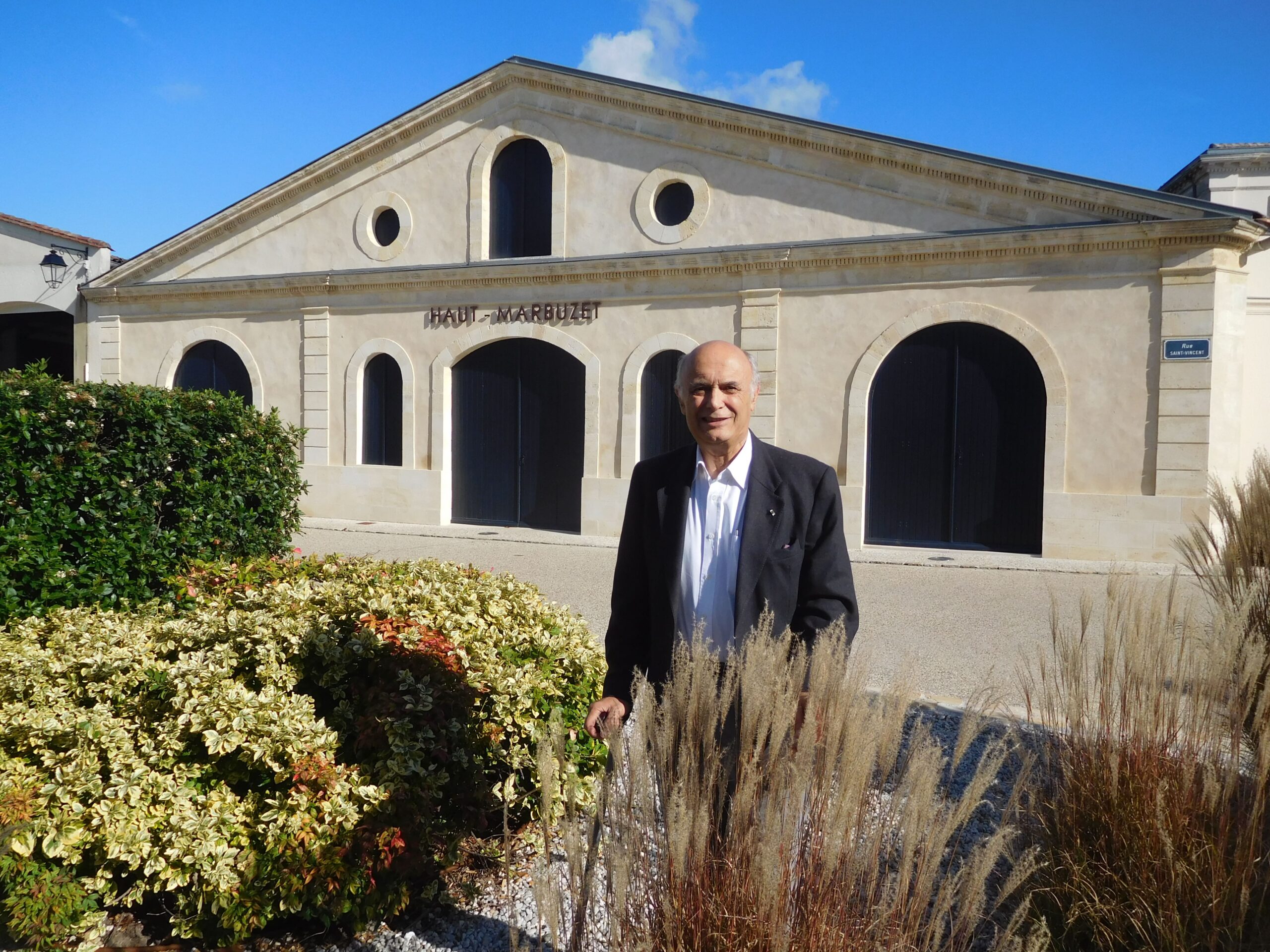
Château Haut-Bailly has featured in the Féret since its very first edition, in 1850, and has never ceased to be present through the editions of Bordeaux et ses Vins. It will of course feature in the 20th edition, currently in preparation.
Spotlight on Véronique Sanders-van Beek
For this second interview broadcast as a podcast for “Les Chroniques Féret”, we chose to meet Véronique Sanders, president of Château Haut-Bailly.
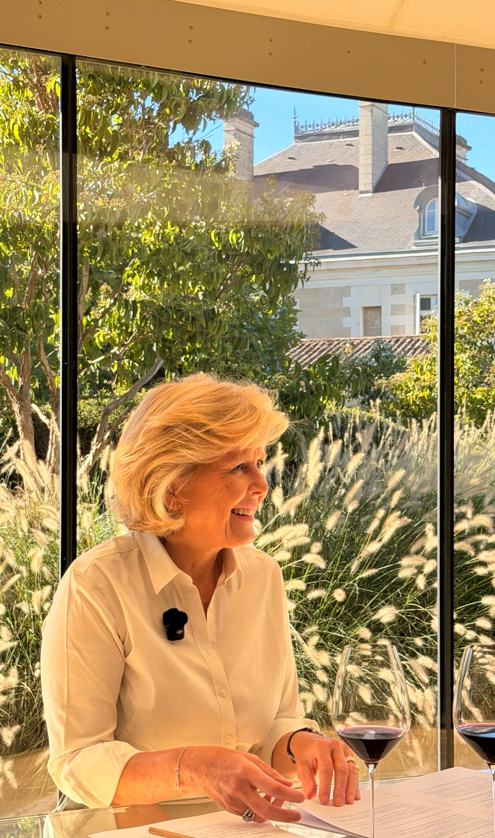
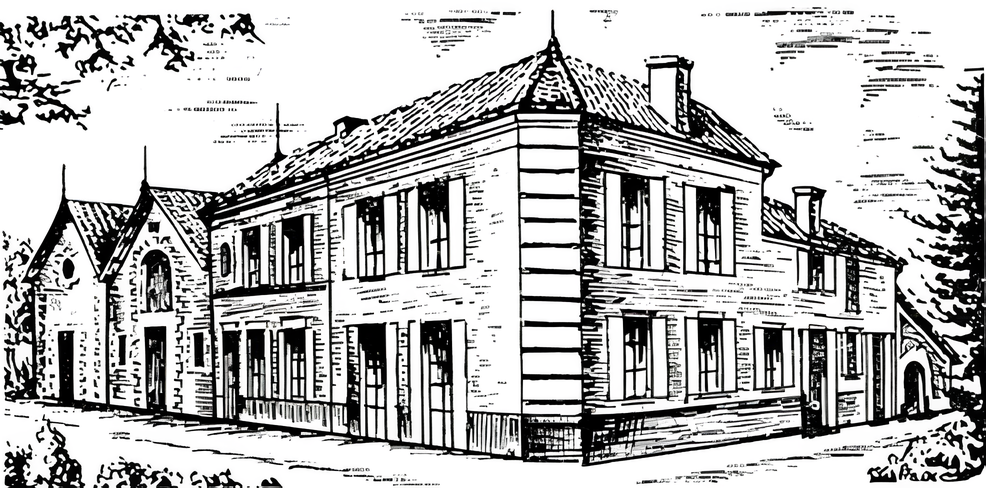
The story begins in 1630 with a Parisian banker, Firmin le Bailly, who fell in love with this gravelly terroir in Léognan, bought the estate and gave it his name.
There you are, but the story begins even earlier, though under the name Haut-Bailly it is indeed 1630. There were probably vines from the 12th century. Deeds of sale have been found and above all written traces of the existence of vines going back to 1300-odd, but we know there were vines even before that, though it is very hard to find documents.
Féret didn’t yet exist. (laughter) Two centuries later, in 1872, another figure enters the story, Alcide Bellot des Minières, who is not an owner like any other. He is going to pull up, replant, drain, level. Above all he is going to impose an almost scientific precision. And in the Férets of the late 19th century, he is even referred to as the “King of winegrowers”.
Absolutely, he was a legendary character who considered that Haut-Bailly had an exceptional terroir and that it produced a nectar. And he even managed to sell Haut-Bailly’s wines, between 1872 and 1940, at the same price as the Premiers Crus Classés. He was extremely charismatic, he was a scientist. He searched a lot, found a lot too. He was sometimes wrong. But in any case, he left a very strong imprint and he left a golden age in the history of Haut-Bailly for that period.
[…]
[…] We are delighted to be able to talk with you today about a subject close to your heart: the place of wine in our society and the issues linked to its perception.
Could you look back a little at the main stages of your career? What led you to devote your life to the world of wine?
Haut-Bailly has been part of my life since my earliest childhood, since I was often here with my grandfather Jean, and I very quickly fell in love with the place, the smells, the light. I was viscerally attached to the property from a very young age. I started by following another path since there were few women in this world. I did studies that took me towards other universes. But I came back to Bordeaux to begin my studies at the faculty of oenology in 1997 and then in 1998, Bob Wilmers bought the property very quickly and he trusted me by bringing me into the property full time. This year, then, is my thirtieth harvest, since I was here in 1997 as an intern and in 1998 full time. My grandfather stayed on for two years while I continued learning with him, between 1998 and 2000, and indeed, in 2000, he withdrew completely. My aim has been to continue the work of my great-grandfather and my grandfather while trying never to distort what they had done, but to move forward what could be moved forward. We worked step by step, little by little. First we had to understand what Haut-Bailly was intrinsically, where we came from in terms of history and what the particularities of this terroir were, and that cannot be grasped in a few months. I think today I can say that I know Haut-Bailly intimately, and it still took a few years.
[…]
You were one of the first women to run a Bordeaux grand cru, the first woman to preside over the Union des Crus classés de Graves. At that time, how did you experience your arrival in this still largely male universe?
I think what I remember very strongly is the trust Bob Wilmers gave me, and that was a stroke of luck and I seized that chance, it was an opportunity. When I later became the first woman to preside over the Union des Crus classés de Graves, I took it as a mark of trust from my peers. It is obvious that since it was rather unusual, it required a great deal of hard work so as not to disappoint. But work has never frightened me, so I think I took a lot of pleasure in it. Once again, I have always considered that being a woman was an advantage. We are all the time placed next to the most important people in the room, the most interesting, so we have the chance to ask questions and learn faster.
[…]
Today, the wine world is going through a period of transformation, as you have just said. What are, in your view, the main challenges that properties have to face?
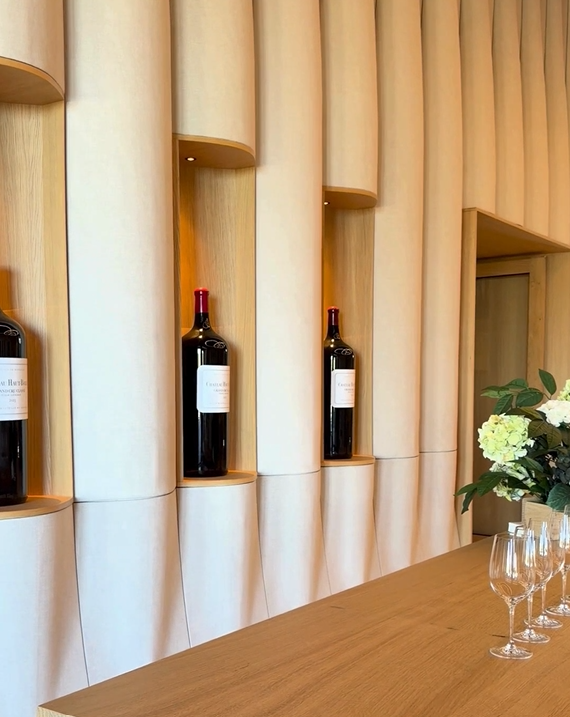
I think today we are facing several simultaneous transformations and that is no doubt what makes this period so particular. The first challenge is obviously climatic, we have all noticed it and we have to cope with conditions that are more and more extreme. People talk a lot about heat, but I will also speak to you about frost, very intense rain episodes, periods of drought, and despite these very extreme conditions, we must keep producing wines that are balanced, that are fresh, that are able to stand the test of time. So at Haut-Bailly, we adapt, we try of course to preserve the vines, to know our soils ever better, we keep researching and learning, and then we have equipped ourselves with a winemaking facility that allows us to adapt to these new conditions. This new cellar that you have seen is a fantastic tool that lets us look to the future with serenity. But there is also a transformation in consumption patterns, and that is true of every era, but this one we are in the thick of. Overall, people pay more attention to what they drink, to what they consume in general, and perhaps we drink less but better, which is very interesting. I think we have to adapt without betraying ourselves. We don’t chase every fashion, but we must stay curious, we must stay open, stay capable of evolving while remaining faithful to our terroir, to our style, to the future. So despite the complexity of the period, I think it forces us to think very deeply about what we do, how we do it and what we want to pass on. But it is an incredibly complex and therefore rich period.
This notion of transmission is very present in your career. How do you prepare the future in an estate as historic as Haut-Bailly?
Well, I think you have to begin by accepting something very simple, which is that we are only passing through. That is the starting premise, and then, I think Haut-Bailly is greater than those who serve it. So our responsibility is to hand it on in the best possible condition and even, ideally, in a better condition than the one in which we received it. Preparing the future is really knowing our past very intimately, where we come from, who we are, what our identity is, and without ever being prisoners of it. Every decision we take today takes account of what was built before us, but also of what we want to leave to those who will come after.
Let us talk about your role in the Académie internationale du vin. Since 2023, you have been chancellor of the Académie internationale du vin alongside Guillaume d’Angerville. Could you explain a little what the main mission of this institution is?
Yes, the Académie is an independent, international think-tank that brings together figures from the wine world from more than twenty countries. We are a little over a hundred members and we meet twice a year. We communicate, of course, much more often than that, but we have two big moments in the year, one in autumn and one in spring. And our mission is to understand, to enlighten, to share wine culture in all its complexity. So terroir, science, meaning, history, environment, gastronomy, and also to exchange among ourselves, and these are moments of extraordinary richness. And today I think the Académie is taking the measure of the fact that we will also have to defend the meaning of wine and pass on this culture to the generations to come because, precisely in response to what we have just discussed, to this evolution, these fashions, these challenges awaiting us.
Indeed, you recently made a public appeal in favour of wine culture to the heads of state gathered at the UN. What prompted you to do so?
Well, indeed in September 2025, it was the first time in its history that the Académie spoke out publicly, and with Guillaume d’Angerville and all the members of the Académie, we felt it was important to speak out because it was a moment when the debate on wine tended to be reduced to its alcohol dimension alone, its health dimension alone. And in the appeal we addressed to the heads of state and government gathered in New York for the United Nations meeting on the prevention of non-communicable diseases, we told ourselves that even if we do not dispute the risks linked to excess or the need to protect, of course, the most vulnerable, we were simply asking for scientific nuance to be respected rather than erased in favour of a message easier to communicate, which at that time was “there is no safe level”. Behind wine there are 8,000 years of history, there are landscapes, there is know-how, there are men and women, there is also a culture of sharing and moderation, and so reducing all that to a molecule seemed to us profoundly reductive. So our conviction was simply that education and responsibility should be favoured over simplification. So what we say is that people must learn to taste, they must learn to understand and appreciate in moderation, but in no case should we have an over-simplifying message.
[…]
We face a difficulty today, which is succeeding in promoting responsible consumption while preserving wine culture. How do we do that?
I believe first of all in education. I saw it with my own son and I simply passed on the way I was taught to discover wine. I think that, quite young, even very young, you have to educate people to smell the world around them. Every city has a smell, every flower has a smell. And so when you have a baby in your arms, let them smell flowers, let them smell spices, let them smell things just to awaken this sense, which is a marvellous sense. A little later, you can begin to let them taste. Let them taste a drop of Sauternes, let them taste the aromas of a red wine, and educate by explaining, of course, that it is alcohol, but also giving a sense of responsibility. And if there is no prohibition, I think moderation is natural. The problem of abusive alcohol consumption often comes from another type of drink, stronger spirits consumed in different contexts. When we talk about wine, we very often talk about the table; we drink wine at the table, we share it with a meal. And there is also a ceremony. This ceremony of transmission is very important. I remember my son being so proud the day he was able to drink his first glass of wine, a dribble at the bottom of a glass. Then over the years, as he grew, it was a little more. It was a second glass and then a comparison. And in fact, it happens naturally. But I think you shouldn’t forbid anything. You must leave great freedom of approach and above all of desire.
You have to educate your nose, then educate your palate. And then I think you mustn’t go too far in the pursuit of knowledge. Wine is above all pleasure. And the only question people should ask themselves when they taste a glass of wine is “do I like this wine or not?” Possibly, the next question is “why do I like it”. “But I like it or I don’t like it”. That is the only question one should ask. I think the magic of wine is also the fact that we share the same bottle. In a world where everyone is very individualistic, there are many people who drink cocktails, who consume different things, but here, we are going to share the same product, the same bottle. And what is fun around a table is that at that point our perceptions are different. And we can exchange and say “Hey, what do you smell? How do you taste it? What do you like?” And then wine is taste, and tastes differ. Some around the table will fall in love with it, others will find it perhaps less interesting, but the richness of being able to share the same bottle often generates conversations that are quite different from those if we were drinking something else. Studies have been done on this subject, among other places in the United States. It was found that a table sharing the same bottle of wine had perhaps richer, more joyful, different conversations. And I believe a lot in that.
In the Académie’s manifesto, you write that wine is a heritage of Humanity. Why is this notion essential for you?
Well, wine embodies eight millennia of human history. It is a ferment of civilisation. Wherever you have vines, you have civilisation. It is also a ferment of joy and sharing. So everywhere in the world where there is the vine, wine expresses the same thing. It is man’s patience in the face of time, his humility before the earth. And to offer a glass of wine is to invite the other to your table. It is to manifest through the gesture peace, friendship, the happiness of being together. So, I believe wine is much more than a product. It carries landscapes, it carries know-how, gestures, traditions, and human stories that have been passed down since the dawn of time. And, moreover, UNESCO recognises it very concretely. UNESCO has inscribed on the World Heritage list wine landscapes in France, of course, but also in Hungary, Portugal, Switzerland, a bit everywhere in the world. And UNESCO has also inscribed on the intangible cultural heritage list the gastronomic meal of the French, which explicitly includes the marriage between food and wine among its essential components. So that shows clearly that wine is not limited to what is in the glass. Wine shapes landscapes, communities, cultures and ways of living.
[…]
Would you like to discover the full interview? You can listen to it on Les Chroniques Féret.
Share this article