Pierre-Yves Rigaux and Denis Chazarain acquired Château Larteau (Bordeaux Supérieur), Clos Bel-Air (Pomerol), Château Tour Saint-Pierre (Saint-Émilion Grand Cru) and Château Sénilhac (Cru Bourgeois, Haut-Médoc). Denis Chazarain tells what sets them apart and, for Féret, looks back at his intention to put Bordeaux and its almost eternal history back at the centre of everyone’s attention.
Tell us how the acquisition of your properties came about.
It is my friend Pierre-Yves Rigaux who is the investor in this story! We worked together in the oil industry. Later, Pierre-Yves took on responsibilities in banking and trading, mainly in Asia. After a career in oil, I was also active in banking. Pierre-Yves had no experience in wine, whereas I had some, through my stake in the Médoc at Château du Cartillon, managed by Grand Chais de France. I also invested in Côte-Rôtie and in Corton Grand Cru a few years ago. It was Pierre-Yves Rigaux who had the opportunity to buy this Bordeaux vineyard following the default of the Chinese owners, based in Hong Kong. Knowing my attachment to this sector, he asked me to join him in this adventure. Clos Bel Air in Pomerol, Château Tour Saint-Pierre in Saint-Émilion Grand Cru, Sénilhac, Cru Bourgeois in Haut-Médoc, and Larteau in Bordeaux Supérieur were bought on 31 August 2022. Four châteaux that I look after directly.
How would you characterise these different châteaux?
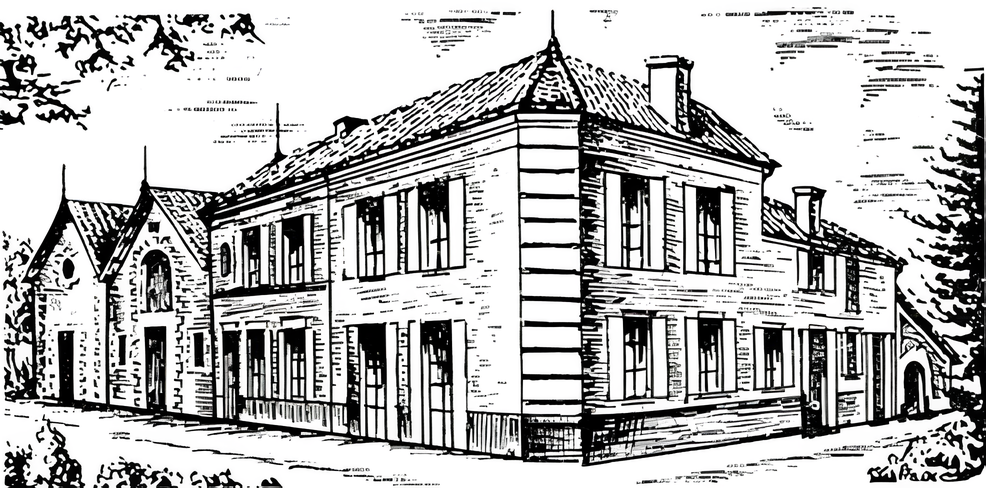
The project is global and the four properties are managed together by the same staff. I will start with Clos Bel Air in Pomerol, typical of this appellation that needs no introduction. It is a small property of 2.5 hectares north of Libourne. You could call it a garage Pomerol! You do in fact open the garage door to get into the cellar (laughs). It long belonged to an old Libourne family before being taken over in 2016 by Chinese owners for reasons of inheritance and succession costs, as in many cases. This is pure Merlot, very typical of the appellation, quite fine, deep and very balanced. Vinification is integral (“vinification intégrale”), followed by 12 months’ ageing in barrels. Château Tour Saint-Pierre in Saint-Émilion Grand Cru now covers 13 hectares, compared with 11.5 when we bought it. The vines are located on the slope down from the Saint-Émilion plateau towards Montagne. This property, adjoining Châteaux Dassault and Larmande, dates from the 18th century. It belonged to the former mayor of Libourne, whose heirs had to sell it to Chinese buyers for the same succession reasons in 2016. We are on a terroir and soil configuration quite close to Château Dassault. The wines are predominantly Merlot with also some Cabernet Franc, and the intention is to incorporate Malbec into the cru in the coming years. The cellar has been completely redone. Château Sénilhac on the Left Bank is a Cru Bourgeois in Saint-Seurin de Cadourne, a few kilometres from Saint-Estèphe and Château Sociando-Mallet. It is a fine bourgeois house typical of the Médoc, located at the top of the Saint-Seurin gravel rise with a view over the Gironde, set in a beautiful park of some twenty hectares of forest. The property consists of 25 hectares of vines. Cabernet Sauvignon dominates, alongside Merlot, Cabernet Franc and Petit Verdot. I would add that we have planted three hectares of Sauvignon Blanc and Sauvignon Gris. Château Larteau, south of Libourne at Arveyres, covers 13 hectares in all, of which 10 hectares are planted and two hectares are parkland. It is an elegant 18th-century château, built by François de Belcier, knight, lord of Le Crain, baron of Arès, whose family probably owned these lands as early as the 17th century. The château is located on the banks of the Dordogne. It is a Bordeaux Supérieur from the palus, typical of this region. It has been somewhat forgotten, but the palus produced quite rich wines, mainly intended for export because of their ageing capacity, while the wines of the gravel soils were rather reserved for local consumption. The hierarchy was then reversed (laughs). Merlot dominates here at 80%, with 20% Cabernet Franc.
I would add that we benefit from Larteau’s real tourist appeal, on the one hand the 18th-century building and on the other its easy access, close to the A89 and about twenty minutes from Bordeaux. There are six bedrooms – which are not rented individually –, large reception areas and the former barrel cellar converted into a seminar or wedding room. We have made Larteau a genuine events centre, which works very well today, particularly with businesses.
Tell us about the distinctive range of wines made at Larteau.
At Larteau, we decided to innovate by making, in particular, a Blanc de Merlot. Blanc de Nuit launched the “night” range of cuvées, with the recent arrival of Bulles de Nuit, a white sparkling wine made from Merlot! We have also created a Rouge de Nuit, this time as a Vin de France. A light red with slightly lower alcohol. This variation of the night wine range is always made from the same vineyard and the same Merlots.
Larteau remains an area of experimentation, if I understand you correctly?
Yes, the idea is to innovate without breaking with the tradition of the Larteau terroir and keeping the native grape varieties. It was out of the question to import Mourvèdre or Syrah, to create a totally disembodied branded wine, disconnected from Bordeaux and without identity. It seems to me that this innovation reaches its high point with our sparkling wine made from Merlot Noir. We must be almost the only ones making one. It is made as a Vin de France because appellations d’origine contrôlée have certain rigidities that can be detrimental to innovation and to the wish to respond to market demand. Our wines are perfectly traceable.
An answer to the crisis?
Yes, certainly. Perhaps the crisis comes from the fact that some châteaux have remained in the comfort of what made Bordeaux’s glory, whereas glory is by definition transitory. We should remember that there have been many changes in Bordeaux, as the history of the palus wines, whose name has disappeared, of Clairet, or the significant presence of Malbec until quite recently, shows. Bordeaux has forgotten that it has changed many times. Its history is made of cycles and changes, while remaining — and this is important — always Bordeaux. The industry has lost sight of this a little in recent years. I like to point out that Bordeaux wines were famous in the Middle Ages, well before the introduction of the AOCs, which, it must be said, have very often frozen and fixed things.
When you think of Bordeaux, which Bordeaux do you think of?
Bordeaux must make wines that consumers like! We can make that a maxim! To answer your question more precisely, I would say that what above all characterises Bordeaux is balance, like its climate, neither too hot nor too cold, and its soft light. That balance was for a time undermined by the ostentatious use of oak. When you want power, you go to Vacqueyras, and you find lightness in the Moselle. Bordeaux is surely somewhere between the two (laughs). If Bordeaux is characterised by its climatic balance, it is also by its technical depth, second to none. You do not necessarily find this expertise, this know-how, in all the other wine regions.