


[The article below is co-authored by Cornelis van Leeuwen, Benjamin Bois, Laure de Rességuier and Gérard Seguin]
THE CONCEPT OF TERROIR IN VITICULTURE
INTRODUCTION
Bordeaux is the largest French appellation vineyard. In wine production, the word “terroir” reflects the link between the wine and its origin. The Bordeaux vineyard is a vineyard in which the effect of terroir on the quality and typicity of the wines has been affirmed very early in history. This notion of terroir is nevertheless difficult to explain, as many factors are involved: the vine, the soil, the climate, human factors, and these different factors interact. Moreover, terroir can be considered at several scales (region, small AOC, estate, parcel) and the relative importance of the factors that contribute to the terroir effect varies with the scale considered.
In viticulture, the reality of a terroir effect is established by tasting. Depending on where the wine is produced, its taste, characterized by a certain quality and typicity, differs. The more precisely the origin is defined, the clearer the terroir effect. In Burgundy, where the entire chain of production and marketing of most of the first and great growths dissociates each parcel (locally called climate), the terroir is expressed with great purity. In Bordeaux, where the unit of vinification and marketing is the estate, generally covering a few hectares to a few dozen hectares, the terroir effect is also very present. The best wines have a strong typicity that can be related to the particularities of the place of production.
However, not all wines are terroir wines, whether in Bordeaux or elsewhere in the world. The designation “terroir wine” implies that the origin of the place of production is precisely defined. Then, it is necessary that the particularities of this place of production provide a certain quality and a certain typicity to the wine produced, offering it a potential added value. Finally, it is necessary that the producer decides to put forward the origin of the product in his marketing strategy and also by avoiding a too interventionist vinification. This set of factors is respected for most of the Bordeaux crus, which can therefore be called “terroir wines”. For all wines produced with the name “château” the producer must in principle be the owner or tenant of the land. Except in exceptional cases, it is not possible to buy grapes or wine if one produces a château wine. The land base of a Bordeaux “château” is therefore stable over the years, which guarantees a lasting link between the wine and its origin. This base can obviously evolve over time through the purchase or sale of land. When these transactions represent a small proportion of the total land, they are not likely to jeopardize the link between origin and typicity. On the other hand, rapid extensions of the vineyards in significant proportions can end up undermining the expression of the terroir effect.
When the origin does not play a major role in the typicity of the wine, the producer usually tries to create a brand awareness to market his production. A branded wine does not have a very precise origin. It owes its quality to particular vinification and maturation techniques and especially to the art of blending. Therefore, the volumes produced are not strictly limited as is the case for terroir wines. The name “brand wine” or “terroir wine” does not prejudge their quality. In some regions, such as Champagne or Australia, branded wines are among the very best wines produced. In Bordeaux, the greatest wines are terroir wines, but there are also many less famous and more affordable wines that respect the same production conditions. In addition, the Bordeaux wine merchants and some cooperative wineries offer branded wines, some of which can be found on the shelves of supermarkets at bargain prices, while others are renowned without competing with the best wines.
While in theory “terroir wine” and “branded wine” correspond to two distinct production and marketing strategies, in reality there is some overlap between the two concepts. A branded wine can be produced within the framework of an AOC, which is the case in Bordeaux. Even if the AOC does not guarantee a very precise origin, it is nevertheless delimited. On the other hand, a famous local wine becomes, by its fame, also a brand. In a pragmatic way, we can consider that a wine is said to be of terroir when it is possible to visit the plots from which it comes, and that these plots remain the same over the years (VAN LEEUWEN and SEGUIN, 2006).
THE MAIN FACTORS THAT CONTRIBUTE TO THE WINEGROWING TERROIR
The vineyard terroir is often confused with the vineyard soil. This is too simplistic a view. In reality, the influence of the place of origin on the sensory qualities of the wine depends on a set of factors that are linked to the natural environment (geology, soil, topography, climate), to the cultivated plant material (grape variety, clone, rootstock, age of the vines) and to human factors (VAN LEEUWEN et al., 2004). The effect of each of these factors is difficult to determine, because not only are they numerous, but they also interact. Many researchers have tried, unsuccessfully, to explain the winegrowing terroir from a single discipline (usually their own): geology, pedology, climatology or even soil microbiology. These studies remain at best descriptive but in no way allow us to understand why a wine is better, or tastes different, when it is produced in a particular place. Only a multidisciplinary approach, which places the vine at the center, can explain the effect of terroir in wine production. Professor Seguin of the University of Bordeaux was a pioneer in this type of approach. He defined terroir as “an ecosystem associating in a given geographical location the climate, the soil and the vine. To these factors we must add human factors” (SEGUIN, 2007). In a terroir study, it is important to place the vine at the center of the ecosystem defined by Seguin. The influence of natural factors on the composition of the grapes is mediated by the vine.
The edaphic factor is characterized by a geological bedrock on which a certain type of soil has developed, under the action of the climate and the vegetation. Soils are differentiated by texture (proportion of coarse elements, sand, silt and clay), presence or absence of limestone, organic matter content, pH and nutrient composition. To understand the effect of the soil, we must break down its action on the functioning of the vine.
The climate acts on the vine first of all by the air temperature. The latter is the metronome of the growth and the succession of the developmental stages of the plants, which we call “phenology”. The higher the air temperature, the more the growth and the phenology accelerate, if the water supply is not limiting. Thus, on warm terroirs or during “hot” vintages, bud break, flowering, veraison and harvest take place earlier. Rain is a key element in the expression of the terroir and the vintage. Like all living organisms, the vine needs water to live, but paradoxically, it is in conditions of limited water supply (called “water deficit”) that the best wines are obtained. Indeed, a water constraint favors an early growth cessation of the shoots, limits the size of the berries and stimulates the synthesis of tannins and anthocyanins (coloring matter) in the grapes. It has also been shown that wines produced from vines that have experienced water deficit develop more complex bouquets during aging (PICARD et al., 2017). These conditions are favorable for wine quality especially in a red wine production setting. As harvest approaches, intense and repeated rainfall can be detrimental to the quality potential of the grapes, either by stimulating excessive development of gray mold (Botrytis cinerea) that causes the winemaker to harvest the grapes before optimal ripeness, or by diluting sugars, acids, tannins, and anthocyanins in the grapes. Radiation is another climatic factor that affects quality. Sunlight stimulates the synthesis of anthocyanin in the berries and improves the aromatic potential of the grapes. Color and aromas are better preserved when night temperatures remain cool during the grape ripening period. The distribution of temperature, precipitation and sunshine is therefore a determining factor in the composition of the grapes and the quality of the wine produced. It also affects the quantity of the harvest. In this respect, it is essential that the flowering takes place under mild climatic conditions (sunshine, absence of rain and mild temperatures) to guarantee satisfactory yields. Climate is a key concern for winegrowers and researchers because, with climate change, one of the key factors in the notion of terroir evolves over time and can no longer be considered constant in a given place. It is necessary to implement adaptations to continue producing high quality wines with a strong typicity in relation to their origin, while maintaining yields that allow the economic profitability of the estates (VAN LEEUWEN et al., 2019).
Topography indirectly affects the quality of the wine. The evolution of soils during pedogenesis (soil formation), and consequently their distribution in space, depends on the topography. Soils located at the top of the slope are often shallower and less rich than soils located at the bottom of the slope (especially when the relief is concave). The latter are also more often subject to waterlogging, but also more prone to the risk of spring frosts, because cold air accumulates in the shallows during the night. The topography also determines the amount of radiation received by a vineyard plot. The plots exposed to the south receive more radiation and are therefore warmer, earlier and drier than those exposed to the north.
Man acts as the conductor in the expression of the wine terroir. He optimizes the quality potential of the grapes by choosing the grape variety and rootstock best suited to the natural environment of the plot. He also chooses management practices and adapts the green operations implemented for the production of grapes according to the soil and the climate. Man’s action has a historical dimension, as it expresses the know-how accumulated in a given region to make the most of all the factors of the natural environment. This optimization process has sometimes taken several centuries, which is the case in Bordeaux.
The interactions between factors play a determining role in the expression of the wine terroir. The capacity of the soil to retain water can thus correct the effects of rainfall. In a rainy climate, only soils with a low capacity to store water (low water holding capacity) can achieve a sufficient water deficit for the production of quality red wines. On the other hand, in a dry climate, a moderately important water holding capacity can allow the vine to avoid deleterious water stress. The interaction between grape variety and climate is no less important in the expression of the terroir. The best wines are obtained when the ripening period takes place at the end of the season: ripening too late leads to the production of acidic and herbaceous wines, while ripening too early leads to the production of heavy wines, lacking freshness and aromatic finesse. In this context, the precocity of the grape variety can correct the effect of the climate. In a cool climate, as in Burgundy, only early grape varieties such as Pinot noir or Chardonnay can reach full maturity. In a hot climate, such as Châteauneuf-du-Pape, a late variety like Grenache allows the end of the ripening period to be postponed until September, after the heat of the summer. In Châteauneuf, the produced wine would be heavy with a high alcohol level and no finesse with Pinot noir, and acidic and herbaceous with Grenache in Burgundy. Man has played a determining role in this optimization process by selecting grape varieties adapted to a wide variety of climatic situations. By adapting the earliness of the grape variety to the local climatic conditions, the ripening of the grapes takes place at the optimal period, i.e. at the end of September or beginning of October, in the vast majority of the appellations of origin in Europe. This is a determining condition for the production of a terroir wine.
EXPLAINING THE FUNCTIONING OF A WINE TERROIR
Given the large number of factors involved in the expression of a wine terroir, it is necessary to break them down and rank them. Three composite factors play a major role.
A terroir has a potential for precocity. This potential depends first of all on the local climate: the warmer the climate, the earlier the terroir. Within a region, the topography can make it vary considerably. Finally, the soil also has an effect on the earliness. A soil with a low water content, which is the case of soils rich in coarse elements, warms up quickly in spring and induces a certain precocity. The temperature in the root zone is also higher if the soil is shallow and well structured, which is the case of soils on hard limestone bedrocks.
The water regime plays an important role in the expression of a wine terroir. This water regime is ideally limiting, but without imposing a severe water stress on the vine. A low to moderate water deficit is optimal for the production of high quality white wines, while this water deficit is ideally moderate to quite strong for the production of high quality red wines. The intensity of the water deficit depends first of all on the climate: the amount of precipitation and its distribution, but also on the evapotranspiration, which can be defined as the drying power of the air, which determines the evaporation of water on the surface of the soil and the transpiration of the vine. Secondly, the water status of the vine depends on the water holding capacity of the soil. The soil can store a large amount of water, between 100 and 300 liters per square meter. In a plot with a planting density of 5000 vines/ha (an average density, very frequent in Bordeaux), each vine has a footprint of 2m2. The volume of soil explored by its root system gives it access to 200 to 600 liters of water contained in the porosity of the soil, depending on the rooting depth, the texture of the soil and its load of coarse elements (gravel and pebbles). This reservoir allows the vine to continue to get water between two rainy episodes. For given climatic conditions, the water deficit occurs earlier as this water reserve, called water holding capacity, is low.
Mineral nutrition is the third most important factor in the expression of terroir. Paradoxically, most of the minerals that the vine draws from the soil (potassium, magnesium, calcium, phosphorus, sulfur, trace elements) do not play a determining role in the quality of the wine, except in cases of excess or deficiency. Only nitrogen significantly modifies the vigor of the vine, its productivity and the composition of the grapes. In particular, the effect of nitrogen nutrition on secondary metabolites such as phenolic compounds, aromas and aroma precursors of the grape must be emphasized. Low nitrogen nutrition (but not deficiency) is favorable for the production of phenolic compounds and, therefore, desirable for the production of high quality red wines. Nitrogen nutrition should be at least moderate, but not excessive, for the production of aromatic white wines. The nitrogen supply of the vine depends on the type of soil: soils rich in organic matter and deep soils on colluviums naturally provide an abundant nitrogen supply. Nitrogen is available in more limited quantities in calcareous soils, very clayey soils and shallow soils. The winegrower can influence the nitrogen supply through fertilization and vineyard floor management practices (VAN LEEUWEN et al., 2000).
Thus, to characterize a vineyard terroir, it is necessary to determine its earliness potential, its water regime and its nitrogen availability. Numerous tools and methods have been developed over the last decades to characterize climate (weather stations, miniaturized temperature sensors), water regime (pressure chamber, 13C isotope discrimination, VAN LEEUWEN et al., 2009) and vine nitrogen status (assessment of nitrogen content of different plant organs, VAN LEEUWEN et al., 2000).
OPTIMIZE THE EXPRESSION OF THE TERROIR
Man can optimize the expression of the vineyard terroir through the choice of plant material and the orientation of the vineyard management pracices. To understand this optimization, it is necessary to identify the levers that act on the potential of precocity, the water regime of the vine and its nitrogen nutrition.
To produce grapes with high quality potential, the end of ripening period is ideally during the second half of September or the very first days of October. The winegrower can influence the time of maturity by the choice of the grape variety (RENOUF et al., 2010). Five grape varieties are mainly cultivated in the Bordeaux region. Compared to the Bordeaux climate, Sauvignon blanc and Semillon are very early grape varieties, Merlot is moderately early, Cabernet franc is late and Cabernet-Sauvignon is very late. Thus, a late-maturing site can be enhanced by planting Sauvignon blanc, Semillon or Merlot. On the contrary, advantage of an early situation can be taken with Cabernet franc or Cabernet-Sauvignon. To a lesser extent, the rootstock also has an effect on earliness, with Riparia Gloire de Montpellier tending to favor earliness while 420A and 41B tend to delay maturity by a few days. Moreover, the choice of a high density planting system with low trunk height favors earliness. This system is thus particularly adapted to the cultivation of Cabernet-Sauvignon. Regarding annual operations, yield reduction and leaf thinning are practices that hasten maturity. To delay maturity in situations where it could be reached too early, i.e. at the end of August or beginning of September, it is advisable to choose a late grape variety. Certain practices such as late pruning, i.e. carried out at the end of February or beginning of March, are also likely to delay the cycle of the vine.
To manage the water regime of the vine in order to reach a situation of moderate water deficit, the winegrower can play on the choice of the plant material. Indeed, some grape varieties and rootstocks are more resistant to drought than others. Cabernet-Sauvignon is more resistant to water stress than Merlot. If there is a risk that the water deficit is insufficient to produce grapes with high quality potential, which is a frequent situation in Bordeaux, the establishment of a high leaf area can help to empty the water reserves of the soil through intense transpiration. This is generally achieved by increasing the height of the rows or by increasing the number of vines planted per unit area: a greater number of leaves transpire and evacuate excess water out of the soil. To manage situations with a risk of excessive water stress (gravelly soil in a dry year), yield reduction by thinning is an efficient way to continue producing high quality wine.
Nitrogen nutrition is controlled by fertilization and soil maintenance. It is important to avoid both deficiency and excess situations. Insufficient supply of nitrogen by the soil can easily be compensated for by fertilization, whether in mineral or organic from. To limit access to nitrogen in a soil that is too rich, it is possible to establish a grass cover that competes with the vines for nitrogen.
A difficult factor to control is the microbiological activity of the soil. Contrary to a widespread idea, there is no direct link between the microbiological activity of the soil and the quality of the wine produced. The action of the microflora on the functioning of the vine and the composition of the grape is indirect. The microflora participates in the mineralization of the organic matter of the soil, which allows the availability of mineral nitrogen for the vine. A too low microbiological activity of the soil leads to an insufficient nitrogen supply. This situation is easy to diagnose: the vine is then low in vigor, pale green in color and not very productive. A too intense microbiological activity of the soil is also harmful. It would lead to an excessive nitrogen supply, which would result in excessive vigor and the production of poorly concentrated grapes.
THE HUMAN FACTOR IN THE BORDEAUX REGION
A VITICULTURE BORN OF GEOGRAPHY, HISTORY AND TRADE
It is essentially for geographical, historical and human reasons that a quality viticulture has been able to develop and prosper in the Bordeaux region (ENJALBERT, 1954; DION, 1959; PIJASSOU, 1980; ROUDIÉ, 1988). Very early on, the existence of navigable rivers (Garonne, Dordogne, Gironde) leading to the Atlantic Ocean allowed trade with non-producing northern maritime countries, such as England and Holland, which were major buyers and consumers of wine. These were countries of sailors. Wine, thanks to its acidity, remained the only drink that could be preserved properly during long voyages. It remained drinkable even if it stung, while fresh water ended up stagnating. In addition to this privileged geographical situation, there were also particular historical circumstances. After the remarriage in 1152 of Eleanor of Aquitaine to Henry Plantagenet, who became king in 1154, Aquitaine was, for three centuries, a duchy of the kingdom of England. The kings of England had granted the bourgeois of Bordeaux, wine producers, important commercial privileges such as the exemption from taxes, called customs, on entering and leaving the city and the prohibition of selling wines from the High Country before November 11, then before Christmas. This explains, from that time on, the rise of the Bordeaux vineyard which was hardly in competition. This is surely also the reason for its geographical limitation to the Gironde department alone, an exceptional fact for a vast AOC region. At the beginning of the 14th century, wine exports in barrels reached almost one million hectoliters. In December, a thousand ships were in the port of Bordeaux to load the new wine that had not yet “turned” and transport it to England before the Christmas holidays (PIJASSOU, 1980; ROUDIÉ, 1988).
THE EFFORTS OF MEN IN A DIFFICULT CLIMATIC CONTEXT: TECHNOLOGICAL INITIATIVES, SELECTION OF SOILS AND GRAPE VARIETIES
The success of Bordeaux wines can also be explained by the considerable efforts of men who, from the 17th and especially the 18th century, succeeded in creating the great red wines of Bordeaux to fight against the competition from Portugal and Spain. These efforts were focused on the selection of grape varieties and the improvement of viticultural techniques. These efforts also focused on the development of methods of vinification, conservation and aging of wines: use of new barrels (not contaminated by acetic bacteria), practice of topping up and racking which allowed the chemical and biological stabilization of wines, and later, around 1750, aging in barrels and then in bottles thanks to the “Dutch match”, that is to say the sulphur wick (ENJALBERT, 1954; DION, 1959; PIJASSOU, 1980). One of the most important steps, which is undoubtedly not yet completed, concerned the selection of soils. These men were able to identify the best sectors, among soils not very suitable for other crops, which they had to accommodate, sometimes trying to improve them. Then, over the centuries, they selected the grape varieties best adapted to the diversity of the soils and especially to the humid climate of the region, especially the Cabernet (Vidures). Thus, the current grape varieties are quite different from what they were when the hierarchy of the crus was established. During a trip to Western Europe in 1787, Thomas Jefferson, the American ambassador to Versailles, stopped in Bordeaux and noted the prices of the best wines of the time: red wines from the Médoc and Haut-Brion (in the Graves), white wines from the Graves and Sauternes. It is, more or less, this same hierarchy of prices that was codified in 1855 during the “official” classification of the Bordeaux wines (MARKHAM, 1997). This classification, which was ignored by consumers for decades and was forgotten in the 20th century, is still used today, more than 200 years after Jefferson’s trip (PIJASSOU, 1980). The hierarchy of the Médoc Crus has thus resisted several social, economic and technological revolutions (oenology did not exist), several European and world wars, the introduction of rootstocks to fight against phylloxera, new cryptogamic diseases (powdery and downy mildew) and above all, a major change in the grape varieties. At the end of the 18th century, during Jefferson’s visit, Malbec was one of the main grape varieties along with Petit Verdot and Cabernet. Merlot, which is currently the leading red grape variety in Bordeaux (66%, CIVB, 2022), was still unknown and only began to spread around 1830. Petit-Lafitte, in 1868, still classifies it among the secondary grape varieties of Bordeaux. Before the ravages of phylloxera and mildew, at the end of the 19th century, 180,000 hectares were planted with a large number of grape varieties. During the post-phylloxera reconstitution of the vineyard, the less good soils were abandoned and the less interesting grape varieties, from a cultural point of view, were eliminated (because they were too early or too late ripening or because they were sensitive to the new diseases). Finally, it is worth mentioning that it was mainly after the frosts of 1956 that only one variety was planted per plot in order to harvest the grapes at their optimum maturity.
Geographical, historical and human factors are decisive for the genesis of great vineyards. Thereafter, a process of natural selection takes place. If the vineyards are located in an environment conducive to the quality of the wines, their production is easily perpetuated. Indeed, the quality leads to a better valuation of the wines, which makes it possible to cross the periods of crisis. Vineyards that are located in an environment less conducive to the production of quality wine are more likely to fail when a crisis occurs. Thus, in Bordeaux and La Rochelle, important vineyards were developed at a time when the geographical context was favorable: the power of these two ports made it easy to export wines. A set of natural factors conducive to the production of high quality wines allowed the Bordeaux vineyards to survive the decline of the port of Bordeaux, which was not the case for the vineyards of La Rochelle.
CURRENT PRODUCTION AND GRAPE VARIETIES
The Bordeaux vineyard covered an area of 110,000 hectares of AOC vines in 2013 (fig. 1, CIVB 2014). 89% of the area is planted with red grape varieties and 11% with white grape varieties. It produces annually 3.3 (2017, spring frost year) to 5.6 million hectoliters (2016) of wine. The proportion of red and white wine production varies according to demand. The strong predominance of red grape varieties that we find today already existed in the 19th century, while in 1961 62% of white grape varieties were grown. The Bordeaux region produces a very wide range of wines. Most of the volume is produced in the regional appellations Bordeaux and Bordeaux Supérieur while the most prestigious wines, about two hundred Grands Crus Classés and similar, produce only 3 to 5% of the harvest.
Figure 1- Map of the main Bordeaux appellations

Merlot is the dominant grape variety in Bordeaux today (66% of the area planted with red grape varieties, CIVB, 2022). Despite its great international reputation, Cabernet-Sauvignon is far behind with only 23%. Indeed, Cabernet-Sauvignon is a late variety for the Bordeaux climate and can only ripen properly in early situations (soils inducing water deficit, such as gravelly soils), and with high quality viticulture (high leaf area per hectare thanks to a high planting density). Merlot is a less demanding grape variety and can succeed in Bordeaux in a wider variety of situations. Cabernet franc, which occupies 9% of the surface area, is a medium-early variety, which matures between Merlot and Cabernet-Sauvignon. It is very popular as a complementary grape variety to Merlot in the Libourne region and in the Entre-deux-Mers area. Exceptionally, as at Château Cheval Blanc, it can be the majority grape variety. Concerning white grape varieties, Semillon remains in the majority (45%), even if Sauvignon Blanc is increasing (43%; CIVB, 2022). With the exception of Château Couhins-Lurton and Pavillon Blanc de Château Margaux, which are produced exclusively from Sauvignon Blanc, all the great white wines of Bordeaux are a blend of Sémillon and Sauvignon Blanc. For sweet wines, Semillon is most often the majority of the blend. In the Bordeaux region, the grape varieties vary greatly depending on the geographical area (Table 1).
Table 1- Red grape varieties of Bordeaux
(from CIVB, 2014 for Gironde ; Agreste Aquitaine, 2003 for the various geographical areas of Bordeaux)

THE CLIMATE OF THE BORDEAUX WINE PRODUCTION AREA
CHARACTERIZATION OF THE CLIMATE
The climate of the Gironde can be described as mild temperate, with a strong oceanic influence. It differs from the Mediterranean climate by the absence of dry periods in summer, and by slightly cooler temperatures, with a smaller thermal amplitude (fig. 2A and B). In contrast to a semi-continental climate, such as the one observed in Alsace (Fig. 2C), the Bordeaux climate receives more precipitation in winter than in summer.
Figure 2 – Diagrams of climate normals over thirty years (period 1991-2020) for three cities in France located in wine-growing areas.
A: Bordeaux-Mérignac (Bordeaux); B: Nîmes (Southern Côtes du Rhône/Languedoc); C: Colmar (Alsace). Data from Météo-France.

This seasonality of precipitation is largely due to disturbances associated with west and northwest flows of predominantly polar air masses in winter, coming from the Atlantic Ocean (JONES and DAVIS, 2000; Fig. 3A). This situation, although reduced at the beginning of the growing season, continues until June, which induces an early season generally favorable to parasitic fungi of the vine such as the agent of downy mildew whose development is favored by high humidity and mild temperatures. At the end of the summer, warmer air arrives mostly in a southeast/southwest flow (Fig. 3B), in association with the Azores high pressure system.
Figure 3 – Simplified maps of the main air masses over Bordeaux: polar oceanic air (oP), polar continental air (cP), tropical oceanic air (oT), tropical continental air (cT).
A: “winter” period (approximately October to mid-March); B: veraison-harvest (approximately mid-August to end of September).
According to JONES and DAVIS (2000).

The majority of sunshine occurs from June to September (Fig. 4), with a maximum in August. During this month, the sun shines on average for about 60% of the day, ensuring good conditions for the ripening of the grapes.
Figure 4 – Thirty-year normals (1991-2020) of monthly insolation fractions recorded by the Mérignac weather station.
The insolation fraction is the quotient of the duration of insolation by the duration of the day, for a given period (here monthly). Data from Météo-France

Like edaphic variability, climate is a major factor in the diversity of Bordeaux terroirs (BOIS, 2007). Temperatures measured in the different appellation areas of the Gironde wine region show differences of up to 1.5°C on average during the growing season (Fig. 5).
This spatial variability of temperatures is associated with different environmental factors, in particular topography (JOLY et al., 2009). In spite of the gentle relief reflected in the images of the Medoc’s hillsides, there is still a difference of nearly 140 meters between the highest and lowest points of the Bordeaux wine production area. The air temperature decreases on average by 0.65°C/100m, the relief can naturally lead to a difference of almost one degree. If the relief of the Entre-deux-Mers tends to be cooler than the lower altitude sectors (such as the Médoc or Sauternais), we observe paradoxically a warmer climate in altitude in some areas. This is the case in Saint-Émilion, where the limestone plateau has higher temperatures than the Dordogne valley below (DE RESSÉGUIER et al., 2020). The relief alone does not explain this important thermal diversity in the Gironde wine region. The vineyards located near the Atlantic Ocean are marked by a low thermal amplitude. The Gironde estuary also acts as a thermal regulator and softens the minimum temperatures over a short distance (about 15 km). Finally, the wine-growing areas of the Bordeaux conurbation, certainly benefiting from the influence of an urban heat island, show a greater precocity associated with higher temperatures. Thus, the spatial variability of thermal regimes in Gironde, under the influence of relief and land use, is maintained from one vintage to another: there are vineyards that are systematically warmer than others, associated with greater precocity of vine development and grape ripening for the same grape variety (BOIS et al., 2018). The maps of average temperatures from April to September reflect well the differences in thermal regimes between the production areas of Bordeaux (Fig. 5).
Figure 5 – Maps of average temperatures for the period April – September from 2001 to 2005 in the Bordeaux region. Only the AOC areas are colored.
Data sources: Météo-France, INRA, DE.MET.E.R. Interpolation and cartography:
B. BOIS and D. JOLY.

The good relative consistency between cumulative temperatures over the wine season and phenological observations allowed us to establish a thermal zoning of the wine Gironde (Fig. 6). Five classes provide information on the relative earliness of the different Gironde vineyards in response to temperature (BOIS et al., 2018). The interclass interval can potentially reflect a difference in ripening date of 3 to 4 days for the same grape variety. Across the territory, climate variability can induce up to 20 days of differences in terms of harvest date (BOIS et al., 2014), between the earliest and latest areas of Bordeaux.
Figure 6 – Climatic zoning of the precocity of the “theoretical maturation”
of the grape (to reach a sugar content = 200 g/L), in the Gironde wine region based on temperature.
Data sources: Météo-France stations, INRA, DE.MET.E.R. Interpolation and mapping: B. BOIS and D. JOLY.

The vineyards that appear almost systematically as the coolest are those located near the Landes forest in the Médoc, in the north of the Blayais, and in the extreme east of the Entre-deux-Mers. On the other hand, the Sauternais, the Médoc along the estuary, the Bourgeais, Pomerol, the Saint-Émilion plateau, the Pessac-Léognan AOC and Cadillac Côtes de Bordeaux show the highest temperature sums. It can be noted that the Bordeaux grape varieties are not necessarily in agreement with this zoning: it seems, for example, that the cooler western part of the Médoc could potentially benefit from early ripening grape varieties such as Merlot, and that, on the contrary, there is a good thermal potential for the ripening of Cabernet-Sauvignon in certain areas of the Bourgeais, or in Pomerol and Saint-Émilion. Of course, the choice of grape variety is also based on other factors (notably the type of wine sought and the type of soil).
If the relative differences in temperature between the different vineyards of Bordeaux are maintained from one year to another, this is not the case for rainfall. Although, on average, there is a gradient of decreasing rainfall from west to east over the year as well as over the growing season, the summer precipitation maps change considerably from one year to the next: sometimes the eastern Entre-deux-Mers is the wettest region, sometimes it is the Médoc. Consequently, it is more the nature of the soils than the climate that characterizes the differences in the water regime of the vine between the different areas of the Bordeaux wine appellation.
THE NOTION OF VINTAGE
The notion of vintage plays a crucial role in Bordeaux. The quality of the vintage depends more on the dryness of the vintage than on the temperature level (VAN LEEUWEN et al., 2009). While there are high quality hot vintages, such as 1989, 1990, 2005, 2009, 2018 and 2020, there are also very good vintages with cooler climatic conditions, such as 1985, 1988, 1998, 2001, 2008 and 2010. On the other hand, a dry vintage is always a high quality vintage in Bordeaux (1988, 1989, 1990, 1995, 1998, 2000, 2005, 2010, 2016 and 2018). During more unfavorable vintages, the great châteaux can regulate the quality of the first wine by practicing a more severe selection. Exceptionally, they may even offer their entire harvest under the second wine label, as was the case for many estates in 1991. Figure 7 shows the 1955 to 2020 vintages according to their average temperature from April 1 to September 30 (horizontal axis) and the cumulative precipitation of July and August (vertical axis). Studies have shown that the water regime of the vine during these two months is of paramount importance for the quality of the wines produced. In this figure, the average temperature of the vegetative season for the periods from 1955 to 1987 and 1988 to 2020 is shown by two vertical lines. Over 30 years, the average temperature has increased by 1.8°C (difference between the two lines). The average precipitation for July and August is shown with a horizontal line. It did not change significantly between the two periods. All years with mean temperature below 16.8 °C during the growing season are before 1987 and all years with temperatures above 18.6 °C are after 1988. The warmest years from 1955 to 1987 correspond to the coolest years from 1988 to 2020 (space between the two vertical lines).
It is usual to talk about vintages of varying quality and consumers are fond of tables with ratings to guide them in their purchases. However, this “quantitative” approach obscures the importance of the typicity of the vintage. In absolute terms, 2005 may be a greater vintage than 2007, but in the ten to twelve years since the harvest, the 2007 red wines have been very attractive because of their freshness and aromatic quality, while many of the 2005s were still closed and struggled to fully deliver. The typicity of a vintage is essentially determined by the thermal and hydric regime. Cool and humid vintages (2007, 2013) are the most difficult, but they can present pleasant surprises by the freshness and the aromatic quality of the wines produced. Warm and humid vintages (1999, 2014) are pleasant when young, but rarely reach the highest level of excellence after aging. The warm and dry vintages (2005, 2009, 2018, 2020) allow the production of powerful wines, rich in alcohol, with a great aromatic maturity. They are very appreciated by American critics and often well rated. Dry vintages without being very hot (1961, 1988, 1995, 1998, 2010) produce wines with great aging potential, which develop an incredible aromatic complexity during their evolution in bottle. It is in these vintages that we can find the wines that best reflect the typicity of the great red wines of Bordeaux.
Figure 7 – Projection of vintages from 1955 to 2020 based on average temperature over the period April-September and cumulative precipitation in July and August (Bordeaux-Mérignac station data).
The vertical lines represent the average temperature from April to September for the periods 1955 to 1987 and 1988 to 2020, respectively.
The horizontal line represents the average July and August precipitation over the period 1955 to 2020.

CLIMATE CHANGE
The climate is changing as a result of human activities. This change is reflected in an increase in temperatures and in the frequency of water stress situations. The increase in temperature is well documented and there are predictive models to forecast their evolution until the end of the 21st century. The increase in temperature depends on the capacity of humanity to control or not the emission of greenhouse gases. Specialists model the evolution of temperatures according to several scenarios. In the RCP 4.5 scenario, emissions are expected to stabilize by 2040, followed by a decrease (“optimistic” scenario). Scenario RCP 8.5 assumes that emissions will increase at the same rate as today (“pessimistic” scenario). If we compare the period 1956-1986 with the period 1987-2017, the average temperature has already increased by 1.5°C in the Bordeaux region. The vine needs a certain amount of heat to ensure its development and for the grapes to ripen in good conditions. Bioclimatic indices have been created to characterize the climate of the wine growing regions. The Huglin Index (HI) is a widely used index that takes into account the sum of average and maximum daily temperatures above 10°C from April 1 to September 30 (HUGLIN and SCHNEIDER, 1998). The warmer the weather, the higher the HI. The HI is expressed in degrees.days (°C.D). The Huglin index will increase moderately over the period 2031-2050 and the difference between the RCP 4.5 and RCP 8.5 scenarios will be small. Temperatures will continue to increase until the end of the century (2081-2100), and at this time horizon the difference between the two scenarios will become very large (Fig. 8).
Figure 8- Forecast of the increase of the agro-climatic index “Huglin Index” for two greenhouse gas emission scenarios (RCP 4.5 and RCP 8.5) and two time horizons (2031-2050 and 2081-2100) (QUÉNOL et al., 2021)
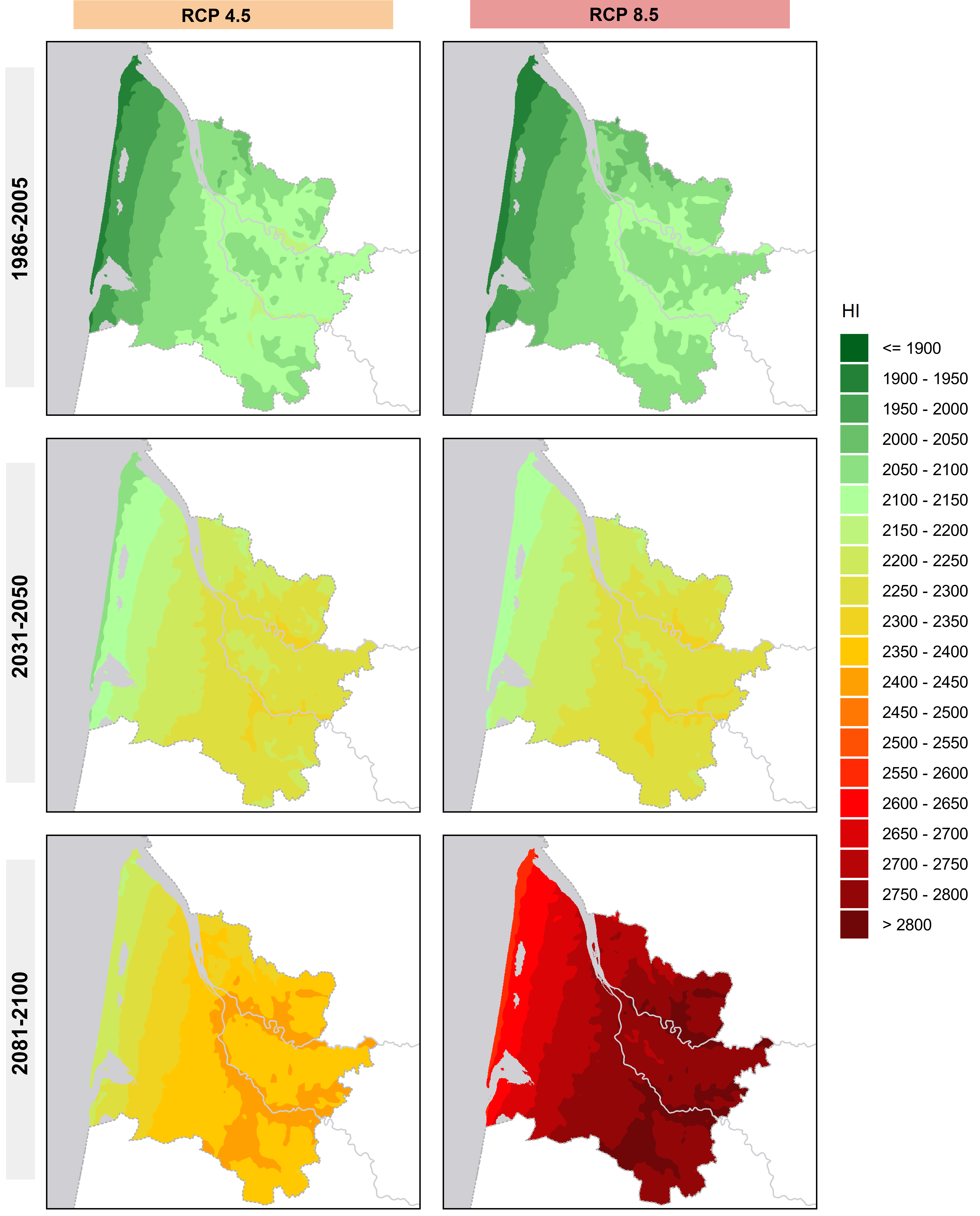
By using phenology models, it is possible to evaluate the consequence of this warming on the precocity of vine development. These models are particularly relevant for the so-called “mid-veraison” stage, when half of the grapes have started to ripen, and which is characterized by the softening of the berries as well as the beginning of sugar accumulation and, for red varieties, anthocyanins. For the Cabernet-Sauvignon grape variety, this stage is estimated to advance by 5 to 8 days by 2031-2050, and by 9 to 23 days by 2081-2100 (Fig. 9).
Figure 9- Forecast of the advance of mid-veraison (beginning of ripening period) for the Cabernet-Sauvignon grape variety, for two greenhouse gas emission scenarios (RCP 4.5 and RCP 8.5) and two time horizons (2031-2050 and 2081-2100)
(QUÉNOL et al., 2021).

The increase in temperatures and the intensification of drought episodes have so far been rather favorable to the quality of Bordeaux wines. It has become rare to lose a vintage due to a lack of maturity caused by low temperatures, as happened in the past, for example in 1972. Many recent vintages have been relatively dry, which explains the very good quality of most vintages since 2000. If temperatures continue to rise, Bordeaux winegrowers must nevertheless implement adaptations to continue producing exceptional wines, responding to the typicity of Bordeaux wines (VAN LEEUWEN and DESTRAC, 2017; VAN LEEUWEN et al., 2019). Many levers exist to adapt the Bordeaux vineyard to a climate that is gradually becoming warmer and drier. These levers concern the annual operations performed on the vine, the architecture of the training system, and the choice of plant material. Adaptations can be implemented progressively.
With the increase in temperature, grape ripening is reached earlier and earlier in the season and takes place under significantly warmer conditions. This is a direct consequence of the advance of mid-veraison (Fig. 9). As a result, overripe and cooked fruit aromas become more frequent, which can affect the freshness and complexity of the wines produced (VAN LEEUWEN et al., 2022). Anything that delays the time of ripening can mitigate this phenomenon. Regarding annual operations, it is advisable to reduce the use of severe leaf removal and to reduce the leaf area to fruit weight ratio. Increasing the height of the trunks allows to limit the maximum temperatures, while reducing the risk of spring frost. Pplanting of early clones with a high potential for sugar accumulation should be avoided, as they produce wines with too much alcohol. The most effective adaptation to limit a negative effect of high temperatures is to use later grape varieties. It is advisable to progressively increase the proportion of late grape varieties (Cabernet-Sauvignon, Petit Verdot, Cabernet franc) and to decrease the early grape varieties (Merlot) in the Bordeaux vineyard. In the longer term, the introduction of very late grape varieties from other wine regions can be considered. Experiments with a limited proportion of these varieties called VIFA (variety of interest for adaptation) are authorized since 2019 in the AOC Bordeaux and Bordeaux Superieur. In these appellations it is possible, under certain conditions, to plant Castets, Arinarnoa, Marselan and Touriga nacional (in red) or Liliorila and Alvarinho (in white), on a maximum of 5% of the surface of the farms. These varieties may not make up more than 10% of the final wine blend and may not be mentioned on the label or back label.
The intensification of the water deficit worries the winegrowers, but it should be remerbered that moderate water deficit is an essential condition for the production of great red wines. It is not by chance that the greatest wine-growing soils in Bordeaux are soils with low water holding capacity and that the greatest vintages are the driest. If we should not worry about the water deficit for the quality of red wines of Bordeaux, it may penalize the yields. It is therefore important to maintain it at moderate levels. Concerning the annual management of the constraint, it is possible to limit the leaf area by a lower trimming, or to thin out to reduce the volume of the harvest. Indeed, in a situation of strong water deficit, the photosynthesis of the vine is reduced and it is no longer able to bring a large crop load at a good level of maturity. When replanting, a decrease in planting density limits the transpiring surface of the vine per unit area, which allows to save water. The most efficient way to control water stress is through the choice of plant material. Cabernet-Sauvignon and Cabernet Franc are more resistant to drought than Merlot. In the choice of the rootstock, there is a wide range of possibilities, with 110R (still not widely used in Bordeaux) having the reputation of being very resistant to drought and Riparia Gloire de Montpellier, on the contrary, being very vulnerable. 420A is at an intermediate level and has the advantage of inducing less vigor than 110R. With a rainfall regime of 800 to 900 mm per year and limited water resources, irrigation is an option that, in Bordeaux, is neither necessary nor desirable (for environmental considerations).
GEOLOGY OF THE BORDEAUX WINE PRODUCTION AREA
GEOLOGICAL OUTCROPS
In the Bordeaux vineyards, there is a Tertiary substrate dating back some fifty million years (Middle and Upper Eocene). In the north of the department, on the right bank of the Gironde (Blayais), but also on its left bank, in the Médoc, various formations are found: marl and limestone of Blaye (Lutetian), limestone of Plassac (Ledian) and limestone of Saint-Estèphe (Ludian) which, laterally, changes towards the south to marly facies in the region of Listrac and Moulis. Among the more recent formations of the Oligocene (35 to 25 million years old), the so-called molasse du Fronsadais (Sannoisian), a soft and friable lime-holding rock, gives rise to calcareous soils of varied texture in Saint-Emilion and Fronsac. The so-called calcaire à Astéries (Stampian) forms the bedrock of the entire Bordeaux region since it outcrops in Bourg-sur-Gironde, in Libournais, in various points of the Entre-deux-Mers, but also on the left bank of the Garonne in Barsac and, locally, in the Graves and the Médoc. As for the molasse de l’Agenais (Oligocene), it is mainly found in the Entre-deux-Mers, above the calcaire à Astéries, and very locally in the Libournais. In the Graves region, the Aquitanian and Burdigalian (Miocene) are represented by faluns, i.e. siliceous and calcareous sands, locally very fossiliferous. These ancient formations were largely eroded and then partially covered by siliceous, gravelly-sandy alluvium, transported and deposited by rivers coming from the Pyrenees and the Massif Central. Thus, the Pliocene “gravel clays” can be found in the Côtes de Bourg, Cadillac Côtes de Bordeaux, Entre-deux-Mers, and in the western part of the vineyards on the left bank of the Garonne. But it is especially during the Quaternary era that the main part of the gravelly-sandy alluvium was deposited in Bordeaux: alluvial layers of the Isle river (Lalande-de-Pomerol, Pomerol, north-west of Saint-Émilion), of the Dordogne (south of Saint-Émilion and Graves de Vayres) and especially alluvial deposits of the left bank of the Garonne and the Gironde, broken up into small hills (so-called « croupes » by erosion, which constitute the bases of the Sauternais, Graves and Haut-Médoc. Other more or less recent deposits can be found: silt that has partially covered ancient sediments in the Côtes de Bourg, the Graves de Vayres, the Entre-deux-Mers and Lalande-de-Pomerol, and the sand of les Landes, which is of little interest to winegrowers, but which has often covered the quaternary gravel-sand alluvium of the Garonne and the Gironde to the west, thus diminishing its quality potential for producing fine wines. Finally, recent alluvial deposits, chemically rich and having a high water-holding capacity, occupy the bottom of the valleys and are still fed with silty-clay materials when the rivers flood (called palus). At the end of the 19th century, these soils could be submerged and helped fight phylloxera, hence ensuring the sustainability of Bordeaux wines. These soils are silty and very fertile in the immediate vicinity of the rivers, where a sort of natural dike emerges, called the “alluvial bulge”. A little further away from the rivers, the palus are much more clayey.
LINK BETWEEN GEOLOGY, QUALITY AND TYPICITY OF WINES
Concerning the soils, one may wonder if the underlying geological formations, called mother rocks, play a determining role in the quality of the wines. Most of the crus that have made the reputation of Bordeaux red wines (tab. 2) are established on quaternary gravel-sand alluvium of a siliceous nature (the gravels are made up for 80% of quartz and quartzites, accompanied by some black lydians coming from the Pyrenees and flints and limestones coming from the Massif Central). This is the case in most of the 61 Crus Classés of Haut-Médoc, almost all the Crus Classés of Graves (fourteen for red wines), also, for part, of two of the eighteen Premiers Grands Crus Classés of Saint-Émilion and finally of several crus of Pomerol where there is no classification but which sell their wines at very high prices. Nevertheless, these alluviums do not have the privilege of quality, since in Saint-Émilion, for example, it is possible to produce equally remarkable wines on the calcaire à Astéries (twelve Premiers Grands Crus Classés, partially or totally) or on the carbonated molasse du Fronsadais (nine Premiers Grands Crus Classés, partially or totally). Interestingly, the parcels of six Premiers Grands Crus Classés of the AOC Saint-Émilion are spread out on both calcaire à Astéries and molasse du Fronsdais, where soils and grape varieties are complementary (tab. 2). As for some very famous Pomerol crus, some of their parcels are established on very clayey sediments, included in alluvium. According to DUBREUILH (1995) these acid clays, rich in smectites, and the underlying sandy gravels correspond to the ancient detrital formation of the “Sables et argiles du Périgord” (Oligocene).
The same is true for white wines. On the gravelly-sandy alluvium, sweet white wines are produced in most of the Sauternes area. On the tertiary limestone, and in particular on the calcaire à Astéries, which is found here and there, dry white wines are produced in the Graves and sweet white wines in Barsac. In Pessac-Léognan, dry white wines are produced on faluns of theMiocene or Quaternary colluvial sands, more rarely on Quaternary gravel-sand alluvium. If they determine in part the intensity of the color, the aromatic and gustatory typicity of the wines, the geological formations and the soils which derive from them do not allow to explain the hierarchy of the crus in the Bordeaux area.
Table 2- Geological formations and classified growths of Bordeaux (red wines)

* According to the 1855 classifications of Saint-Emilion and Graves.
** Although there is no official classification in Pomerol, the wines mentioned can, by their selling prices, be assimilated to Classified Growths.
THE MAIN SOIL TYPES IN THE BORDEAUX WINE PRODUCTION AREA
GENESIS AND FUNCTIONING OF SOILS
Soils form on geological layers under the combined effect of the climate and the humus produced by the vegetation. This process is called “pedogenesis”, which can be translated as “the birth of a soil”. The type of soil that can be identified at a given location has inherited a number of characteristics from the geological bedrock, it but also depends on the type of vegetation, climatic conditions, and the duration of pedogenesis. Just as it is difficult to make a direct link between the nature of the bedrock and the quality of the wine, it is also difficult to link the type of soil with the quality of the wine produced. Indeed, the soil is a complex environment, which will affect the behavior of the vine in different ways. In the end, the effect of a winegrowing terroir on the quality and typicity of the wine can only be understood if we break down the effect of the natural environment on the functioning of the vine. In this approach, it is always important to place the vine at the center of the system. Geological, pedological or climatological approaches remain at best descriptive, but cannot explain the functioning of a vineyard. The main effects of the soil on the development of the vine and on grape ripening are threefold: (1) soil temperature, (2) water availabilityand (3) nutrient supply. Of these, nitrogen is the element that most influences vigor, yield, and grape composition (VAN LEEUWEN et al., 2018).
GRAVELLY SOILS
The gravelly soils have developed on quaternary alluvium. In the French soil classification they are called PEYROSOLS. They are very common in the Bordeaux region. They are found on the left bank of the Garonne in the Sauternes, Graves, Pessac-Léognan, Haut-Médoc, Médoc, Margaux, Saint-Julien, Pauillac, Saint-Estèphe, Moulis and Listrac appellations. In the geographical region of Entre-deux-Mers, it is found on the right bank of the Garonne in the appellations Cadillac Côtes de Bordeaux, Bordeaux, and Bordeaux Supérieur. In the Dordogne valley, they are found on the left bank in the Graves de Vayres and on the right bank in Saint-Émilion. Beautiful gravelly soils are located on the left bank of the Isle, a confluence of the Dordogne, in the appellations of Saint-Émilion, Pomerol and Lalande-de-Pomerol.
The PEYROSOLS warm up rapidly in spring. The water supply is not limiting at the beginning of the summer but can suddenly become deficient from the end of July in dry years (SEGUIN, 1975). Young vines, with a superficial root system, can suffer from excessive drought, to the point of losing part of their foliage. Maturation is rapid, which allows the cultivation of late grape varieties. Yields are generally low on this type of soil with low fertility. Nitrogen nutrition is usually not very limiting. When the subsoil has a sandy-clay texture, compaction phenomena reduce the rooting depth. If the texture is coarse over the whole depth, the roots can explore several meters of soil. The wines have an average alcoholic degree, rarely too high, and the total acidity is always lower compared to that obtained on other soils. The color of the wine is deep. Tannins are present and can be hard in young wine; they soften with aging. The main quality of the wine on gravel is its aromatic palette, which becomes extraordinarily complex with aging. This complexity can be explained by the combination of the effect of water deficit and a low nitrogen status of the vine (PICARD et al., 2017; LE MENN et al., 2018; VAN LEEUWEN et al., 2020). The wines have a very good length in the mouth and keep a remarkable freshness despite a high pH. These soils are ideally suited to the cultivation of Cabernet-Sauvignon, as is the case in the most prestigious crus of the Médoc and Pessac-Léognan. In Saint-Émilion, we find Cabernet franc and, more surprisingly, Merlot in Pomerol. The coupling of an early grape variety with an early soil type gives a unique typicity to the wines of this last appellation.
LIMESTONE SOILS ON HARD LIMESTONE
On the hard limestone formations of the Tertiary, and in particular the calcaire à Astéries of the Oligocene, superficial calcareous soils (superficial CALCOSOLS) have formed. They are found in Barsac, in the south of Graves, in the Côtes de Bourg, in the geographical region of Entre-deux-Mers and in particular in the sector of Grézillac, in Saint-Émilion, in Puisseguin-Saint-Émilion, in Montagne-Saint-Émilion, in Saint-Georges-Saint-Émilion, in Lussac-Saint-Émilion, in the AOC Castillon-Côtes de Bordeaux, Francs-Côtes de Bordeaux and locally in Médoc and in Margaux.
The CALCOSOLS on hard limestone warm up quite quickly in spring and are moderately early. The vines never suffer from excessive water stress, which is surprising considering the shallowness of the soil. It has been shown that the water contained in the calcaire à Astéries, which is not colonized by the roots, actively participates in the water supply of the vine through capillary rise (DUTEAU, 1987). This contribution can constitute more than 50% of the water absorbed by the vine during a dry summer. During periods of heavy rainfall, the calcaire à Astéries absorbs the excess water and there is no free water stagnation in the root zone. The result is a rather low but remarkably well regulated water supply. Nitrogen nutrition is moderate because the presence of active limestone limits the rate of mineralization of soil organic matter. The abundance of active limestone in the soil causes a significant risk of chlorosis: the absorption of iron by the vine is more difficult in the presence of an excess of calcium, which can, in extreme cases, manifest itself by a yellowing of the leaves. This problem can be avoided by choosing rootstocks with a strong resistance to active calcium.
The development of the vines is regular and harmonious, the vegetative cycle is moderately early. Yields are rarely excessive on this soil type. The wines have a relatively low pH, which makes their color bright and gives them great freshness to the mouth-feel. The risks of over-ripening are low and it is generally preferable to harvest fairly late. The wines of the plateau do not excel in the quantity of phenolic compounds (color and tannins), but the quality of their tannins is remarkable. The aromatic palette is discreet in young wines, but amplifies with aging, and it can reach a very great complexity. The length of the aftre-taste is impressive. These wines, which do not seem very powerful in their youth, age remarkably well. They reach the height of finesse and complexity on the limestone plateau in the immediate vicinity of Saint-Emilion, where this type of soil is present in twelve of the fourteen Premiers Grands Crus Classés. This type of soil suits well to Merlot, but also to Cabernet franc. There is no rootstock resistant to active limestone early enough to bring Cabernet-Sauvignon to maturity on a regular basis. This soil type is also very well suited to the production of white wines of great finesse and freshness, whether dry or sweet, as shown by many estates in Barsac.
LIMESTONE SOILS ON SOFT LIMESTONE
There are many outcrops of soft limestone in the Bordeaux region on which medium deep soils have developed (medium deep CALCOSOLS). The most represented belongs to the molasse du Fronsadais formation (Oligocene). It is located under the calcaire à Astéries and outcrops on the hillsides of Entre-deux-Mers, Saint-Émilion, Puisseguin-Saint-Émilion, Montagne-Saint-Émilion, Saint-Georges-Saint-Émilion, Lussac-Saint-Émilion, Fronsac, AOC Castillon Côtes de Bordeaux and Francs Côtes de Bordeaux. Other calcareous soils on soft bedrock are located in Pessac-Léognan, in the Médoc, the Haut-Médoc and in the communal appellations of the Haut-Médoc. The soils that have developed on the molasses du Fronsadais are generally shallower and more calcareous on the south-facing slopes than on those facing north.
The limestone soils on soft limestone bedrock exposed to the south and west give the vines a fairly high degree of precocity. The soils are moderately deep. The subsoil is generally compact, and the vine roots have difficulty exploring the molasse beyond a depth of 130 cm. This compaction of the subsoil is an asset, because it limits the soil water holding capacity. Part of the rainwater is evacuated by runoff, so that there can be small water deficits despite an often silty texture. Nitrogen availability is low at the top of the hillside and nitrogen is less limiting down the slopes, where the soils are deeper due to colluvium phenomena. On this soil type, grape ripening is regular and quite fast. The wines can have a high alcohol percentage, but reaching aromatic over-ripeness is less at risk than on gravelly soils. The wines have a beautiful bright color, due to a moderately low pH. The aromatic palette is dominated by the presence of fresh fruit. The tannins are powerful, “muscular”, but quite well coated. Merlot does very well on these soils, as does Cabernet franc. There is no rootstock resistant to active limestone early enough to bring Cabernet-Sauvignon to full ripeness on a regular basis. These soils are also very well suited to the production of white wines: in Pessac-Léognan and in the Graves, many famous crus produce excellent dry white wines on CALCOSOLS on soft bedrock.
On the molassic slopes exposed to the north and east, the phenological cycle of the vine is clearly less early, both because of the exposure and because of a texture where clay and silt dominate. The soils are more evolved, with little or no carbonate and quite deep (CALCOSOLS, BRUNISOLS, NEOLUVISOLS). Consequently, the water supply of the vine is not very limiting. Nitrogen supply to the vines is very low when the soil texture is clayey. This low level of nitrogen supply is a quality factor, because it guarantees the concentration of phenolic compounds in the grapes. In these situations, the challenge for wine growers is to reach a sufficient maturity to avoid producing hard or herbaceous wines. In this context, viticultural practices favorable to good grape maturity (controlled yields, leaf thinning, optimized leaf area) take on their full importance. On this soil type, the grapes are naturally concentrated but the maturity is late, so that for the production of red wine the choice is naturally oriented towards the early ripening Merlot. If the grapes are not optimally ripe at harvest time, the wines are at best hard and at worst herbaceous. If the grapes are ripe, the wines are concentrated with muscular tannins and age remarkably well. Their intense color evolves very slowly during aging due to a relatively low pH. These areas clearly benefit from the warmer climate in the context of climate change. The north-facing areas are also well suited to the production of dry white wines.
VERY CLAYEY SOILS
In the Bordeaux region, there are geological outcrops from the Tertiary period which are very rich in clay, often with a predominance of swelling clays (smectites). They are very present in Pomerol and in the north-western sector of Saint-Emilion, where they can be linked to the lower Oligocene stage. They are also found in the most prestigious vineyard of Sauternes, and in the gravelly alluvium of the appellations Saint-Julien, Pauillac and Saint-Estèphe. These are soils with remarkable properties, because if their extension is limited to a few hundred hectares in the whole of Bordeaux, they can be found in the very best growths of Bordeaux, whether in Pomerol, Saint-Émilion, Sauternes, Saint-Julien, Pauillac or Saint-Estèphe. If the clay is on the surface, which is rare, they are called PELOSOLS, whereas if the clay is found at depth, under a coarser texture, they are called PLANOSOLS.
The vine has a very particular behavior on this soil type. It only partially takes advantage of the apparent hydric and mineral richness of the soil because it is very irregularly exploited by the roots, which remain localized on the surface of the polyhedra of the structure by fragmentation. Consequently, the vigor of the vine is average to weak. The water supply is very well regulated: it is never excessive because the clay retains water very strongly but there is never severe water stress either (DUTEAU, 1982). The vine shoots stop growing early in the season, the berries are small and the grapes ripen quickly. Therefore, this cool soil paradoxically does not induce late ripening. Nitrogen nutrition is particularly low, which further increases the concentration of the grapes. Because of the rapid ripening, the grapes are very rich in sugars and phenolic compounds at harvest time. However, the total acidity is higher than on gravelly soils and the wines keep a good freshness, despite a sometimes high alcohol percentage. The wines are very colorful and the tannic structure is imposing, with well-coated tannins, giving a sensation of “fatness” to the tasting. In Pomerol, Merlot is often grown on this soil type, which produces opulent wines, but Cabernet franc also mathches very well, bringing more finesse, as evidenced by a famous cru located in the northwest of the Saint-Emilion appellation. In the communal appellations of the Haut-Médoc, Cabernet-Sauvignon is also grown and ripens perfectly well on this soil type, proving that the precocity is more induced by a limited water supply than by the soil temperature. The wines produced on clay, opulent and fat, blend perfectly with the wines produced on gravel, finer and more elegant. High quality sweet white wines can also be produced on this soil type, as shown by the most famous Sauternes cru. Dry white wines tend to be rich and fat, with a high alcohol percentage. They still retain enough freshness to give them a nice long finish.
SANDY SOILS
Sandy soils are very frequent in the Bordeaux region. They have two main origins: aeolian sands, transported by the wind over more or less long distances, and colluvial sands having slid down the slopes. Aeolian sands are found on the eastern side of the gravelly hilltops in the Haut-Médoc communal appellations and at the foot of the southern coast of Saint-Émilion. Colluvial sands can be found in dry valleys and at the bottom of the gravelly hilltops in the Médoc, Haut-Médoc, the Haut-Médoc communal appellations, in Saint-Émilion, in Pessac-Léognan, in the Graves and in Sauternes.
The sandy soils of eolian origin are warm, well drained and do not have a water table within reach of the roots. The rooting of the vine is deep, because there is nothing to prevent it from going deep. This depth of rooting limits the occurrence of water deficits, even if the texture of the soil is sandy. In the absence of limitations in water supply, the berries are rather big and the yields naturally high. Nitrogen nutrition is moderate and can be limited by using cover crops. Grass cover is thus a tool available to the winegrower to increase the concentration of the grapes on this soil type. The wines present a good level of maturity and finesse. The winegrower can obtain greater concentration by using appropriate viticultural and oenological techniques. In Saint-Émilion, on the foot of the hillside, Merlot is grown, but Cabernet franc is also remarkably successful. In the Médoc, Merlot, Cabernet franc and also Cabernet Sauvignon are grown successfully. In Pessac-Léognan, dry white wines of good quality are produced on this soil, especially with Sauvignon blanc. Colluvial sandy soils are not only cooler than sandy soils of aeolian origin, but also richer in water and nitrogen. As a result, the vines are vigorous and shoot growth continues late into the season. Yields are generally high, especially due to high berry weights. The grapes generally lack concentration. However, they can produce fruity wines, which are tasty in their youth and evolve relatively quickly. Their color is moderately intense and quickly takes on tile-like hues with aging. These wines do not excel with a long finish. Merlot does better on this soil than Cabernet franc or Cabernet Sauvignon, thanks to its precocity in the climatic conditions of Bordeaux. Dry white wines made from Sauvignon blanc can be succesfully produced on these soils.
SILTY SOILS
Silty soils are found in various places in the Gironde wine region and in particular on the plateaux of Entre-deux-Mers, in Lalande-de-Pomerol and in the Côtes de Bourg. They can cover the molasses de l’Agenais or the gravel of the Pliocene. In the Lalande-de-Pomerol appellation, and in particular in the commune of Néac, the gravelly terraces of the Isle alluvium are frequently covered with a layer of silt varying in thickness from a few dozen centimeters to several meters. The presence of silt on the surface can also result from a process of leaching, when the clay has been carried down by rainwater that has percolated through the soil profile. This is the case on the decarbonated molasses, on the north or east facing slopes. When the clay fraction of the silt has not been leached, which is quite rare in the rainy climate of Bordeaux, the clay soils belong to the BRUNISOLS. In NEOLUVISOLS weak leaching has taken place, and in LUVIOSOLS this leaching is more intense, and accompanied by an acidification. The latter almost without exception present a certain level of water logging. In the eastern part of Entre-deux-Mers, LUVISOLS have developed on the molasses de l’ Agenais. Often, the upper soil layer has disappeared by erosion, leaving the clay accumulation horizon exposed. The soil can then contain more than 30% of clay practically from the surface.
A silty soil can hold a large amount of water and give it up easily to the vine. Therefore, a silt soil is a cool soil in which the water supply is little or not limiting. The vine’s bud break is late and its vigor tends to be excessive. The shoot growth continues late in the season. These conditions are not favorable to the production of a high quality red wine. Only a limitation of the nitrogen supply, imposed by a competitive cover crop, allows to contain the vigor and the productivity of the vine and thus to improve the qualitative potential of the grapes. On these late ripening soils, Cabernet franc and Cabernet-Sauvignon often lack maturity.. Merlot is the preferred red grape variety and should be planted on a rootstock indusing low vigor. When a quality viticulture is implemented on silty soils, and in particular a row spacing equal or inferior to 2 meters to optimize the interception of sunlight, the wines are well constituted and pleasantly fruity, with an average ageing potential. The precocity and water supply associated with silty soils are well suited to the production of aromatic white wines, in particular with Sauvignon blanc.
PODZOSOLS (BLACK SAND)
When very intense leaching conditions are met, combining winter rainfall, coarse-textured filtering substrate and acidifying vegetation, the soils can evolve towards PODZOSOLS. These very acid soils are characterized by the destruction of clay minerals and a leaching of their constituents (silica and aluminum oxides and hydroxides), as well as by a leaching of organic matter. The iron, aluminum and organic matter precipitate in the subsoil in a horizon called “alios”. Because of the high acidity of these soils, the organic matter mineralizes very slowly and tends to accumulate in the surface horizon which has a very dark, almost black color. These soils can only develop on very filtering substrates, composed of sand or gravel, and not carbonated. They are frequently affected by more or less important water logging. When they are cultivated, they are almost always limed to combat acidity, which can cause toxicity of certain minerals (aluminum and copper in particular). The resulting increase in pH strongly stimulates microbiological activity and is accompanied by the release of large quantities of mineral nitrogen, sometimes for several decades. This results in an excess of nitrogen supply, which is detrimental to the production of quality red wines. PODZOSOLS can be found on the western fringe of the left bank vineyards (Sauternes, Graves, Pessac-Léognan, Haut-Médoc, Médoc and Haut-Médoc communal appellations). They are also found in the North Blayais.
The potential for producing high quality red wines on PODZOSOLS is extremely variable. This potential is stronger on PODZOSOLS cultivated with vines for a long time, because they are less subject to excess nitrogen supply. It is weak for sandy PODZOSOLS with the presence of a water table, where only Merlot can give more or less suitable results for red wine production. On the other hand, excellent red wines can be produced on gravelly PODZOSOLS, provided that the water table drops early enough during the season and that an old cultivation limits the risk of excessive nitrogen supply. In the latter, very nice wine can be produced with Cabernet-Sauvignon. The sandy PODZOSOLS have a very good potential for the rpoduction of aromatic dry white wines with the Sauvignon blanc grape variety (especially in the north of the Blayais).
SOILS WITH TEMPORARY WATER TABLE
There are many wine-growing soils in the Bordeaux region that have a water table in winter, but which disappears during the summer. The presence of a temporary water table causes an alternation between reduction and oxidation conditions in this soil, which explains their name of REDOXISOL. In these soils, the iron is partially in oxidized form and partially in reduced form, which gives a characteristic variegated color, where patches of gray color alternate with rusty spots (so-called « mottling »). The quality potential of these soils is closely related to the time when the water table disappears. If there is no more free water within reach of the roots at the end of May, water deficit can set in and it is possible to produce excellent red wines, especially if the soil texture is gravelly-sandy. It has even been shown that the presence of a temporary water table in winter limits the rooting depth of the vine and can thus increase the frequency of occurrence of water deficits in summer. On the other hand, when the water table disappears too late in the season, there is little chance of water deficit developing. In this case, the potential to produce a high quality red wine is low. In these soils, it is essential to know the dynamics of the water table, which can be evaluated with a piezometer. When the water table disappears too late in the season, the evacuation of the free water can be accelerated by the installation of a drainage system.
SOILS WITH A PERMANENT WATER TABLE
When the presence of free water is permanent during the year, the conditions of reduction prevail over the conditions of oxidation. We speak then of REDUCTISOLS. They are characterized by the presence of a uniformly gray, waterlogged horizon at depth. These soils have a very low viticultural vocation and should be excluded from AOC areas. The vigor of the vine can be either excessive, because of a never limiting water supply, or very weak, if the water table is close to the surface and causes root asphyxia. Even drainage cannot transform them into good vineyard soils, because it would lower the water table without making it disappear. The vine will then plunge its roots deeper, to find the water table and consequently non-limiting water supply conditions. These conditions are less penalizing for the production of a dry white wine than for the production of red wine.
THE SOILS OF THE PALUS
In the lower flood valley of the rivers, we find soils that are called FLUVIOSOLS or “palus soils”. Two types can be distinguished. In the immediate vicinity of the river is an alluvial bulge composed of very silty and fairly well drained soils. These soils are rich, both for the supply of minerals and for the supply of water. Corn can be grown here without irrigation and very high yields can be achieved. When vines are planted, they are vigorous and produce abundantly light, fruity wines without great pretension. A little further away from the river, in a depression located behind the alluvial ridge, the soils are much more clayey. If they are strongly water logged, the vines suffer from asphyxiation and struggle to grow properly. If the water logging is not too pronounced, the wines produced are surprisingly concentrated, but often lack finesse. On the eastern fringe of the Médoc vineyard, the plots located on this type of soil are most often classified as Bordeaux or Bordeaux Supérieur appellation. Despite the fact that these soils do not induce an early maturity, the association Petit Verdot on Riparia Gloire de Montpellier is particularly successful.
THE MAIN TERROIRS BY REGION OF PRODUCTION
THE HAUT-MÉDOC AND ITS COMMUNAL APPELLATIONS
The Haut-Médoc has variable climatic conditions following an east-west gradient. Near the Gironde estuary, the climate is temperate. Maximum temperatures are lower than elsewhere in the Gironde wine region, but minimum temperatures are higher. The thermal sums accumulated during the vegetative season are relatively high, which leads to an early cycle of the vine. As one moves westward from the Gironde, the daily thermal amplitude increases and the climate becomes globally a little less warm. The risk of spring frosts increases rapidly. The soils are predominantly gravelly, with the highest percentages of coarse elements on the top of the hills (PEYROSOLS), and are the emblematic soils of this region. The eastern part of the ridges may be flanked by a deposit of aeolian sands (ARENOSOLS of aeolian origin), also with a high quality potential, and the dry valleys located between the ridges are filled with colluvial sands (ARENOSOLS of colluvial origin). The latter can present a certain degree of water logging and have a lower quality potential. Within the gravelly alluvium, we find clay lenses (PLANOSOLS), particularly in the eastern part of the communes of Margaux, Saint-Julien, Pauillac and Saint-Estèphe. These very clayey soils have an exceptionally high quality potential. The proportion of clay soils is higher in Pauillac and Saint-Estèphe than in Margaux. On the western fringe of the Haut-Médoc, we find podzolized soils (PODZOSOLS). Their quality potential is very good if they are gravelly, but more limited if they are sandy. Calcareous soils (CALCOSOLS), on hard or soft bedrock, can also be found in the communes of Moulis, Listrac and Saint-Estèphe, but also more locally in Margaux and Pauillac. Their quality potential varies from fairly good to very good, depending on the level of water deficit they induce.
THE MEDOC
Despite its geographical proximity to the Haut-Médoc, the climate of the Médoc is very different (Fig. 5). Located between the Atlantic Ocean and the Gironde estuary, the Médoc is characterized by a cool and very buffered climate. Consequently, the vine cycle is rather late (Fig. 6). Merlot is much better adapted to these conditions than Cabernet-Sauvignon, which has difficulty reaching satisfactory maturity on a regular basis, except on the best gravelly hilltops. The soils of the Médoc are very variable. Most of the soils of the Haut-Médoc are found here, but the proportion of calcareous soils, on hard or soft limestone, is much higher.
THE GRAVES AND PESSAC-LÉOGNAN REGION
The climate of Graves and Pessac-Léognan is characterized by temperatures and rainfall that are slightly higher than the average for the Bordeaux region. In particular, the vineyards of Pessac-Léognan benefit from the heat island formed by the urban area of Bordeaux and are among the earliest in the Gironde. The soils are very diversified, due to a complex geology. The quaternary alluvial deposits of the Garonne have left gravelly hills (so-called « croupes ») on which PEYROSOLS have developed, with an excellent quality potential for the production of red wines. Between the gravelly hilltops, there are sandy soils (colluvial ARENOSOLS) at the bottom of dry valleys, with a more limited quality potential. The sandy PEYROSOLS and ARENOSOLS show a tendency to podzolization on the western fringe of the Graves and Pessac-Léognan appellations, which can induce an excessive nitrogen supply. On the geological formation of Miocene faluns, the soils can be either very clayey (PLANOSOLS) or calcareous (CALCOSOLS). These soils have very good potential for the production of red wines, when associated with the Merlot grape variety. The CALCOSOLS are the soils of choice for the production of dry white wines. In the south of the Graves, near Barsac, calcaire à Astéries is found, on which superficial CALCOSOLS have developed. These soils have an exceptional potential for the production of dry white wine and a very good potential for the production of red wine. The Merlot grape variety is preferred here, as the Cabernet-Sauvignon gives wines that are certainly racy, but that need a long aging to deliver.
SAUTERNES AND BARSAC
Sauternes benefits from a warm climate, which favors precocity. The Ciron, a tributary of the Garonne, generates humidity that increases the frequency of morning fog, necessary for the development of noble rot. The emblematic soils of Sauternes are the gravelly soils that develop on the quaternary alluvial terraces of the Garonne (PEYROSOLS, fig. 10B and 10C). In certain crus, and in particular in the most famous of the AOC, one also finds very clayey soils on Tertiary deposits (PLANOSOL, fig. 10D). The Sauternes appellation also includes large areas of sandy soils, which may be more or less podzolized (sandy ARENOSOLS or PODZOSOLS). Barsac, whose wines can be marketed under the name of the commune or under the Sauternes appellation, has a majority of calcareous soils (superficial CALCOSOLS, Fig. 10A) on calcaire à Astéries. On these soils, which produce fine and elegant red wines in Saint-Emilion, it is surprising that also sweet wines full of finesse, freshness and elegance are produced. They are often a little less powerful than the wines of Sauternes.
Figure 10 – Percentage of the different granulometric fractions according to the depth for the main soil types of Sauternes: A) superficial CALCOSOLS (calcareous soils on hard limestone); B and C) PEYROSOLS (gravelly soils) and D) PLANOSOL (very clayey soil).

FRONSAC, SAINT-ÉMILION AND ITS SATELLITES
The Libournais is characterized by a relatively warm climate, especially near the city of Libourne, on the southern slopes of the Saint-Emilion limestone plateau and in Pomerol. The climate becomes progressively cooler towards the north-east of the area, where the satellite appellations of Saint-Émilion are located (de RESSÉGUIER et al., 2020). Rainfall is lower than on the left bank of the Garonne, but the differences are mainly in winter rainfall, which does not affect the quality of the wine.
The heart of the Saint-Émilion appellation is composed of a plateau of calcaire à Astéries, which is dominant in the landscape (fig. 11). On this plateau we find superficial CALCOSOLS, where wines of a rare finesse are produced (fig. 12D). These wines do not excel in power and are therefore often undervalued in en primeur tastings, but they develop an extraordinary complexity and tannins of great elegance with bottle age. On the calcaire à Astéries, some remnants of molasses de l’Agenais (Aquitanian) have locally resisted erosion, giving rise to soils that are more clayey and deeper on which more powerful wines are produced, but which do not achieve the same elegance. Below the calcaire à Astéries (Stampian) are the molasses du Fronsadais, a tertiary formation dating from the Sannoisian ear. Where these molasses outcrop on south-facing slopes, medium-deep CALCOSOLS are found (Fig. 12A). These are excellent vineyard soils, on which Merlot and Cabernet franc are successful. The wines are more powerful than those produced on the calcaire à Astéries. The two types of wine blend particularly well, and several Premiers Grands Crus classés are located on both formations. The molasses exposed to the north are more evolved on the pedological level and the soils are silty-clayey and most often decarbonated (BRUNISOLS, NEOLUVISOLS, LUVISOLS, COLLUVIOSOLS). They produce powerful and concentrated wines, but which can have a certain rusticity if grapes are not harvested at complete maturity, which is more and more rare in a context of global warming. They age remarkably well. The wind has covered the foot of the southern slope of Saint-Emilion with sand (ARENOSOLS of aeolian origin, fig. 12C). These soils are deep and quite warm, without any risk of water logging. They are well suited to Merlot and Cabernet franc. The wines show naturally lots of finesse, but are not very concentrated. This concentration can be obtained thanks to specific viticultural and oenological techniques.
The valley floor of the Dordogne river south of the town of Saint-Emilion is composed of soils mostly sandy. Because of a very flat topography, these soils frequently suffer from water stagnation (ARENOSOLS, REDOXISOLS and REDUCTISOLS). The wines produced here are fruity but do not have the potential for long aging. Between these sandy soils and the lower flood plain of the Dordogne river, a belt of gravelly soils is located, which stretches from the suburbs of Libourne to Vignonet (PEYROSOLS). The wines produced here are rich and characterized by a great aromatic maturity.
The north-east of Saint-Emilion is located in the Isle valley, in the immediate vicinity of the Pomerol appellation. The soils are gravelly (PEYROSOLS, fig. 12B) or sandy (ARENOSOLS, sandy REDOXISOLS). In the best estates of this sector, we also find very clayey soils (PLANOSOLS, fig. 12E). There is an obvious synergy in the blending between the wines produced on PEYROSOLS, endowed with an outstanding aromatic complexity, and the wines produced on PLANOSOLS, concentrated, powerful, with velvety tannins.
On the satellites of Saint-Émilion (Montagne-Saint-Émilion, Saint-Georges-Saint-Émilion, Puisseguin-Saint-Émilion and Lussac-Saint-Émilion) we find CALCOSOLS on calcaire à Astéries and on molasses du Fronsadais. This sector is a little cooler than the plateau of Saint-Émilion. Excellent wines are produced here and it is a sector which benefits from the global warming. On the north of the AOC Lussac, we leave the limestone formations and we find NEOLUVISOLS which have developed on detrital formations. The wines do not have the same finesse as those harvested on the limestone soils.
In Fronsac, limestone soils on calcaire à Astéries and molasses du Fronsadais predominate. The wines are powerful and acquire a lot of complexity with aging. The wines of Fronsac are currently underestimated, probably because they are backward in their youth and require a few years of bottle aging to soften their tannins.
Figure 11- Geological section through the regions of Saint-Emilion and Pomerol

Figure 12 – Percentage of the different granulometric fractions according to the depth for the main soil types of Saint-Emilion and Pomerol:
A) medium-deep CALCOSOLS on molasses du Fronsadais; B) PEYROSOLS (gravelly soils); C) ARENOSOLS (sandy soils) ;
D) superficial CALCOSOLS on calcaire à Astéries and E) PLANOSOLS (very clayey soils).

POMEROL AND LALANDE-DE-POMEROL
Pomerol is one of the warmest places in the Bordeaux wine producing area (BOIS et al., 2018; de RESSÉGUIER et al., 2020). The appellation is located on the alluvium of the Isle River, a tributary of the Dordogne. The gravelly alluviums are well layered, which ensures their good drainage (PEYROSOLS, Fig. 12B). Locally they are thin and the vine can then colonize the underlying Oligocene clays (PLANOSOLS, fig. 12E). The originality of Pomerol is to couple an early grape variety (Merlot) with an early ecosystem. However, Cabernet franc is also very successful here and, even if it is currently practically absent, there is no objective reason why Cabernet-Sauvignon cannot also produce great wines, especially in a context of global warming. The great Pomerol wines produced on clay soils have a natural concentration and power, combined with velvet tannins. The Pomerols produced on gravelly soils are very greedy. The western part of Pomerol has sandy-gravel soils; the wines are less concentrated. In Lalande-de-Pomerol, the soils are very gravelly (PEYROSOLS). The wines are tender and elegant, but not destined for long ageing. Towards Néac, the gravelly soils are often covered with silt. On this last commune, there is also a high proportion of clayey-silt soils with local water stagnation (BRUNISOLS, NEOLUVISOLS, RÉDOXISOLS). The wines produced here are powerful and blend well with the wines produced on gravelly soils.
THE CÔTES DE BORDEAUX
The Côtes de Bordeaux is a group of small regions that are geographically dispersed, but have enough common characteristics to be grouped together in the same appellation, with the exception of the Côtes de Bourg, which decided to keep its autonomy. The Côtes border the right bank of the Garonne (Cadillac Côtes de Bordeaux), the Gironde (Blaye Côtes de Bordeaux and Côtes de Bourg) and the Dordogne (Castillon Côtes de Bordeaux and Francs Côtes de Bordeaux). The Côtes de Bordeaux benefit from a warm climate, especially for the plots located near the Garonne, the Dordogne and the Gironde estuary. The base of the Côtes is made up of calcaire à Astéries, on which superficial CALCOSOLS or BRUNISOLS have formed. Beneath the calcaire à Astéries are the molasses du Fronsadais, which have given rise to moderately deep CALCOSOLS. These limestone soils produce excellent wines, which are complex, have a lot of freshness and age remarkably well. In Cadillac Côtes de Bordeaux, there is a gravelly Pliocene terrace above the calcaire à Astéries. In Cadillac Côtes de Bordeaux and Côtes de Bourg, the soils are more silty at greater distance from the river. The wines produced here are fruity, but do not possess the breed of wines produced on limestone and gravelly alluvium. In the North Blayais, we find black sands (PODZOSOLS), which have a very interesting potential for the production of aromatic white wines with the Sauvignon blanc grape variety.
THE ENTRE-DEUX-MERS REGION
The geographical region of Entre-deux-Mers is located between the Garonne and the Dordogne. The region owes its name to the tide, which flows up the Garonne to Langon and up the Dordogne to Castillon. It is a vast region, which produces almost half of the wine volumes of the Bordeaux region. The Entre-deux-Mers appellation exists only for dry white wines, and only small volumes are declared under this appellation. The vast majority of the production, both red and white, is marketed under the Bordeaux (white and red) or Bordeaux Supérieur (red only) appellations. Traditionally, Entre-deux-Mers produced mainly white wine, but gradually the planting of red grape varieties for the production of red wines has become the majority. The thermal amplitude is rather low in Entre-deux-Mers. The minimum temperatures are slightly higher than the average for the department, but the maximum temperatures are lower, with the exception of the sites near the Dordogne and Gironde corridors. The eastern part of the area has relatively little rainfall. In such a large region, it makes sense that the soils are very diverse. On the plateaus of Entre-deux-Mers, the soils are silty (BRUNISOLS) and often present a more or less intense clay leaching (NEOLUVISOLS or LUVISOLS). These soils induce a late ripening and good red wines can only be produced with the Merlot grape variety, provided that careful viticultural techniques are used, such as planting with a spacing of less than or equal to two meters between rows to optimize the interception of solar radiation. It is possible to produce fresh and fruity dry white wines. In the eastern part of the region, the leached soils are often truncated, exposing the clay accumulation horizon. These soils are more interesting for the production of red wines, which tend to be relatively concentrated. Merlot is the preferred grape variety. Near the Cadillac Côtes de Bordeaux AOC, occasionally gravel soils on Pliocene terraces can be found, which have very good potential for red wine production. There are also limestone soils, sometimes on hard limestone, particularly in the Grézillac area. These soils have an excellent quality potential, both for the production of red and dry white wines. The fact that these wines are produced within the framework of a generic appellation clearly penalizes their access to a stronger reputation.
CONCLUSION
The Bordeaux region has a certain degree of climatic variability. The warmest areas are located along the Garonne, Dordogne and Gironde rivers, in the appellations of Saint-Emilion, Pomerol, Côtes de Bourg, Cadillac Côtes de Bordeaux, Sauternes, Graves, Pessac-Léognan and the communal appellations of Haut-Médoc. The vast majority of these appellations are the most renowned in Bordeaux for the quality of their wines. A wide variety of soils have developed in the Bordeaux region on bedrock dating from the Quaternary and Tertiary periods: gravelly-sandy soils, calcareous soils on hard or soft bedrock, clayey soils, sandy soils and silty soils. Some soils are characterized by the presence of a temporary or permanent water table within reach of the roots, others by podzolization phenomena. All these soils do not have the same potential for the production of great wines. The organoleptic characteristics of the wines vary according to the soil and the parent rock, but can also be different according to the vintage and the grape variety.
In temperate climates, the best red wines are obtained from grapes that just achieve full ripeness under the local climatic conditions: this is the case of Pinot noir in Burgundy, Cabernet and Merlot in Bordeaux. A complete ripening of the grape and its skin is essential but it must be slow and progressive, since, as the famous Bordeaux oenologist Émile Peynaud pointed out : « a too fast ripening, under warm climatic conditions,, has the effect of “burning the essences” which make the finesse of great wines ». It is therefore essential to choose grape varieties and rootstocks according to the regional climate but also according to the hydric and thermal microclimate of the soils, especially for Cabernet-Sauvignon in the Bordeaux climate. In Bordeaux, it appears that the chemical properties of the soils, which can be (and have been) modified by mineral or organic fertilizers, do not seem to have a determining influence on the qualitative hierarchy of the estates, which is generally reflected in the price of the wines. This observation holds true, provided that the vines do not suffer from toxicities or serious deficiencies and, conversely, that an excessive mineral supply to the vines does not lead to high yields and big berries. The only nutrient that the vine takes from the soil and that has a determining effect on its vigor, its productivity and the composition of the grapes is nitrogen. The nitrogen nutrition of the vine is largely influenced by the soil type, but it can be modulated by man through fertilization or vineyard floor management.
Great terroirs regularly produce fine wines that are harmoniously balanced and, above all, have a marked freshness in the mouthfeel. In this context, the soil plays a role in limiting, but not completely eliminating, the consequences of rainfall variations, characteristic of the oceanic climate of Aquitaine. The best terroirs in Bordeaux are those which, by their topography, the texture and structure of their soils with the resulting consequences on their permeability, their aeration, their rooting depth, attenuate the unfavorable effects of a very long drought or, what is more detrimental, those of too much rainfall. There seems to be an optimum level of water supply to the vine that allows the production of quality (red) grapes. It should not be excessively low because photosynthesis would be impaired; it can even lead, in extreme cases, to defoliation and berry shrivel. It should not be too high either, because the vines are then vigorous, with a late growth cessation: the berries are bogger, lower in sugar concentration, higher in organic acids (especially malic acid) and the wines low in phenolic compounds, notably because the skin to pulp ratio of the berries is low. In the case of excessive rainfall, during the ripening of the grapes, the berries can burst, which leads to the development of Botrytis. In the best crus established on gravelly-sandy alluvium, on certain limestones or certain clays, this regulation of the water supply at a rather low level is based on a conjunction of various natural factors, sometimes apparently opposed, but which man can hardly modify or recreate.


