Tell me about yourself and the Vauthier family
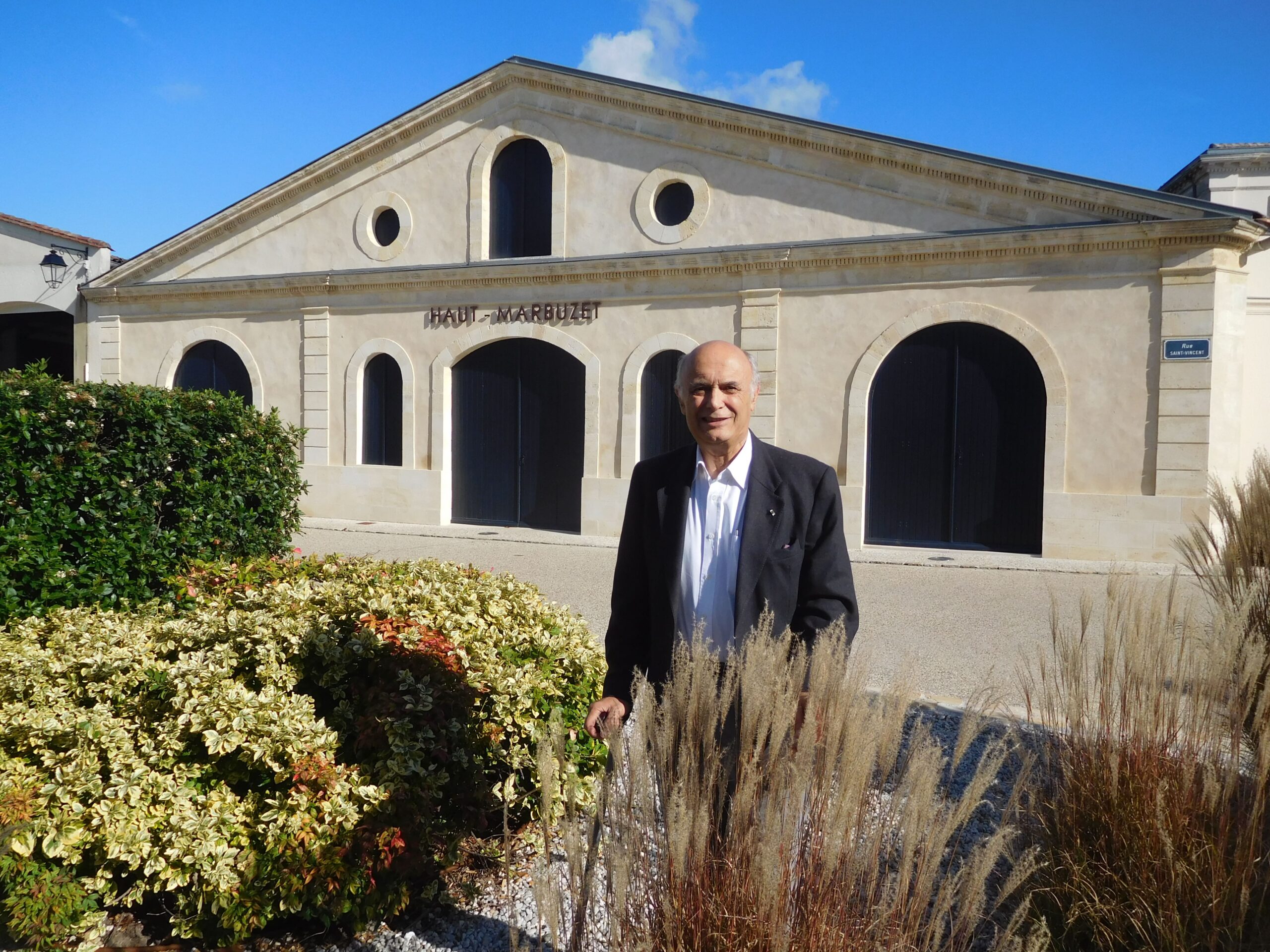
The Vauthier family has owned Château Ausone since the end of the 16th century, and I represent the eleventh generation at the head of this cru. Our trade is deeply rooted in the land: we are owners and winegrowers, farming five crus. The family business is run today by my father, Alain Vauthier, alongside two of his children, Constance and me.
After a BTS in viticulture and oenology at the agricultural school in Blanquefort, I continued my studies at a business school specialising in wines and spirits in Bordeaux. My career then took me abroad for five years, where I worked for an Asian wine and spirits import and distribution group, between the Philippines and Shanghai. This experience gave me an international view of the market. Since 2019, I have been co-manager of the family properties, with responsibility for development.
Tell me about the career of Constance, your sister and co-manager?
Constance has a rather atypical career. She first took a preparatory class in agronomy and veterinary science before entering the veterinary school at Maisons-Alfort. She then practised for seven years as a vet specialising in horses.
In 2020, she chose to change careers, dividing her time between engineering training in Bordeaux and the vineyard, where she took her first steps at harvest. Since 2021, she has been in charge of administration, legal aspects, and the restructuring, works and Research & Development department, which had been put somewhat on hold while the handover was organised. Her scientific eye, her rigour and her love of the living world bring a new dynamic to improve our wines still further.
Since 2023, we have continued to share all the technical and operational decisions, in the vineyard as in the cellar with our teams.

How important is R&D to you?
Research and development have been an integral part of the winegrower’s trade for millennia. Farmers have always selected the most productive, highest-quality or most resistant plants. Today, scientific advances allow us to go even further in this understanding.
For example, we study our plant material by selecting clones of Cabernet Franc and Merlot, but with more precise tools such as genetic analysis or phenological monitoring. Of course, our main selection criterion remains very personal and empirical: overall observation of the vine, tasting the grape and above all tasting the wine. The aim is to identify the vines that offer a good leaf-to-fruit balance and that will yield exceptional grapes, both for today and for future generations.
With Constance, we have relaunched this selection work, looking for vines that show less sugar, a little more acidity, but always the same harmony. And if, in addition, they offer assets such as later budburst or better resistance to downy mildew, that is ideal! That is what R&D is: identifying challenges, asking the right questions and finding solutions to them. And it is truly fascinating.
In Bordeaux, we are fortunate to be able to count on a solid scientific community. Moreover, this research is not limited to our vineyards, and I am delighted to see that many winegrowers are also investing in it. This quest for new clones is essential for adapting to climate change and continuing to produce wines we love… and which, let’s be honest, we hope will be better than the others! (laughs)
We naturally share the fruits of our research, in particular on frost protection and water management. We are also running several trials to combat downy mildew better, testing ever more effective spraying and treatment techniques, which is all the more crucial in organic farming. Finally, we analyse and taste enormously in order to refine each stage of winemaking, whether it concerns press handling, the management of free-run juice or extraction at the end of alcoholic fermentation under a submerged cap.
As you will have understood, R&D is essential, not only to guarantee the constant quality of our wines but also to pass on a healthy vineyard, maintained by proven and validated techniques.
How do you characterise the Ausone spirit?
The Ausone spirit is above all the legacy of eleven generations of know-how, applied with the same rigour across all of our crus. Whether it is Châteaux Simard, Haut-Simard, Moulin Saint-Georges, Fonbel, La Clotte or, of course, Château Ausone, we bring the same attention to each of them, with a shared philosophy. One team, one culture, one agriculture… one spirit for a unique signature.
But the Ausone spirit is also a certain discretion, cultivated over three generations. Here there is no staging and no fashion effect: our priority remains our trade, our vines and our wines. I fully embrace this approach, far from flashiness. What I like is to see moss settle on the north-facing walls, or grass appear spontaneously between the rows of vines. It does no harm at all to the quality of the wines; on the contrary, in some vintages or on some plots it can even be valuable to us.
This exceptional quality is the fruit of an ecosystem that is preserved and cherished, but also of an essential value passed on by our parents: the taste for effort.
What gives Ausone its status as a timeless cru?
The quality of Ausone’s soils remains immutably the same, whereas planting, cultivation and winemaking evolve and progress. It is a difficult question, because it involves constant choices and changes. Yet we are deeply attached to the idea of preserving a centuries-old heritage. In that respect, certain landmarks remain unchanged, such as the label or the ageing in the quarry, which have endured for more than a century. It seems to me that the soul of Ausone lives on in a fine balance between tradition and adaptation.
Let us come back to current affairs: in your view, when did the disaffection with Bordeaux wines begin?
We need to talk about the en primeur system, which remains our main mode of distribution. Things became complicated, even deteriorated, from the moment too many crus joined this system. In the 1970s, about forty châteaux took part in en primeur; in 2010, there were more than 300. The offer became too large for the system to work properly and for the négociants to really add value to the wines. Many no longer had the time or the desire to tell the story of each cru, which gradually distanced consumers and therefore importers. The dialogue was lost, and with it the interest in Bordeaux.
Another factor was the massive increase in volumes at certain producers, which went from 10,000 to 100,000 bottles in less than twenty years, making it harder for the market to absorb them. Finally, second wines or sub-brands, in my view, have in some cases done Bordeaux a disservice by blurring the perception of the great wines. Our father has always been opposed to this type of second wine when they use the name of the cru without coming from the property’s historic terroir.
What about en primeur in this context?
I am totally in favour of keeping it. My sister and I are winegrowers, and each has their own trade: négociants are merchants. Our role is to explain our wines to them, but it is up to them to provide the service and responsiveness that we, as winegrowers, cannot always ensure. As our father used to say: “I know how to make wine; the négociants know how to sell it.”
Today the market is self-regulating and, even though the phase is painful, it will surely clean up the en primeur system by refocusing it.
And the négoce in all this?
The négoce remains above all a very efficient commercial organisation. The concentration of available crus has led to a loss of efficiency in their communication and in their relationship with certain importers.
The négoce had too many crus to sell and forgot to go door to door with a good narrative. It has to reinvent itself and go back to see its customers face to face. A good salesperson will be more effective with 200 references than with 1,000! There has been a strong decorrelation, a definite decoupling between the market, the négoce and the properties – or the “châtelains”, as I hate being called (laughs).