The merit of an estate, beyond a single vintage
The Michelin Grapes do not distinguish a particular cuvée or vintage, but assess an estate as a whole: its know-how, the personality of its wines and its ability to maintain a high level of quality over successive harvests.
This approach joins a long Féret tradition which, as early as 1850, with the first edition of the work Bordeaux et ses vins, ranked the Bordeaux crus “in order of merit”. In both cases, it is the value of a property over time that is appreciated, beyond one-off successes.
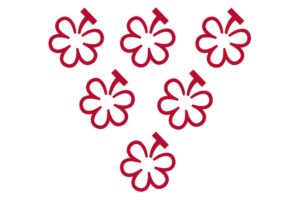
Three grapes honour exceptional producers, whose quality inspires confidence whatever the vintage. Two grapes distinguish remarkable excellence and consistency; one grape rewards producers of great quality, making wines of character and strong identity.
To establish this hierarchy, Michelin uses five criteria: the quality of the agronomy, the technical mastery of winemaking, the identity of the wines, their balance and their qualitative consistency.
The assessment covers several vintages, including difficult years, and also takes into account the wines’ ageing ability. An exceptional harvest can reveal a great wine; it is consistency that makes it possible to recognise a great estate.
The evaluations are entrusted to an international team of specialist Michelin inspectors, drawn in particular from sommellerie, wine criticism and production. They visit the properties, observe the vineyards and taste the wines. The distinctions are then awarded collegially, according to a principle of independence claimed by the Guide.
Although the identity of the inspectors who drew up this first Bordeaux ranking has not been revealed, it should be recalled that the Michelin group has also owned, since 2019, Robert Parker Wine Advocate, whose critics, William Kelley and Yohan Castaing, have recently followed many Bordeaux crus. And although Michelin has not specified to what extent its inspectors draw on their work, one may suppose that their comments, accumulated over the vintages, constitute a precious critical memory of the properties and their evolution.
Rediscovering the spirit of 1855, without its immobility
This approach recalls, in some respects, the one that presided over the establishment of the famous 1855 classification.
On the occasion of the Paris Universal Exposition, the Bordeaux brokers were tasked with establishing a hierarchy of the grands crus. Their assessment then rested essentially on the level of prices durably obtained by the wines on the market.
The kinship with Michelin 2026 is plain: in both cases, the aim is to appreciate the value of a property over time, and not the one-off success of a harvest. But where the 1855 brokers recorded a commercial hierarchy, Michelin today offers a qualitative evaluation, necessarily more subjective.
The 1855 classification remains one of the most remarkable promotional instruments the Bordeaux vineyard has ever known. Its stability, legibility and prestige have contributed greatly to its international influence.
But this permanence also has its limits. For one hundred and seventy years, the areas of properties have changed, owners have succeeded one another, and cultivation and oenological practices have been profoundly transformed. Some crus have progressed considerably, to the point of regularly producing wines whose quality exceeds the historic rank assigned to them.
Yet, with the exception of the promotion of Mouton Rothschild in 1973, the hierarchy of the red crus classified in 1855 has remained unchanged. As for the Right Bank crus, they were entirely absent from it.
Without taking anything away from the heritage value of the “historic monument of 1855”, Michelin therefore brings a contemporary view, freed from inherited titles.
By awarding three grapes to Montrose and Léoville Las Cases, two second growths, when some first growths obtain only two, the Guide shows that it intends to judge properties on their performance and not on historical precedence.
This is undoubtedly one of the main merits of this initiative: recognising the progress made and doing justice to the crus whose quality and consistency today exceed their official rank.
A welcome bridge between wine and gastronomy
The other asset of this initiative lies in the power of the Michelin signature.
All over the world, the stars of the Red Guide have become a reference for chefs, sommeliers and food lovers. By in turn distinguishing wine estates, Michelin naturally brings together those who make wines and those who choose, serve and introduce them.
For Bordeaux, this prospect is particularly encouraging.
Despite their prestige, our wines must now defend their place on the lists of fine dining, where other wine regions are gaining visibility and influence.
In a world where recommendation, discovery and the pleasure of tasting hold an essential place, the Michelin Grapes can help renew sommeliers’ view of Bordeaux, by highlighting the crus’ current performance.
It is also an opportunity to recall that the great Bordeaux are not only prestige or collector’s wines. They are first and foremost gastronomic wines, made to accompany cuisine, to be shared and to give pleasure at the table.
An old ambition, dear to Féret
This new approach finally finds a singular echo in the history of our house.
As early as 1850, five years before the brokers’ classification, there appeared from Féret the work by Charles Cocks, Bordeaux, ses environs et ses vins classés par ordre de mérite.
This “ranking in order of merit” sums up an ambition that is still relevant today: to know the properties, appreciate their qualities and account for their value, without taking reputations as definitively acquired.
The Michelin Grapes will naturally widen to better represent the whole diversity of the Bordeaux vineyard, but let us salute this initiative, which puts merit and consistency back at the heart of the appraisal of crus. It brings a fresh view of our wine hierarchies and could contribute, thanks to Michelin’s international authority, to giving the great wines of Bordeaux back a prime place on the tables of world gastronomy.