


The labelling and presentation of wines is governed in the European Union by the CMO Regulation 1308/2013 of the European Parliament and of the Council of 17 December 2013, Delegated Regulation No 2019/33 of 17 October 2018 and Implementing Regulation 2019/34 of the same date, relating to PDOs/PGIs, traditional terms and the labelling of wines. Regulation No 1169/2011 of 25 November 2011, known as the “FIC” Regulation (the French “INCO”), on the provision of food information to consumers, which contains numerous provisions on labelling, is also applicable. However, it follows from Article 1(4) of the FIC Regulation that the special rules on the labelling of wines derogate from the general rules laid down for the labelling of foodstuffs. Article 117 of Regulation No 1308/2013 defines the term “labelling” as: “any words, particulars, trade marks, brand names, pictorial matter or symbols appearing on any packaging, document, notice, label, ring or collar accompanying or referring to a given product”. More generally, the term “presentation” applicable to the product is defined as all the “information conveyed to consumers by means of the packaging of the product concerned, including the shape and type of the bottles”. These are very broad definitions that encompass all the signs by which a product is identified, including trade marks. Operators’ knowledge of these rules is therefore absolutely essential, both as regards the choice of trade marks (see in this work : É. AGOSTINI The Wine brands) and as regards the presentation of wines in general when they are promoted and marketed.
European law refers back to the law of the Member States in a number of cases, to impose certain labelling options or to adopt stricter rules. The specifications of PDOs/PGIs may also lay down labelling rules. The French implementing text was adopted on 4 May 2012 (Decree No 2012-655 of 4 May 2012 on the labelling and traceability of wine products and on certain oenological practices).
Account must also be taken of the Decree of 19 August 1921, in its current version, which originally implemented the Law of 1st August 1905 and is now governed by Article L. 412-1 of the Consumer Code, which contains certain essential provisions on the labelling of wines.
The general trend in labelling law is towards greater liberalism. Originally, the European approach, following in this the rather directive French regulations, was founded on a more objective approach to describing the qualities of a wine through its labelling. The principle was that of a positive list of regulated mandatory and optional particulars, as for oenological practices. The reform of the wine CMO in 1999 created a space of freedom in the design of labels, and the reform of the CMO in 2008 considerably accelerated the process.
In reality, since the 2008 reform, the architecture of the old system has formally been retained, with mandatory and optional particulars, but the system has been substantially altered by two factors: the freedom to create particulars not provided for by the texts, and the abolition of the table wine category in favour of the category of wines without geographical indication (WGI; in French, VSIG), entitled to a whole series of promotional particulars like wines benefiting from a geographical indication (hereinafter GI), and more specifically a protected designation of origin (PDO) or a protected geographical indication (PGI) (see J-M. BAHANS and M. MENJUCQ, Droit de la vigne et du vin, Lexisnexis, 2020, p. 96 et seq. and p. 318 et seq.).
The regulations on the labelling of wines will be presented in three parts:
- mandatory particulars
- optional particulars,
- the special rules governing the labelling of WGIs.
MANDATORY PARTICULARS IN THE LABELLING OF WINES
A distinction must be made between the rules governing the content of the mandatory particulars and those governing the form of their presentation.
THE CONTENT OF THE MANDATORY PARTICULARS
There are nine mandatory particulars laid down by European regulations: the first three under the rules applicable to all foodstuffs and the other six under the wine regulations (Reg. 1308/2013, Arts 118 and 119; R. 2019/33, Arts 23, 40 to 48).
It should be stressed that Member States may define other mandatory particulars for the purpose of product control (R. 2019/33, Art. 58, point 3). This is the case in France, which has created a tenth particular aimed at pregnant women. In addition, under French law, the specifications of PDOs or PGIs may also contain labelling conditions (Consumer Code, Art. R 112-7-1 and Rural Code, Arts R 641-12 and 641-21-1). These eleven particulars are as follows:
1) The volume of the bottle
2) The batch number
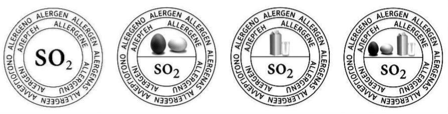
3) Allergen ingredients
In the current state of European regulations, these are solely SO2, casein and ovalbumin. The operator may choose between a verbal statement indicating the presence of the substance and the use of the following pictograms authorised by Regulation 2019/33 (Art. 41 and Annex 1, Part B):
4) The name of the grapevine product category
This mandatory particular applies only to WGIs. It consists of stating the category of grapevine product within the meaning of European regulations. There are seventeen product categories, such as wines, new wines still fermenting, liqueur wines, sparkling wines, semi-sparkling wines, aerated sparkling wines, and wines of raisined or overripe grapes (see Annex VII, Part II of CMO Regulation 1308/2013).
5) The terms “Protected designation of origin” or “Protected geographical indication”, together with the protected name in question
The traditional terms “Appellation d’origine contrôlée” or “Vins de pays” may replace, for French wines, the terms “Protected designation of origin” or “Protected geographical indication” in France. The specifications of PDOs/PGIs may lay down labelling rules in this respect. These terms may even be omitted for certain PDOs/PGIs for which the mere statement of the name in question is sufficient. This is the case for certain well-known appellations such as the Champagne appellation for France or the Porto appellation for Portugal (Reg. 2019/33, Art. 23 and Decree of 4 May 2012, Art. 11).
It should be recalled that throughout the European Union it is strictly forbidden to use, or even to evoke, the name of a PDO or PGI for comparable products (that is, wines) that do not benefit from it. It is even forbidden to use the name commercially, directly or indirectly, for products that are not wines, where it can be established that there is a commercial exploitation of the reputation of the PDO or PGI. The CIVC was thus able, for example, to obtain the conviction by the court in The Hague of the company Unilever, which was marketing a shampoo under the sales name “Champagne”, in a decision of 8 October 2010 (R. 1308/2013). There have since been other cases in the case law, this one not being isolated. In France, under domestic law, the same direct or indirect use of the name of a PDO or PGI for wines that do not benefit from it is severely penalised. It constitutes both the civil offence of infringement punished by the Intellectual Property Code (IPC, Art. L. 722-1 et seq.) and a criminal offence punished by the Consumer Code (Consumer Code, Arts L. 431-2 and L. 432-4). To this is added the possibility, opened by Article L. 643-1 of the Rural Code, of penalising the misappropriation or weakening of the reputation of appellations of origin, where the name is used for products other than those covered by the PDO or PGI (an example being the Yves Saint Laurent perfume Champagne). Case law is particularly protective of geographical indications (see for example : J.-M. BAHANS and M. MENJUCQ, Droit de la vigne et du vin, op. cit., pp. 189 to 219).
6) Actual alcoholic strength by volume
Regulation 2019/33 provides that it must be expressed in units of percentage, or half-units as in the past. The alcoholic strength indicated must not differ by more than 0.5% from that given by analytical examination. For wines with a GI kept in bottle for more than three years, and for sparkling wines, semi-sparkling wines, liqueur wines and wines made from overripe grapes, the tolerance is even greater, at 0.8%. In reality, the difference may be greater still, because Regulation 2019/33 provides that it is added to the tolerance allowed for the analytical result itself (Reg. 2019/33, Art. 44). The figure corresponding to the actual alcoholic strength by volume must be followed by the symbol “% vol.” and may be preceded by the words “actual alcoholic strength” or “actual alcohol” or by the abbreviation “alc.”.
7) The provenance of the wines
The provenance of the wines must be indicated by the words “wine of (…)”, “produced in (…) ” or “product of (…)”, or equivalent terms, completed by the name of the Member State or third country where the grapes are harvested and made into wine in that territory. For a French wine, one will therefore state “Wine of France” or “Wine produced in France”. It may also be a wine originating from different EU Member States. In that case “wine of the European Union” will be stated, or greater precision given by naming the States concerned (Reg. 2019/33, Art. 45; see infra for further details on wines without a GI).
8) Identity of the bottler, the importer, or, in the case of sparkling wines, the name of the producer or the seller
On this point, Regulation 2019/33 (Art. 46) defines each of the terms in question in order to avoid any ambiguity. For sparkling wines, the producer is the person by whom, or on whose behalf, the transformation of the grapes into sparkling wine is carried out. The seller is distinguished from the producer in that he buys the wine and puts it into circulation; he is therefore a merchant (négociant). The bottler is the person who packages the product in containers not exceeding 60 litres, or on whose behalf this operation is carried out. For France, the regulation allows the use of “élaborateur” and “élaboré par” (made by). Article 2 of Decree No 2012-655 of 4 May 2012 allows this option under domestic law and makes it compulsory to state the producer or maker on the labelling of sparkling wines benefiting from a PDO or PGI.
The particulars relating to the bottler, producer, seller or importer may be combined if they concern the same person (Reg. 2019/33, Art. 46).
As under the previous law, the regulation allows the statement of the bottler, producer, seller or importer to be replaced by a code corresponding to the registered office of the undertaking in question, determined by the Member State concerned. In that case, the code must be completed by a reference to the Member State and by the name and address of another person who took part in marketing the product (Reg. 2019/33, Art. 46).
Where the name or address of the bottler, producer, seller or importer is the same, in whole or in part, as a name protected as a PDO or PGI, European regulations offer the following alternative (Reg. 2019/33, Art. 46):
- either show these particulars in characters half the size of those used for the protected name or for the grape variety;
- or replace these particulars with a code.
Member States may decide which option to apply on their territory, which France has done with the Decree of 4 May 2012 (Article 1st). For wines without a GI, a code complying with the requirements of Article 1 of Decree No 2012-655 of 4 May 2012 must be used in this case. By contrast, for wines with a GI (PDO/PGI), use of the code is optional but, if the code option is not taken, characters half the size of those used for the name of the PDO/PGI to which the wine is entitled must be used.
9) Sugar content for sparkling wines
The new regulations are stricter than the old ones as regards the terms brut, extra dry, dry (sec) and medium dry (demi-sec), because the maximum sugar levels are lower than the former ones. If the sugar content of the product permits the use of two of the terms referred to in the first paragraph, the maker or importer must use only one of them, at its choice. A margin of error of 3 grams per litre between the actual and the labelled content is permitted (Reg. 2019/33, Art. 47).
10) The French health statement for pregnant women and its pictogram
French legislation provides that a health warning recommending that pregnant women not consume alcohol must appear for the attention of pregnant women, taking the form either of the following message: “Consuming alcoholic beverages during pregnancy, even in small quantities, can have serious consequences for the health of the child”, or of the pictogram below (CSP [Public Health Code], Art. L. 3322-2 and Order of 2 October 2006):

THE RULES FOR PRESENTING THE MANDATORY PARTICULARS
A distinction must be made here between the formal rules imposed by the European Union and those laid down by French regulations.
1) European Union law
The presentation of the mandatory particulars is common to all types of wine and has undergone no significant change. European regulations promote the consumer’s ability to see and understand the mandatory information. It follows that the particulars must be grouped together in the same field of vision on the container and presented in clear, legible and indelible characters so that they can be clearly distinguished from all the other written information and drawings and can be read simultaneously without having to turn the container. All the mandatory particulars must therefore be concentrated on the same label, except for the particulars relating to the importer, the batch number and the allergens, which may appear outside the field of vision in which the other mandatory particulars are located (Reg. 2019/33, Art. 40).
Regulation 2019/33 also reproduces the former ban on the use of a lead-based capsule or foil (Reg. 2019/33, Art. 43).
As in the past, the new regulation reserves the use of certain types of bottle for certain specified wines in its Annex XVII. It also lays down two general conditions for admission to this list (Reg. 2019/33, Art. 56):
• this type of bottle must have been used exclusively, genuinely and traditionally over the last 25 years for a wine with a geographical indication;
• it must also evoke for consumers a wine benefiting from a particular appellation of origin or geographical indication.
Thus, the Alsace flute (flûte d’Alsace), whose characteristics are laid down in Annex VII of Regulation 2019/33, is reserved exclusively for the French PDOs “Alsace” or “vin d’Alsace”; “Alsace Grand Cru”, “Crépy”, “Château-Grillet”, “Côtes de Provence”, red and rosé, “Cassis”, “Jurançon”, “Jurançon sec”, “Béarn”, “Béarn-Bellocq”, rosé, “Tavel”, rosé. But the regulation specifies that the restriction on the use of this type of bottle applies only to wines produced from grapes harvested in France.
Likewise, the Clavelin bottle type is reserved for the following French appellation d’origine wines: Côtes du Jura, Arbois, L’Étoile, Château-Chalon. This restriction on use applies to all wines and not just French wines, as is the case for the Alsace flute.
As regards sparkling wines, they may be held for sale or put into circulation only in glass bottles closed with a mushroom-shaped stopper of cork or of other materials approved for contact with foodstuffs, held in place by a fastening, covered, where appropriate, by a plate and fitted with a foil covering the whole of the stopper and all or part of the neck of the bottle (Reg. 2019/33, Art. 57). However, this requirement does not apply to bottles with a nominal volume not exceeding 20 cl. The foil and the capsule must not be made from lead. These wines are also the only ones that may be packaged in “sparkling wine” type bottles fitted with the aforementioned type of closure. Nevertheless, Regulation 2019/33 provides that Member States may decide that this type of bottle and closure also applies to other products, provided that they are traditionally packaged in such bottles and that they do not mislead the consumer as to the nature of the drink.
As regards the languages used for labelling, Article 121 of Regulation 1308/2013 provides that mandatory or optional particulars, when expressed in words, must appear in one or more official languages of the Union, which leaves considerable room for manoeuvre given the diversity of official languages. However, the name of a PDO or PGI, or the corresponding traditional term, must appear on the label in the language or languages for which the protection applies. For names written in an alphabet other than Latin (Greek, for example), a translation may be added in one or more official languages of the Community.
Finally, European regulations provide that products that do not comply with the mandatory provisions of European labelling regulations may not be marketed in the territory of the Union (Reg. 1308/2013, Art. 74; Reg. 2019/33, Art. 42). Member States must take the measures necessary to prevent such products from being placed on the market or to ensure their withdrawal. By contrast, for wines intended for export, Member States may authorise derogations from the European requirements where these are demanded by the legislation of third countries.
FRENCH LAW
Article 13 of the Decree of 4 May 2012 provides that wines and liqueur wines pre-packaged in France may be put into circulation only if they bear an indication making it possible to identify the batch and the bottler. This identification appears on the non-reusable closure device or on the container, in plain text or using the regulatory code.
Article 14 of the Decree of 4 May 2012 also provides that, as soon as they are put into circulation outside their area of production or making, sparkling wines made in France and benefiting from a PDO or PGI must bear the name of the PDO or PGI on the part of the stopper contained in the neck of the bottle and be labelled in accordance with the regulations in force.
OPTIONAL PARTICULARS IN THE LABELLING OF WINES
Like the old one, the new system combines a principle of freedom with regulated optional particulars. The overall direction is, however, more liberal than in the past.
PRINCIPLE OF FREEDOM TO CREATE UNREGULATED PARTICULARS
The principle of being able to create particulars outside the regulated categories had been established since the CMO of 1999.
In the current CMO, the rule is even clearer, since it refers back to the general standard laid down for the labelling of foodstuffs, which provides for freedom of particulars subject to two reservations: the obligation not to mislead the consumer and, of course, compliance with the regulated particulars (R. 1308/2013, Arts 118 and 120; R. 1169/2011, Art. 7).
This is the application of Article 7 of the FIC Regulation 1169/2011. Particulars must not be liable to mislead the buyer as to the characteristics of the foodstuff, and in particular as to its nature, identity, qualities, composition, quantity, durability, origin or provenance, or method of manufacture or production. The result is greater creative freedom, as with other food products, and a shift from a priori control towards litigation taking place a posteriori. There is thus a move from administrative control to what is probably a more judicial treatment of labelling difficulties (a typically Anglo-Saxon approach).
The Court of Justice of the European Union has had occasion to recall another limit on this freedom, namely the ban on health claims in the labelling of alcoholic beverages (CJEU, 6 September 2012, Case C-544/10). Indeed, Union law prohibits any health claim in the labelling and advertising of beverages containing more than 1.2% alcohol by volume, and in particular of wine (Regulation 1924/2006 of the European Parliament and of the Council of 20 December 2006 on nutrition and health claims made on foods). The Court of Justice was able to hold that the prohibition on using health claims covers the term “easily digestible”, accompanied by a reference to the reduced content of substances regarded by a large number of consumers as negative. Any particular that could be regarded as a health claim should therefore be avoided.
REGULATED OPTIONAL PARTICULARS
There are fourteen categories of regulated optional particulars, which we present below.
1) The vintage of the wine
The first particular is the year of harvest, known as the vintage of the wine in the language of the wine sector (R. 1308/2013, Art. 120). Regulation 2019/33 makes use of this indication conditional on at least 85% of the grapes used to make the wine coming from the year in question. This percentage is calculated excluding products added for enrichment or the alcohol used to make a liqueur wine. Where the harvest takes place in January or February, the vintage of the preceding year is shown on the label (R. 2019/33, Art. 49).
2) Grape varieties
The second particular is that of the grape variety or varieties (R. 1308/2013, Art. 120). The varieties must appear on the list of authorised varieties that each Member State must draw up. For Member States exempted from drawing up this list, on the ground that their production does not exceed 50,000 hectolitres per marketing year, the varieties must appear on the list established by the OIV. For third countries, three lists are recognised: that of the OIV, that of the UPOV (Union for the protection of plant varieties) and that of the IBPGR (International board for plant genetic resources). For products benefiting from a geographical indication (PDO/PGI), indicating the grape variety is conditional on 85% of the product coming from the variety named on the label (R. 2019/33, Art. 50). Where two or more varieties are shown on the label, the rule that applies, by contrast, is that 100% of the product must come from the varieties in question. The varieties must then be shown in descending order of their proportion in the product, in characters of the same size. For sparkling wines, the generic term “Pinot” may be used in preference to the precise indication of the Pinot variety concerned (Pinot blanc, noir, Meunier or gris). Where the name of a grape variety is also that of a PDO or PGI, it may not in principle appear on the labelling of a product not benefiting from it (R. 1308/2013, Art. 100). However, Delegated Regulation No 2019/33 provides for derogations, the list of which is set out in an annex (Annex IV). A distinction is made between variety names that contain or consist of a protected name and variety names that only partially contain a protected name. In all cases, derogations exist only for products benefiting from a GI (PDOs/PGIs and GIs of third countries). It is true that the 1994 TRIPS Agreement (an annex to the treaty establishing the WTO) very strongly limits, in its Article 26-4, the protection of GIs whose name is identical to that of a grape variety, in these terms: “Nothing in this Section shall require a Member to apply its provisions in respect of the geographical indication of any other Member with respect to products of the vine for which the relevant indication is identical to the customary name of a grape variety existing in the territory of that Member as of the date of entry into force of the WTO Agreement”. The European Union’s freedom of manoeuvre is therefore limited on this point.
In France, a restriction has been laid down in relation to European regulations (which provide for the possibility of naming several grape varieties if they account for 100% of the blend): PDOs and PGIs may name several grape varieties only if each of them accounts for more than 15% of the blend, which adds a further constraint to labelling (Decree No 2012-655 of 4 May 2012, Art. 3).
3) Sugar content for non-sparkling wines
The third particular is the sugar content for non-sparkling wines (R. 1308/2013, Art. 120). The terms dry (sec), medium dry (demi-sec), medium sweet (moelleux) or sweet (doux) may be used in the French language.
Each term is regulated as regards residual sugar content (R. 2019/33, Art. 52 and Annex III-B). The regulation sets a tolerance of 1 gram of sugar per litre between the labelled and the actual content. In addition, the text allows Member States to adopt national rules on these terms as regards liqueur wines and semi-sparkling wines.
4) Traditional terms
The fourth optional particular mentioned by the CMO Regulation is that of traditional terms (R. 1308/2013, Art. 120). Delegated Regulation 2019/33 and Implementing Regulation 2019/34 currently govern their system of recognition and protection. Retaining the category of traditional terms is not without its difficulties, notably because of the uncertainties surrounding their legal nature and their precise scope. It includes, all mixed together, the traditional terms used by Member States to designate appellations of origin and geographical indications (AOC and vins de pays in France) but also promotional terms evoking a method of production or a qualitative hierarchy of wines. These promotional terms enjoy no international protection outside the bilateral agreements concluded between the EU and third countries. A compromise has nevertheless emerged within the Union to retain the category, albeit framed by a more precise definition and a procedure giving third parties a right to challenge the recognition of a traditional term.
To be recognised by the Commission, a traditional term must correspond to the definition given by the new Article 112 of Regulation 1308/2013. This is not very demanding if one looks at the definition in question, namely:
“A term traditionally used in a Member State:
(a) to indicate that the product benefits from a protected designation of origin or a protected geographical indication under Community law or the legislation of a Member State; in France these are the terms “Appellation d’origine contrôlée” and “Vin de pays”.
(b) to designate the method of production or ageing, or the quality, colour, type of place or a particular event linked to the history of the product benefiting from a protected designation of origin or a protected geographical indication.”
In France, these are the terms: Ambré, Clairet, Claret, Tuilé, Vin jaune, Château, Clos, Cru artisan, Cru bourgeois, Cru classé, with or without the words Grand, Premier Grand, Deuxième, Troisième, Quatrième or Cinquième, Edelzwicker, Grand cru, Hors d’âge, Passe-tout-grains, Premier cru, Primeur, Rancio, Sélection grains nobles, Sur lie, Vendanges tardives, Villages and Vin de paille.
The second category of traditional term can be protected only if it is (R. 1308/2013, Art. 112 and R. 2019/33, Art. 27):
- either a name traditionally used in trade over a large part of the territory of the Community or of the third country concerned to distinguish specific categories of grapevine products;
- or a well-known name, traditionally used in trade, at least throughout the territory of the Member State or third country concerned to distinguish likewise specific categories of grapevine products.
In addition, the traditional term:
- must not be generic;
- must be defined and regulated by the legislation of the Member State or of a third country, or by that of a representative producers’ organisation of third countries.
Finally, the term may be protected either in the original language of the production area, in which case the traditional use must have existed for at least 5 years, or in the language used in trade for that term, in which case the traditional use must be longer-standing, namely a minimum of 15 years. The Conseil d’État held in a decision of 20 February 2014 that the five-year condition concerns the recognition of a new traditional term and not the amendment of the list of wines entitled to use that term (Conseil d’État, 26 February 2014, No 356006, admission of the term “Vendanges tardives” for the wines of the Gaillac AOC, hitherto reserved for the wines of the “Alsace”, “Alsace Grand Cru” and “Jurançon” AOCs).
The Conseil d’État has also specified that the substantive conditions that must be met in order to be admitted to use a traditional term lie in compliance with the definition of that traditional term appearing in the e-Bacchus database, and not in compliance with the production conditions specific to this or that set of specifications governing wines previously entitled to use that term (CE, 3rd and 8th Chambers sitting together, 7 November 2019, No 416076).
The application for recognition of a traditional term is made by the authorities of a Member State or of a third country, or by a representative professional organisation of the producers of a third country, directly to the European Commission (R. 2019/34, Art. 21).
Traditional terms are now entered in the e-Ambrosia electronic register, like the names of wine PDOs/PGIs (R. 2019/34, Art. 25).
Traditional terms enjoy ex officio protection, that is, national authorities must take, on their own initiative or at the request of a third party, all necessary measures to put an end to their unlawful use. They are, however, protected only in the language in which they are registered and for the category of grapevine product to which they correspond. They are protected against any misuse, even if accompanied by expressions such as kind, type or the like, as well as against any false or misleading indication and, more broadly, any practice liable to mislead the consumer (R. 1308/2013, Art. 113).
Traditional terms are protected against the registration of trade marks subsequent to their recognition for products that do not benefit from them. For earlier trade marks, a principle of coexistence applies. Regulation 2019/33 specifies, as for PDOs and PGIs, that where there is an earlier well-known or reputed trade mark with the same name, a traditional term may not be registered if its protection is liable to cause confusion in the consumer’s mind as to the true identity, nature, characteristics or quality of the wine in question (R. 2019/33, Art. 32).
The registration of a term that is a homonym of another traditional term, a grape variety or a geographical indication is not absolutely prohibited but is conditional on there being no risk of confusion in the consumer’s mind (R. 2019/33, Art. 33).
Like PDOs/PGIs, registered traditional terms may be subject to a cancellation procedure if they no longer meet European requirements (R. 2019/33, Arts 35 to 37 and R. 2019/34, Arts 28 and 29).
5) European symbol for PDOs/PGIs
The fifth optional particular provided for by the CMO Regulation is the Community symbol specific to PDOs and PGIs, common to all agricultural PDOs/PGIs (R. 1308/2013, Art. 120 and R. 2019/34, Art. 14). Under French law, the official symbol of the appellation d’origine contrôlée (AOC) may likewise be omitted from the labelling of wines (Consumer Code, Art. L. 431-3).
6) Particulars relating to certain production methods
The sixth category of regulated optional particular corresponds to particulars relating to certain production methods (R. 1308/2013, Art. 120). Regulation 2019/33 lays down rules on the labelling of certain production methods but clearly specifies that it is possible to refer to other production methods (R. 2019/33, Art. 53). On this subject, a distinction must therefore be made between the regulated particular and the free particular, which, like all free particulars, is subject to the principle we have mentioned that the consumer must not be misled.

- What are the regulated particulars relating to the production method?
(a) Particulars relating to the use of wood in the maturation of wines
The regulation provides that, for wines with a GI whose fermentation, maturation or ageing takes place in a wooden container, only the particulars on the list set out in an annex to the regulation are authorised. The particulars are as follows: “matured in barrel”, “matured in barrel of + the wood variety concerned”, or, where applicable, “fermented in barrel”, “fermented in barrel of + the wood variety concerned”, or “aged in barrel”, “aged in barrel of + the wood variety concerned”.
Member States or third countries may also define other particulars provided that they are equivalent. These particulars are, however, prohibited for wines made with oak chips, even in combination with a wooden container (R. 2019/33, Art. 53 and Annex V).
French law lays down restrictive provisions. Indeed, the particulars relating to the fermentation, maturation and ageing of wines in a wooden container may be stated provided that the whole of the wine claiming one of these particulars has been fermented, matured or aged in wooden containers and that at least 50% of its volume has been so for a minimum period of six months (Decree No 2012-655 of 4 May 2012, Art. 11).
(b) Particulars relating to fermentation in the bottle
These are reserved for sparkling wines benefiting from a PDO or a GI of a third country, or belonging to the category of quality sparkling wines (it should be stressed that in the new regulations the category of quality wines has been retained only for sparkling wines: quality sparkling wines and quality aromatic sparkling wines). As in the past, the regulation on this point is very precise. It has changed very little. A distinction must be made between the general term “bottle fermentation” and the term evoking bottle fermentation by the traditional method.
The expression “bottle fermentation” is lawful only under four conditions (R. 2019/33, Art. 53):
- the product has been made sparkling by a second alcoholic fermentation in the bottle;
- the duration of the production process, including ageing at the production undertaking, counted from the fermentation intended to make the cuvée sparkling, has not been less than nine months;
- the duration of the fermentation intended to make the cuvée sparkling and the time the cuvée spent on the lees have been at least 90 days;
- the product has been separated from the lees by filtration using the transfer method or by disgorging.
The expressions “fermented in the bottle by the traditional method” or “traditional method” or “classical method” or “traditional classical method” are lawful under three conditions (R. 2019/33, Art. 53):
- the wine has been made sparkling by a second alcoholic fermentation in the bottle;
- the wine has remained on the lees without interruption for at least nine months in the same undertaking from the making-up of the cuvée;
- the wine has been separated from the lees by disgorging.
(c) The term Crémant
This too is subject to rigorous rules. It may be used only for white or rosé quality sparkling wines benefiting from a protected designation of origin or a GI of a third country, and only if six conditions are met (R. 2019/33, Art. 53):
- the grapes must have been harvested by hand;
- the wine is made from a must obtained by pressing whole or destemmed grapes. The quantity of must obtained must not exceed 100 litres per 150 kg of grapes;
- the maximum sulphur dioxide content must not exceed 150 mg per litre;
- the sugar content must be less than 50 g per litre;
- the wine must meet the requirements laid down for wines resulting from a so-called classical traditional fermentation;
- the term Crémant must appear on the label in combination with the protected name, without prejudice to the right to state the name of a larger or smaller geographical unit.
The requirements laid down by the regulation concerning hand harvesting and the indication of the protected name do not apply to producers who have acquired trade marks containing the term “crémant” registered before 1st March 1986.
(d) The term Rosé
Still on the subject of regulated particulars relating to production methods, the Commission’s draft regulation in 2008 provided that the expression “traditional rosé” could be used to describe rosé wines produced by brief maceration, by partial or total running-off (saignée) or by complete pressing of the grapes. The term “rosé by blending” (in French “rosé par coupage”), or another equivalent term accepted by a Member State or a third country, could have been used to describe a rosé wine produced by blending a white wine and a red wine. This stemmed from the Commission’s wish to end the ban on blending to produce a rosé wine. However, the Commission gave up the idea of ending this ban, following effective lobbying by rosé producers. They rightly saw in this measure a genuine distortion of competition, arising from the fact that making a rosé wine by skin maceration is markedly more costly than making a rosé wine by adding a small quantity of red wine to a white wine. They are not the same type of wine, but the colour can be very similar (see J.-M. Bahans and M. Menjucq, Droit de la vigne et du vin, op. cit., No 149, p. 75 ; G. MASSON, “Singularité et diversité des vins Rosés “, in Le vin Rosé, Éd. Féret, Bordeaux, 2009; J.-C. MARTIN, “Histoire des vins Rosés dans des anciens traités viticoles et œnologiques jusqu’au XXe siècle”, in Le vin Rosé, Éd. Féret, Bordeaux, 2009). The current problem with rosé wines, from the standpoint of wine law, lies in the absence of any general legal definition concerning them. There is no international definition drawn up by the OIV. Nor is there a true European definition. However, Regulation 2019/934 on oenological practices, which repealed and replaced Regulation 606/2009, gives us an interesting indication by specifying in its Article 7 that, as regards the definition of blending, “rosé wine is considered to be red wine”, and Article 8 of the same regulation prohibits, for wines without a GI, the blending of a white wine with a red wine to produce a rosé wine. Nevertheless, the same article makes an exception for sparkling and semi-sparkling wines and implicitly refers wines with a GI to the provisions of their approved specifications. It should be stressed that the terms clairet and claret are in fact protected as traditional terms by the EU, which reserves their use to light red or rosé wines from Bordeaux and Burgundy for clairet and to light red wines from Bordeaux for claret.
French law lays down restrictive provisions, since for wines produced in France, the blending of a white wine with a red or rosé wine may not produce a rosé wine, with the exception of sparkling and semi-sparkling wines (Decree No 2012-655 of 4 May 2012, Art. 17). The rule is stricter than in the EU, where blending is permitted for PDOs/PGIs if the specifications provide for it (R. 2019/934, Arts 7 & 8).
(e) Distinctive signs of environmental quality
The main sign is the one distinguishing organic wines; the second, more recent, is that of High Environmental Value certification.
Organic farming is governed by two European texts: Regulation (EC) No 2018/848 of the European Parliament and of the Council of 30 May 2018 and the implementing Regulation (EC) No 889/2008 of the Commission of 5 September 2008.
Regulation 889/2008 was amended by Commission Implementing Regulation (EU) No 203/2012 of 8 March 2012 in order to give organic wines a legal existence.
Regulation 2019/33 expressly refers to these texts for the labelling and presentation of organic wines (Art. 53, point 6).
We shall not go into the technical detail of the European definition of organic wines, which is essentially a negative definition. There is in fact no true positive definition of organic wines, but rather a list of viticultural and winemaking practices that are specifically prohibited for these wines (the essential products used must be certified organic and the use of sulphur is more restrictive than for non-organic wines). The new regulations resulting from Regulation 203/2012 came into force on 31 July 2012. Wines produced earlier may carry the EU organic logo if they comply with the new regulations. Wines packaged earlier may be marketed until stocks are exhausted. Wines previously labelled as “wines made from organic grapes” may not carry the EU organic logo. It should be stressed that operators who choose to produce organic wines and who wish to state this quality on their wine labels must use the EU organic logo (R. 848/2018, Art. 32; R. 889/2008, Arts 57 and 58). An operator seeking the benefit of the term “Organic farming” must itself choose a certification body approved by the INAO, which will check compliance with the applicable standards (Rural Code, Art. R. 642-37).
The operator must notify its organic production activity annually to the Agence française pour le développement et la promotion de l’agriculture biologique, known as Agence Bio.
Under EU law, uncertified operators may not use the logo or the terms organic, bio or eco or other terms evocative of organic farming (R. No 848/2018, Art. 30). Breach of this prohibition constitutes a criminal offence under domestic law, where the operator uses the logo, the terms in question, or a method of presentation that may lead people to believe that a product has the quality of an organic product (Consumer Code, Arts L. 432-6 and L. 453-6). Penalties go up to two years’ imprisonment and a fine of 300,000 euros.

European logo
There is also a French logo whose legal regime is hybrid, since it is both an official logo and a trade mark. This results in a dual regime governed by the Rural Code and the Intellectual Property Code. The logo corresponds to two trade marks registered with the INPI by the French State. Article R. 641-31 of the Rural Code provides that the INAO is responsible for protecting this mark, while Agence Bio is responsible for managing it.


Communication mark Certification mark
French logo (collective certification mark registered by the French State)
There is also a process of certifying farms that allows the products of certified farms to benefit from the promotional term ” from a farm of High Environmental Value “, which may be used on product labelling, with the logos shown below. This is a process of certifying an agro-ecological approach that is distinct from organic farming. In particular, it is possible to use synthetic chemical treatments. (R. (EU) 1306/2013 of 17 December 2013; Rural and Maritime Fishing Code, Arts L. 611-6, L. 640-2 and L. 641-19-1; R. 641-57 to R. 641-57-5 and D. 617-4).


(f) The terms ” vieux “, ” très vieux “ and ” extra-vieux “
In France, for liqueur wines, the qualifiers “vieux”, “très vieux” and “extra-vieux” are reserved for liqueur wines benefiting from a PDO for which these terms are defined in their specifications (Decree No 2012-655 of 4 May 2012, Art. 11).
(g) The term: ” blanc de blanc “ or ” blanc de blancs “
In France it is reserved for wines produced from, and resulting from the exclusive fermentation of, white grape juice (Decree No 2012-655 of 4 May 2012, Art. 11)
7) Indication of the name of a geographical unit smaller or larger than that delimited for the PDO or PGI
The seventh category of regulated optional particulars is the indication of the name of a geographical unit smaller or larger than that on which the appellation of origin or geographical indication is based (R. 1308/2013, Art. 120; R. 2019/33, Art. 55). The most famous historical example is that of the names of the climats of the great Burgundy wines, but today there are such names in very many PDOs or PGIs.
Regulation 2019/33 also provides that the name of a geographical unit smaller than the area serving as the basis for the protected name may be stated only if that unit is precisely defined by the specifications and is subject to rules laid down by the Member State for its use. At least 85% of the grapes used to produce the wine must come from this smaller geographical unit, and the remaining 15% may not be harvested outside the delimited area of the PDO or PGI.
The geographical unit must correspond to a locality or group of localities, a local administrative area or part of one, a wine-growing sub-region or part of one, or at the very least an administrative area defined in the specifications.
French law contains stricter provisions on this matter (Decree No 2012-655 of 4 May 2012, Art. 5). The labelling of wines benefiting from a PDO or PGI may indeed state the name of a geographical unit smaller than the area on which the PDO or PGI is based only if all the grapes from which these wines were obtained come from that smaller unit.
A case that gave rise to multiple legal twists and turns illustrates this question. It was held, both by the Court of Cassation and by the Conseil d’État, that wines benefiting from the Côtes de Provence PDO may not circulate in bottles bearing the terms “Cuvée du Golfe de Saint Tropez” or “Port Grimaud”, since the appellation’s specifications do not provide for this possibility. The existence of trade marks predating the decree of 5 May 2012 but postdating the recognition of the PDO was held to have no bearing on the right to use these terms, no disproportionate infringement of the rights of the trade mark owners being established in this case, according to the Court of Cassation (Cass. crim., 4 April 2018, No 16-83270; Cass. crim., 16 February 2021, No 20-81.151 and CE, 3rd and 8th Chambers sitting together, 12 July 2021, No 433867).
Recently, the Bordeaux Administrative Court of Appeal handed down a judgment upholding the legality of a circular from the DIRECCTE and the INAO, which took the view that the use of the term “le Bordeaux de”, followed by the name of an estate, in particular where the name of the estate derives from a place name, tended to suggest the existence of a smaller complementary geographical term within the appellation in question (CAA Bordeaux, 16 July 2021, No 20BX02993).
8) Regulated terms designating the wine estate
This concerns the question of designating a wine by the name of a wine estate and the use of a number of promotional terms that are subject to strict regulation.
(a) European rules
Article 54 of Regulation 2019/33 provides that certain terms applying to the designation of the wine estate are reserved for wines benefiting from a PDO or PGI, such as, for France: Abbaye, Bastide, Campagne, Chapelle, Château, Clos, Commanderie, Cru, Domaine, Mas, Manoir, Mont, Monastère, Monopole, Moulin, Prieuré, Tour. The text adds three further conditions:
- the wine must be produced exclusively from grapes harvested in the vineyards operated by that estate;
- the vinification is carried out entirely at that estate;
- and the use of the term must be regulated by the Member State or third country concerned, where applicable.
The text adds that the name of the wine estate may be used by other operators involved in marketing the product only if the estate in question consents.
(b) French clarifications
Definition of the estate (Decree 2012-655 of 4 May 2012, Art. 6). French law gives the following definition of the wine estate. It is a specific entity made up of vineyard plots, buildings and particular equipment, and having, for the vinification and storage of the wine, a particular vat room that is individualised or identified within a cooperative winery of which it forms part.
The same text makes the essential clarification that only wines appearing on the harvest declaration (PDO) and on the producer’s production declaration (PGI), within the meaning of Articles 8 and 9 of Regulation 436/2009, may benefit from the name of the estate. It is therefore unlawful to designate a wine simply by the name of the estate when the wine is made with grapes that do not come from the estate and hence from the duly identified and identifiable vineyard plots. The name of the estate may thus not be used directly for purchases of grapes made outside the estate.
There are, moreover, terms designating the wine estate that are protected and reserved for certain wines made from grapes harvested and vinified on the estate (Decree 2012-655 of 4 May 2012, Art. 7).
The following are reserved solely for wines benefiting from a PDO: “château”, “clos”, “cru”, “hospices”, to designate wines harvested from the plots of an estate so named and vinified at that estate. A restriction is placed on the term “clos”: the plots must either be enclosed by walls or hedges or have an appellation that includes this term.
The following terms (a list that is now exhaustive) are reserved for PDO and PGI wines: “abbaye”, “bastide”, “campagne”, “chapelle”, “commanderie”, “domaine”, “mas”, “manoir”, “monastère”, “monopole”, “moulin”, “prieuré”, “tour”.

Merger of estates (Decree 2012-655 of 4 May 2012, Art. 8). Where a new wine estate is created by merging several wine estates that meet the above conditions, the name of each estate, preceded by one of the regulated terms, under which all or part of the production was previously marketed, may continue to be used.
In this case, the grapes are vinified:
- either in each of the former wine estates;
- or separately in the buildings of one of them or in the buildings belonging to the estate resulting from the merger.
For wines from the new estate, as defined above, the use of the names of the former estates thus merged excludes the use of a new name for the said estate.
The Conseil d’État has held that it follows from this text that such a merger of estates does not necessarily require the new entity to take over the buildings and equipment of the former estates, but only the whole of their viticultural activity and the plots assigned to that activity. It is nevertheless necessary that, at the date of the merger, the estates taken over still meet the conditions laid down by Article 6 and therefore have identified vineyard plots and vinification buildings (CE, 3rd and 8th Chambers sitting together, 16 April 2021, No 434131).
Name of a second wine for the same estate (Decree No 2012-655 of 4 May 2012, Art. 9). The French text specifies that wine estates that acquired their reputation under two different names before 7 January 1983 may continue to use both names.
9) Special rules on the use of the term “ cru “ with or without a hierarchical indication
Here the rules of Article 13 of the Decree of 19 August 1921 and of Article 7 of Decree No 2012-655 of 4 May 2012 must be combined.
First of all, French law imposes a general restriction on the use of the term “cru”: it is newly required (Decree of 4 May 2012, Art. 7):
- either a minimum reputation of ten years if the term is used to designate an individual estate, in addition to the requirement, already mentioned above, of benefiting from an appellation d’origine contrôlée;
- or a provision in the specifications of the PDO authorising its use to designate a geographical unit larger or smaller than that delimited for the appellation in question.
This provision is essential for designating, in particular, a large number of Burgundy climats.
It is then in principle forbidden, in any labelling process and more generally in any presentation of the wine, to use (Art. 13 of the Decree of 19 August 1921):
(a) The terms ” grand cru “ or ” premier cru “, except where these words are used collectively in accordance with the provisions of the specifications of the protected designations of origin entitled to them.
This refers to the hierarchical classification system of appellations of origin that historically prevails in Burgundy (regional, communal, premiers crus and grands crus appellations) but also in Alsace, in Champagne and, more recently, to differentiate the Coteaux du Layon (premier cru) from the Quarts de Chaume (grand cru) and the Saint-Émilion from the Saint-Émilion Grand Cru.
(b) The terms ” cru classé “, whether or not preceded by a hierarchical indication or any other word evoking a hierarchy of merit among wines from particular wine estates, except:
- Where a text predating Decree No 64-668 of 27 June 1964 authorised their use:
– classification of the Graves approved by an order of 7 August 1953, repealed and replaced by an order of 16 February 1959, made on the basis of the decree of 30 September 1949;
– classification of the Côtes de Provence approved by an order of July 1955, made on the basis of the decree of 30 September 1949;
– classification of Saint-Émilion approved on the basis of a decree of 7 October 1954 (currently governed by Decree No 2011-174 of 11 February 2011 approving the specifications of the Saint-Émilion grand cru AOC, the order of 6 June of the same year approving the regulation concerning the classification of the “premiers grands crus classés” and “grands crus classés” of the Saint-Émilion grand cru AOC, and the order of 29 October 2012 approving the new classification).
- Where the wines are Bordeaux wines from the wine estates included in the 1855 classification. For these wines, the terms “crus classés” or “grand cru classé” may be used, whether or not preceded by an indication of their rank in the classification and whether or not followed by a reference to the year of classification: 1855.
- Where the wines are Bordeaux wines from wine estates forming part of an AOC, selected in order of merit as the result of a public competition organised by the territorial CCI (Chamber of Commerce and Industry), the Chamber of Agriculture and the Fédération des Grands Vins de Bordeaux, the results of which have been approved by the Minister of Agriculture after consulting the winegrowers’ associations concerned and the INAO. The rules of the competition must also be approved by the Minister of Agriculture. The date and origin of the classifications must be stated on the labelling.
This is the system of the Crus Artisans du Médoc. It was the system of the Crus Bourgeois before they opted for the following system, when their approval order was annulled for lack of impartiality of the jury by the Bordeaux CAA in 2007.
- Lastly, where the wines are Bordeaux wines from wine estates forming part of an AOC and have been the subject of a selection organised periodically by the most representative wine trade body of the estates likely to be authorised to use words evoking a hierarchy of merit among these wines, on the basis of specifications drawn up by that body and a verification plan for the specifications established and implemented by a third-party body offering guarantees of competence, impartiality and independence. The specifications and the verification plan must be approved by a joint order of the Ministers of Agriculture and Consumer Affairs.
At present, only the Crus Bourgeois du Médoc have adopted this system. The representative body is the Alliance des Crus Bourgeois du Médoc association and the body responsible for verifying the specifications is Bureau Veritas (order of 16 November 2009, JORF 24 November 2009). They are currently governed by an order of 29 December 2017 approving new specifications and a new verification plan, notably to make it possible to distinguish “Crus bourgeois supérieur” and “Crus bourgeois exceptionnels”.
10) Distinctions and medals
Some regulated optional particulars that previously existed have disappeared from the current European regulations. This is the case for distinctions and medals.
They therefore survive only in the domestic law of the Member States (Decree No 2012-655 of 4 May 2012, Art. 4). The competition must be entered on a list drawn up by the Minister responsible for Consumer Affairs and published in the Official Bulletin of Competition, Consumer Affairs and Fraud Control. An order of the Minister for Consumer Affairs sets out the rules, notably those relating to the guarantees of competence and impartiality of the competition organiser, that allow a competition to be entered on the list (order of 13 February 2013: JO of 22 February 2013).
11) Particulars relating to bottling
Article 10 of Decree No 2012-655 of 4 May 2012 reserves the following particulars in French law to PDOs/PGIs and attaches precise conditions to them:
- the term “bottled at the château…” or another term reserved for PDOs/PGIs: obligation for the wine to be vinified and bottled at the estate whose name the wine claims;
- the term “bottled at the property”: obligation for the wine to be vinified and bottled at the estate or the vinification cooperative;
- the term “bottled in the production region”: obligation to bottle within the delimited geographical area or the immediate proximity area (according to the specifications).
12) Primeur wines
Stating the year of harvest is compulsory in the labelling of wines bearing the qualifier “primeur” or “nouveau” (new). The size of the characters of the vintage indication is at least equal to that of the terms “nouveau” or “primeur” (Decree No 2012-655 of 4 May 2012, Art. 11).
13) Export
The Minister for Consumer Affairs may by order authorise derogations from Community labelling rules when the products are intended for export, in order to adapt to the requirements of the legislation of third countries (R. 2019/33, Art. 42; Decree No 2012-655 of 4 May 2012, Art. 12).
14) Other particulars regulated by the specifications of PDOs/PGIs
In addition, Member States may make compulsory, prohibited or restricted, for wines benefiting from a PDO or PGI, the following optional particulars: the vintage, the grape varieties, the sugar content, the production methods and the indication of the name of a geographical unit smaller or larger than the area on which the protected name is based (R. 2019/33, Art. 58). This regulation is effected by introducing stricter conditions by means of the specifications corresponding to these wines. This possibility has been used in French law (Consumer Code, Art. R. 112-7-1, Rural Code, Art. R. 641-21-1).
THE SPECIAL RULES FOR LABELLING WINES WITHOUT GEOGRAPHICAL INDICATION (CSIG)
The new classification, based on the distinction between wines with and without a GI, has liberalised labelling law to the benefit of wines without a GI, that is, wines that formerly came under the table wine category. This can be seen from three key points: the benefit of stating the indication of provenance, the widening of the authorised optional particulars, and also the possibility of creating other particulars.
THE BENEFIT OF STATING THE INDICATION OF PROVENANCE: A PROMOTIONAL MANDATORY PARTICULAR
The indication of provenance is a mandatory particular common to all wines, certain aspects of which we have already addressed in relation to wines benefiting from a PDO, a PGI or a GI of a third country. Formally, this mandatory particular did not exist as such in the old regulations. The comparable particular was the “sales description”, which for table wines required the term “table wine” to be stated, followed by the name of the producing Member State or States (see J.-M. BAHANS and M. MENJUCQ, Droit du marché vitivinicole, 1st ed., 2003, Féret, No 344).
Regulation 2019/33 provides essential guidance on this subject, framing the indication of provenance of wines without a GI that we mentioned supra under the mandatory particulars (Reg. 2019/33, Art. 45).
For non-sparkling wines, including aerated sparkling wines and semi-sparkling wines, the provenance will be indicated by the words “wine of (…)”, “produced in (…)” or “product of (…)”, or equivalent terms, completed by the name of the Member State or third country where the grapes are harvested and vinified (for example, Wine of France/Wine produced in France/Product of France). In the case of a wine from a cross-border grape variety, it will be possible to state only one of the Member States or third countries concerned. Where the wines are made from a blend of wines originating in different Member States, the following terms must be used: “Wine of the European Union”, or equivalent terms, or “Blend of wines from different countries of the European Union”. If the wine is produced in one Member State from grapes harvested in another State, the words “Wine of the European Union” or “wine obtained in (…) from grapes harvested in (…)” must be used (wine obtained in France from grapes harvested in Italy, for example). If the wine is made from a blend of wines produced in third countries, the terms that must appear on the label are “blend of wines from different countries outside the European Community” or “blend of (…)”, citing the names of the third countries concerned, completed by the names of the third countries in question. Finally, if the wine is produced in a third country from grapes harvested in another third country, the terms “wine obtained in (…) from grapes harvested in (…)” must be used, citing the names of the third countries concerned.
For sparkling wines, where the wine is made from grapes harvested and vinified in the same Member State or third country, the terms used must be as follows: “wine of (…)”, “produced in (…)” or “product of (…)” or “sekt of (…)” or equivalent terms, completed by the name of the State in question. In other situations, the terms “produced in (…)” must be used, completed by the name of the Member State where the second fermentation in bottle takes place.
The indication of provenance on the labels of grape must, grape must in fermentation, concentrated grape must or new wine still in fermentation must be made using the following terms:
- “must of (…)” or “must produced in (…)”, or equivalent terms, completed by the name of the Member State or of the territory forming part of the Member State in which the product is obtained;
- “blend resulting from products of two or more countries of the European Union”, in the case of blending of products originating in two or more Member States;
- “must obtained in (…) from grapes harvested in (…)”, in the case of grape must that has not been produced in the Member State where the grapes used were harvested.
In the end, there is no doubt that, even framed in this way, the mandatory indication of provenance is now indeed a promotional particular. Being able to state “Vin de France” on a wine is very different, in terms of consumer perception, from the former description “vin de table de France”. In reality, this wine will easily replace the defunct vin de pays des vignobles de France, which had been rejected by the European Commission and struck down by the Conseil d’État on the ground that it did not concern a specific production area and therefore a regular geographical indication (CE, 13 February 2009, judgment No 305177, Lexbase No A 1156ED8). To this may be added the grape variety and the vintage, as we have seen, which makes it possible to compose attractive labels. Two other types of particular may also be added: the sugar content and indications relating to production methods.
THE WIDENING OF THE AUTHORISED OPTIONAL PARTICULARS
1) Right to state the grape variety and the vintage
(a) The conditions
As regards the indication of the vintage of the wine, Regulation 2019/33 makes use of this indication conditional, as for products benefiting from a geographical indication, on at least 85% of the grapes used to make the wine coming from the year in question (Reg. 2019/33, Art. 49). This percentage is calculated excluding products added for sweetening or the alcohol used to make a liqueur wine. Where the harvest takes place in January or February, reference is made to the vintage of the preceding year.
As regards the indication of the grape variety, the varieties must appear on the list of authorised varieties that each Member State must draw up (Reg. 2019/33, Art. 50). In France, it is currently the order of 7 July 1995, last amended on 23 December 2021, that establishes the classification of authorised grape varieties. For wines without a GI, it is possible to plant any variety throughout metropolitan territory provided it belongs to the list of varieties entered in the Official Catalogue of Vine Varieties as a wine grape variety. This is a flexible instrument that makes it possible to pursue a genuine policy of producing varietal wines. Article 51 of Regulation No 2019/33 also contains a rule favouring the production of varietal wines without a geographical indication. Member States may indeed decide to use the words “varietal wine”, completed by the name of the Member State and/or the name of the grape variety. The same rule exists for wines without a geographical indication from third countries.
Where the name of a grape variety is also, in whole or in part, that of a PDO or PGI, it may not in principle appear on the labelling of a product not benefiting from it (Reg. 2019/33, Art. 50). Regulation 2019/33 provides for derogations, the list of which is set out in an annex (Annex IV), but these are excluded for products not benefiting from a GI (PDOs/PGIs and GIs of third countries).
In addition, the CMO Regulation allows Member States to prohibit the mention of certain grape varieties in the labelling of wines without a geographical indication if there is a risk of confusion for the consumer as to the true origin of the wine, owing to the fact that the variety in question forms an integral part of a PDO or PGI (Reg. 1308/2013, Art. 120). In France, it is forbidden to mention the following varieties in the labelling of a VSIG: Aligoté, Altesse, Clairette, Gewurztraminer, Gringet, Jacquère, Mondeuse, Persan, Poulsard, Riesling, Savagnin, Sylvaner and Trousseau (Decree No 2012-655 of 4 May 2012, Art. 3).
Moreover, wines without a GI made from a blend of wines from different States of the European Union are in principle excluded from the right to mention grape varieties on the labelling. However, the Member States concerned may decide otherwise, on condition of ensuring the feasibility of relevant certification, approval and control procedures (Reg. 1308/2013, Art. 120).
This condition is, moreover, common to all wines without a GI. The CMO Regulation makes the right to state the grape variety on the labelling of wines without a GI conditional on Member States introducing legislative, regulatory or administrative provisions to ensure that certification, approval and control procedures guarantee the veracity of the information concerned (Reg. 1308/2013, Art. 120). This is the counterpart obtained by producers of wines with a GI, who are subject to demanding controls, so as not to face unfair competition from producers of wines without a GI.
(b) The controls
The control requirements are specified by Articles 49 and 50 of Delegated Regulation No 2019/33. The wines must be certified in accordance with Article 12 of Implementing Regulation No 2018/274. Article 12 of Implementing Regulation No 2018/274 provides that, as a minimum, the procedure for certifying, approving and controlling wines requires administrative proof of the veracity of the information concerning the grape varieties and vintages in question to be established.
In France, the control procedure is governed by Articles R. 665-18 to R. 665-29 of the Rural and Maritime Fishing Code. Operators must apply for approval from FranceAgriMer (FAM) before the first marketing of the wines in question. An operator is any professional who places on the market in national territory unpackaged VSIG wine stating a grape variety or the vintage, or dispatches the same wine outside national territory, or packages wines of this category (Rural and Maritime Fishing Code, Arts R. 665-18 and 19). A wide range of professionals is therefore concerned (merchants, producers, cooperatives, packagers and certain retail wine shops that sell directly “from the tap”). If the application is accepted, the operator receives an approval number. In the event of refusal (for example where the documentary system intended to verify the traceability of the wines appears insufficient), a reasoned decision will be taken by the director of FAM, which may be challenged before the administrative courts. Approval is in principle valid for one wine-growing year, that is, from 1st August to 31 July of the following year. However, it is possible to obtain approval for a maximum period of three years (Rural and Maritime Fishing Code, Arts R. 665-20 and 21). Approval may be withdrawn at any time if the operator ceases to meet the conditions on the basis of which approval was granted. Withdrawal of approval is pronounced by a reasoned decision of the Director General of FranceAgriMer, after the operator has been given the opportunity to submit observations (Rural and Maritime Fishing Code, Art. R. 665-22).
Products placed on the market are subject to a certification procedure that operates in two stages. Before any placing on the market, the operator submits its certification request, stating the volume (in hectolitres, by grape variety and vintage) that it intends to market and undertaking to submit to the controls that will be carried out. FAM then issues, within 15 days of the request, a registration number serving as a certificate for these forecast volumes. The certificate is valid only for the current marketing year. Subsequently, before 31 August each year, the operator must declare the volume actually marketed (Rural and Maritime Fishing Code, Arts R. 665-24 and 25).
The controls are exclusively documentary and are carried out in accordance with the control plan established by FAM, which includes a grid for dealing with breaches and a grid of penalties (Rural and Maritime Fishing Code, Art. R. 665-27). FAM may delegate specific tasks relating to the certification procedure to certification bodies (Rural and Maritime Fishing Code, Arts R. 665- 23 and 26). The costs of the control are in any event borne by the operators (Rural and Maritime Fishing Code, Art. R. 665-29). It is for operators to provide proof of the traceability of the grape variety or varieties and the vintage stated, and this at all stages of production, including packaging. (Rural and Maritime Fishing Code, Art. R. 665-28). If the control shows that the veracity of the information relating to the grape variety or vintage is not guaranteed, FranceAgriMer must send the operator notification of the finding made within the period set by the control plan and may give the operator formal notice to carry out corrective operations within thirty days. The operator has fifteen working days in which to submit its response or to bring itself into compliance. On expiry of that period, a penalty may be imposed, which may consist of withdrawal of the certification for the wine in question, but also of withdrawal of the operator’s approval, for the most serious breaches(Rural and Maritime Fishing Code, Art. R. 665-28).
2) Benefit of certain regulated particulars evoking production methods
As regards sugar content, this is compulsory for sparkling wines and optional for non-sparkling wines, as we saw earlier. These rules also apply to wines without a geographical indication, which can help to enrich the labelling of these wines.
As regards the particulars relating to certain production methods, we saw that Regulation 2019/33 provides that wines marketed in the Union may carry indications referring to them. The text in question does not reserve this type of particular to wines benefiting from a PDO or PGI. It merely reserves and regulates certain particulars reserved for wines benefiting from a GI. For wines without a GI, there are therefore prohibited particulars (ageing in wooden containers, bottle fermentation, crémant), the other particulars being open to wines without a GI (sparkling and semi-sparkling rosé, organic wines).
3) Continued prohibition of certain particulars
As we have already seen in studying the mandatory and optional particulars, certain regulated particulars remain prohibited for wines without a GI (VSIG). We recall them together for the sake of clarity.
These particulars are as follows (see supra for references to the regulatory texts):
- indication of a geographical origin smaller than a State;
- the term Crémant;
- regulated terms designating the wine estate;
- particulars relating to the use of wood in the maturation of wines;
- particulars relating to bottle fermentation;
- traditional terms;
- particulars relating to bottling at the estate.
THE POSSIBILITY OF FREELY CREATING OTHER PARTICULARS
The principle of freedom of particulars that we mentioned in connection with wines benefiting from a geographical indication also applies to wines that do not benefit from one. The new CMO Regulation 1308/2013 is clear, since Article 120, which is common to all wines, provides that the list of optional particulars is not exhaustive. As for Article 118 of the same regulation, it subjects all wines to the horizontal regulations on the labelling of foodstuffs, which provide for freedom of particulars subject to two essential reservations that we have already presented, namely not to mislead the consumer and to comply with the regulations relating to certain particulars.
The freedom to create particulars is therefore not without limits. In addition to the general limit arising from the requirement not to mislead the buyer, there are all the special rules governing the use of the mandatory and optional particulars.
However, the scope of the principle of freedom of particulars should not be underestimated. Operators of wines without a GI now have at their disposal a fairly wide range of promotional particulars that will allow them to pursue a more quality-oriented strategy. It will indeed be possible to combine the use of an attractive trade brand with the free particulars and the promotional particulars newly permitted by European regulations.


