People now speak of de-consumption, even of a disaffection with wine among the under-40s. Arthus de Germay, how do you perceive the image of wine in your generation? Is it hard to sell Bordeaux today?
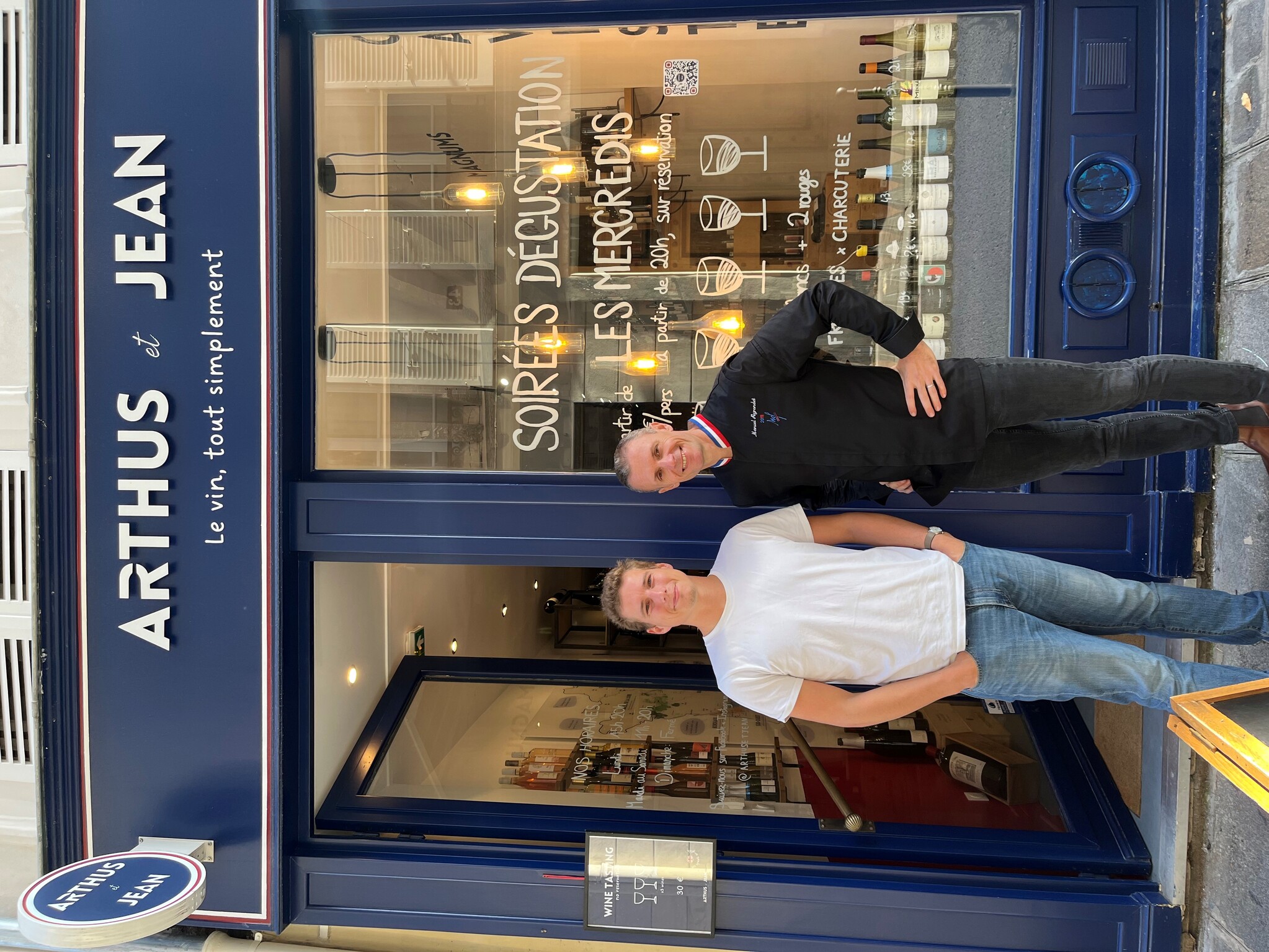
AdG: At our tastings, I see real curiosity. People in their thirties want to get into the world of wine, but they often feel intimidated by the vocabulary, or by the impression that you have to “know how to talk about wine” to dare to enjoy it. That is where the wine merchant plays the role of translator. Contrary to received wisdom, I don’t believe young people are turning away from wine. They come to it later, with more moderate and considered consumption – and you can’t blame them for that! As for Bordeaux, I prefer to talk about distance rather than bashing. For many, it is their parents’ wine, even their grandparents’. Customers don’t ask for it spontaneously, but once we offer it to them, they show no reluctance. The shock is often a positive one when they taste it: they are surprised by the fruit and the freshness, far from the image of a massive wine that they feared. In Paris, if trust is there, many young people are ready to spend €20 or €30 on a bottle.
Your shop is in the 3rd arrondissement, an area reputed to be sensitive to organic, natural and alcohol-free trends. Is that a market reality or a sociological prejudice?
Organic and biodynamic wines are in greater demand than before, that’s true. But it remains marginal for us. And the labels are often mentioned without any real knowledge of what they mean. So I make a point of breaking down the caricatures and explaining that a winegrower without a label is not necessarily an irresponsible polluter. As for “alcohol-free”, it is an emerging demand, but it remains anecdotal at a specialist wine merchant’s. I offer terroirs, wine stories, passions for wine, not kombucha or dealcoholised wines! We could probably make a bit more turnover with that, but it is not my approach to the trade. Wine always has an intimate link with the meal, and it is rare for the dish not to be mentioned when choosing a wine. We also see more and more requests around the apéritif dînatoire, but it is not the majority.
In this context, how can Bordeaux respond intelligently to current expectations without betraying itself? Which profiles work best?
The profiles that sell best are first and foremost those of the wines you believe in. If I am convinced, I can sell as much Bordeaux as Rhône or Burgundy. That said, the styles most in demand today are light, fruity, low in tannin and lightly oaked. And unfortunately, many consumers do not associate Bordeaux with that style. Paradoxically, Rhône Valley wines seem to be very popular, and I don’t think they are much lighter than Bordeaux wines! Without breaking away completely from the appellations, I think the notion of grape varieties is clearly a card to play to speak to younger generations. But above all, talk about the profile and the occasion for drinking: aperitif wine, powerful wine, light and fruity wine, and so on. It is true that we talk less and less about appellations because our customers ask for them less and less, and above all because we have arranged our wines not by wine region but by price.
As supermarkets see their wine fairs decline, do you sense a return to neighbourhood shops among young consumers?
I don’t think we are in direct opposition. In Paris, the context is particular: hypermarkets are almost non-existent. My customers don’t spend their time checking whether the bottle I sell for €19 is priced at €16.45 in a supermarket an hour’s drive away. That a consumer in search of a “rock-bottom price” goes to the outskirts is logical. On the other hand, someone looking for a gem, the assurance of not going wrong and a clear reading of what they are buying comes to their wine merchant. Besides, I don’t think a producer should forbid himself the supermarkets in order to work with us; the two channels are not mutually exclusive. Likewise, it is not for the winegrower to spend his time running sales in the shop. His first mission, the one that really helps us, is to make good wines. Our role as wine merchants is to be the link between his work and the consumer.
You have opted for an exclusively French range. Is this a positioning that your Parisian clientele, reputed to be drawn to international productions, understands? Or is the power of the “100% French” message aimed more at foreign customers?
At the outset, it was as much because we knew little about foreign wines as because we love French wines. But it works. Very few customers ask us for foreign wines. Tourists account for 40 to 50% of our turnover – about 95% of them American. They are often surprised by the quality of a €20 wine, while being fascinated by the sacred image of the great French wines. We ship a lot to the United States, everyday wines as well as more prestigious bottles. These customers know Bordeaux. They don’t shun it. They also buy Burgundies, by the way. French wine retains an exceptional reputation!
To conclude, what message should Bordeaux hear in 2026 in order to win over these young people?
Let’s stop saying that young people reject wine: it’s false. What they reject is needless complexity and closed codes. They expect to be spoken to simply, without being made to feel excluded from the “club”. In Paris, I see young people ready to pay €25 or €30 for a bottle, provided the style appeals, the moment suits and the explanation is crystal clear. Bordeaux has incredible assets: its diversity, its history and its international aura. We need to translate this richness into direct language, focused on the aromatic profile and immediate pleasure. The market is going through a necessary phase of rebalancing. It is less a problem of image than of confronting reality: when overall consumption falls, supply has to adjust, and that takes time. It is a difficult period, but those who produce coherent, sincere and well-positioned wines will of course continue to find their place.
Consumption in 2026: what the figures say
According to FranceAgriMer’s latest economic briefings, consumption of red wine has fallen by 15% in volume over the last decade, but the premium segment (over €15) at independent wine merchants remains stable, even growing slightly in urban areas.
The rise of No-Low: Regulation (EU) 2021/2117 now strictly governs dealcoholisation. Although the global market is already worth several billion dollars, it still struggles to win over the network of traditional wine merchants, who favour natural fermentation as a marker of authenticity.
The organic asset: in Bordeaux, more than 25% of the vineyard is now certified or in conversion. A weighty argument for Parisian wine merchants, where 70% of the millennial clientele say they prefer to buy environmentally certified products (Source: Agence Bio/OpinionWay).